No-Code Snowflake Ingestion for Customer Records Without a Single Engineering Ticket
No-code Snowflake ingestion shifts pipeline ownership, not just the interface.
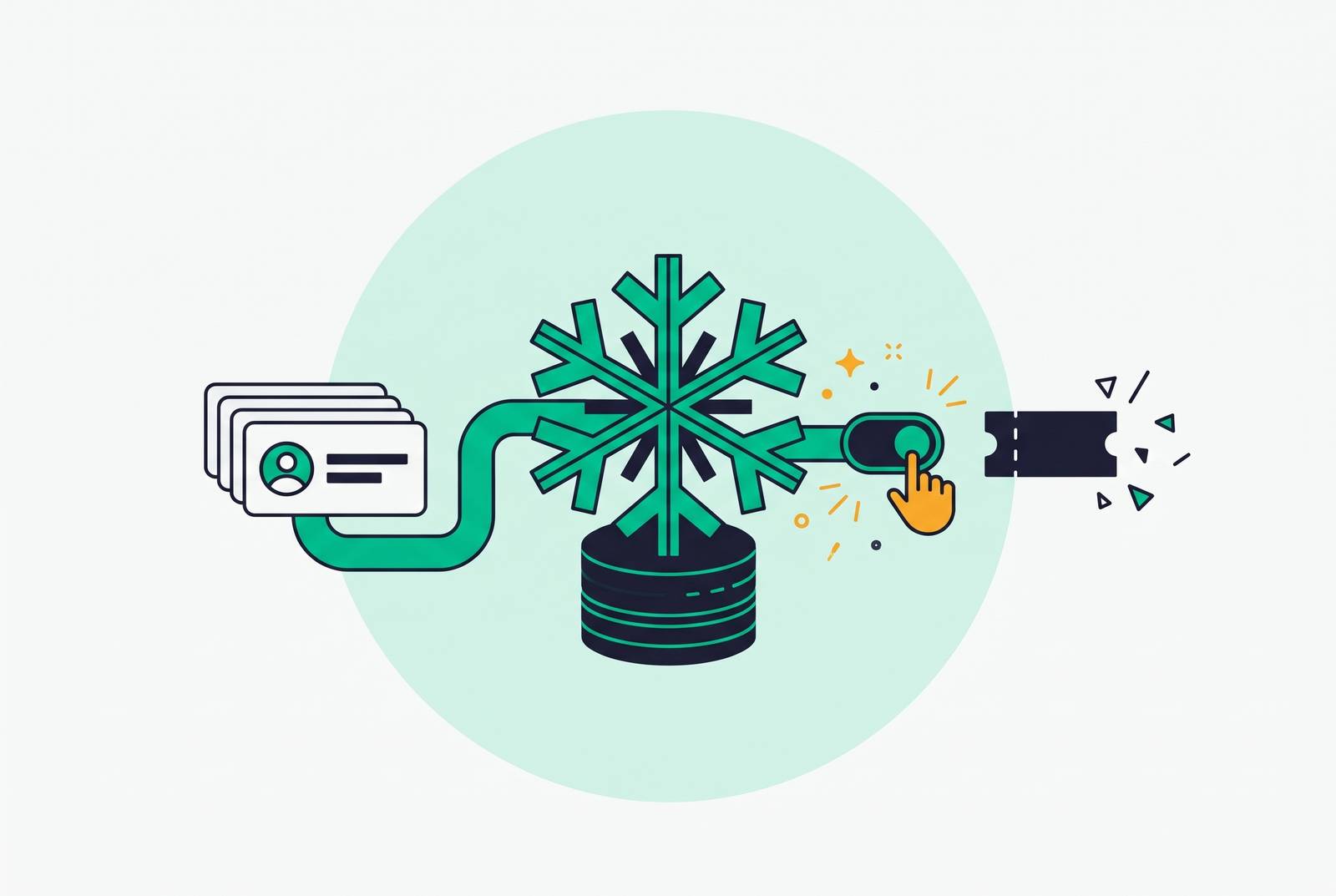
No-code Snowflake ingestion lets product and business teams move customer records without building custom ETL pipelines, if the tool also helps them handle the work of running those pipelines. For enterprise exports to Snowflake and other data warehouses, the choice turns on destination support, sync cadence, schema-change handling, tenant isolation, and compliance architecture. Removing engineering tickets transfers ownership along with changing the interface.
Why getting customer records into Snowflake without engineering tickets is harder than it looks
Customer data requests keep landing on engineering’s plate because the person who needs the records rarely controls the path into the warehouse. Someone has to explain the request to engineering, wait for the work to be done, and deal with rework when requirements change. Ownership is the first obstacle to self-service. A product manager may know which customer records a workflow needs without knowing how to choose the ingestion method that serves it.
Snowpipe Streaming brings a streaming SDK, infrastructure management, and billing considerations, while poorly managed COPY INTO workloads can leave warehouses consuming credits while idle. Selecting between these paths requires knowledge of latency tiers, warehouse sizing, file count parallelism, and CDC semantics. Those decisions require engineering judgment.
The Snowpipe Streaming Node.js SDK reached general availability in May 2026, extending the shared client core used by Java and Python SDKs to JavaScript and TypeScript applications. This closes a gap for teams building on Node stacks. It does not give a product or operations owner an independently manageable ingestion process.
What the engineering queue actually costs when product teams can't self-serve
Customer records can stay in Salesforce or HubSpot while decisions wait and campaigns stay blocked. Queue time becomes part of the workflow. Building ingestion in-house can also cost a lot in engineering salaries and take months before records reach the warehouse reliably, so even a simple export competes with work on the product.
Maintenance renews that competition after the initial release. A Salesforce custom field or renamed object can break a hand-built pipeline silently, with the defect appearing later in a dashboard or campaign. Sesame Software’s 2026 guide identifies schema drift among five core Salesforce-to-Snowflake failure modes, together with API limit exhaustion, broken relationship integrity, data residency exposure, and incomplete coverage of custom objects and deleted records.
Fast engineering teams can shorten the wait considerably. They cannot remove the prioritization trade-off, because an hour spent repairing a pipeline is unavailable for product work. The case for self-service therefore depends on whether routine connectivity work should require engineering prioritization at all.
What no-code ingestion actually does and does not abstract away
No-code ingestion responds by moving pipeline configuration and operation to the team that owns the business process. Tools can abstract authentication flows, pagination, rate-limit handling, retries, file staging, warehouse sizing decisions, and scheduling. That is a substantial transfer of work. Openflow offers pre-built SaaS connectors for sources including Salesforce, ServiceNow, and Workday, handling authentication, pagination, rate limits, and incremental sync at cadences typically ranging from minutes to hourly.
However, removing implementation work does not remove operational judgment. Source schemas still change, tenant access still needs boundaries, and sensitive customer records still pass through a managed vendor plane. Some surface schema changes, while others can pass partial or misaligned data downstream without alerting the operator.
The new owner therefore inherits more than configuration. Product or operations teams also take responsibility for monitoring and responding to schema changes that engineering previously handled. A successful transfer requires understanding the remaining complexity so teams can choose a tool and operating model that can contain it.
How embedded white-label integration changes the equation for SaaS product teams
For SaaS companies, self-service has a second audience. Customers need to send records to their own warehouses without the host company building a one-off connector for every destination. Customers configure their destinations through the product, while an integration platform handles the underlying pipeline logic.
Albato’s white-label guide describes a model in which an iPaaS handles API connections, data transformation, and error handling behind the host company’s branding. Users get an integration hub that feels like part of the product. This shifts the product team’s task. Instead of maintaining each connector, it owns the customer experience and the requirements the embedded platform must meet.
The platforms occupy different positions as of November 2026. Paragon has a fully white-labeled Connect Portal, automatic per-tenant OAuth token refresh, a native MCP server for AI agents, and a catalog of integrations built for embedded multi-tenancy. Workato Embedded has the most connectors by published count among the top platforms and a wide range of certifications. Nango spans 900+ APIs, offers self-hosted deployment, and provides SOC 2 Type 2 with a HIPAA BAA add-on. Tray Embedded, Prismatic, and Cyclr also participate in the category, but those names alone do not establish their fit for a particular warehouse export requirement.
Warehouse-focused evaluations need a different lens from connector counts. Relevant requirements include warehouse, database, and object storage destinations, an embeddable React SDK, a clean API, high row volumes per destination, and a fast sync cadence. Pricing needs its own review because platforms charge in very different ways. Destination-based pricing is one way to align the commercial model with shipping warehouse connectivity rather than charging for every increase in records moved.
What enterprise security and compliance actually require from a no-code ingestion path
The customer still has to meet its security obligations when someone else takes over the pipeline. Moving records through a managed vendor plane raises questions about residency, access, and monitoring regardless of which department operates the tool. Those questions are knowable before deployment begins. Leaving them unresolved can return routine connectivity work to engineering through a compliance review.
SOC 2 Type II controls connect directly to architecture. CC6.1 addresses logical access security, including workforce MFA for in-scope systems, while CC6.6 addresses protection against threats from outside system boundaries, including remote-access MFA and network segmentation. CC6.3 covers access controls and how access is changed and removed. CC7.2 addresses anomaly monitoring, and CC6.7 covers encryption and restrictions on data in transmission and removal. A simple configuration screen does not replace these controls.
Where a compliance team requires private-cloud deployment for customer records, a shared vendor plane cannot satisfy that requirement merely because its provider has SOC 2 certification. The customer still owns data classification, access reviews, and the audit evidence its auditor requests. Choosing an architecture that supports those obligations from the outset builds compliance into the ingestion path.
Where schema drift actually lives and how to plan for it before it fires
Schema drift is the primary operational failure mode in no-code ingestion. The critical distinction is whether a tool surfaces the change or silently continues. A Salesforce admin may add a custom field, or an engineering team may rename a CRM object, while ingestion keeps running and writes partial or misaligned records to Snowflake. The failure, invisible in the pipeline interface, then appears in a dashboard or broken audience segment.
Sesame’s guide calls “automated schema discovery so custom fields don't break the pipeline” a non-negotiable requirement. Discovery gives the ingestion engine a basis for detecting source changes and either adapting the target schema or pausing and alerting. Detection alone is not the complete response. The operator also needs to understand what happens to the sync and how affected data can be recovered.
Multi-tenancy adds an independent boundary to this problem. Each customer’s source schema may change at a different time, so a Salesforce change for one tenant should leave another tenant’s pipeline working and its data structure private. Schema state therefore needs tenant-level isolation. Without that boundary, an embedded connector can turn a local source change into a broader operational problem.
The practical evaluation starts with four questions. Does the tool detect source schema changes automatically, or require manual reconfiguration? When a mismatch occurs, does it alert, pause, or silently continue with partial data? Is schema state kept separate for each tenant or shared? What is the recovery path when a sync has written bad data for an unknown period?
How AI agents change what "getting data into Snowflake" means for product teams
AI agents extend ingestion’s consequences beyond dashboards and campaigns. An agent acting on synced customer records may use stale or misaligned data before a human notices the defect. Freshness and schema integrity become prerequisites for automated action.
Access control must follow that change in use. Agents querying customer records need fine-grained permissions at the agent level alongside permissions assigned to human users or general roles. Tenant boundaries remain essential in this model. An agent authorized to read one tenant’s data must not be able to traverse schema boundaries into another tenant’s records.
A connectivity layer that both syncs records to customer warehouses and exposes them to agents under governed access serves a different purpose from a tool that only moves files. Paragon’s native MCP server illustrates how agent connectivity already enters embedded-platform evaluations. It does not, by itself, settle whether an implementation has the required tenant isolation or agent permissions.
If agents are part of the intended workflow, their access requirements belong in the ingestion decision. Otherwise, the team may choose a path that works for human analysis and find later that automated use needs a different governance layer.
A practical framework for evaluating no-code ingestion tools against the requirements that actually matter
Evaluation starts with the workflow that needs the data and its latency requirements. Minute-level sync may suit operational customer data, while historical loads can use batch ingestion. Real-time is not the default answer. Estuary’s ingestion method guide distinguishes COPY INTO for bulk and backfill, Snowpipe for automated file-triggered ingestion, and Snowpipe Streaming for second-level CDC. A tool exposing only one path can force a workflow into an unsuitable tier.
For CRM sources such as Salesforce, automatic detection, alerts, and recovery deserve more weight than an uninterrupted-looking sync status. Tenant isolation belongs in the same examination. Does each customer have its own schema state and access control, or does the product give customers an interface to an internal integration tool?
Compliance evaluation starts with where the records may travel. Does the way the records are classified allow a shared vendor plane, or does it call for private-cloud deployment? The answer should follow the applicable requirement. If agents will use the records, the evaluation must also ask how agent-level permissions preserve tenant boundaries and whether that governance exists at ingestion time.
Commercial and product fit complete the decision. Can customers configure the required Snowflake or other data warehouse destination through an embedded experience, and do the SDK and API support that experience without custom pipeline logic? Does the price go up with more destinations, stay flat, or grow with data volume? Destination-based and flat-fee models have no volume charges to put teams off moving more records as a product grows, but teams still need to check whether the tool can handle their work.
A no-code path succeeds when the product or business owner can configure the connection, recognize a failure, and manage the supported response without reopening an engineering ticket for every adjustment. Engineering may still own exceptional infrastructure decisions. The gain is a clear operating boundary that lets customer-data workflows move on the timeline of the team responsible for them.