MCP Server Architecture for Live Warehouse Query Access
How MCP server design makes warehouse access safe and scalable.
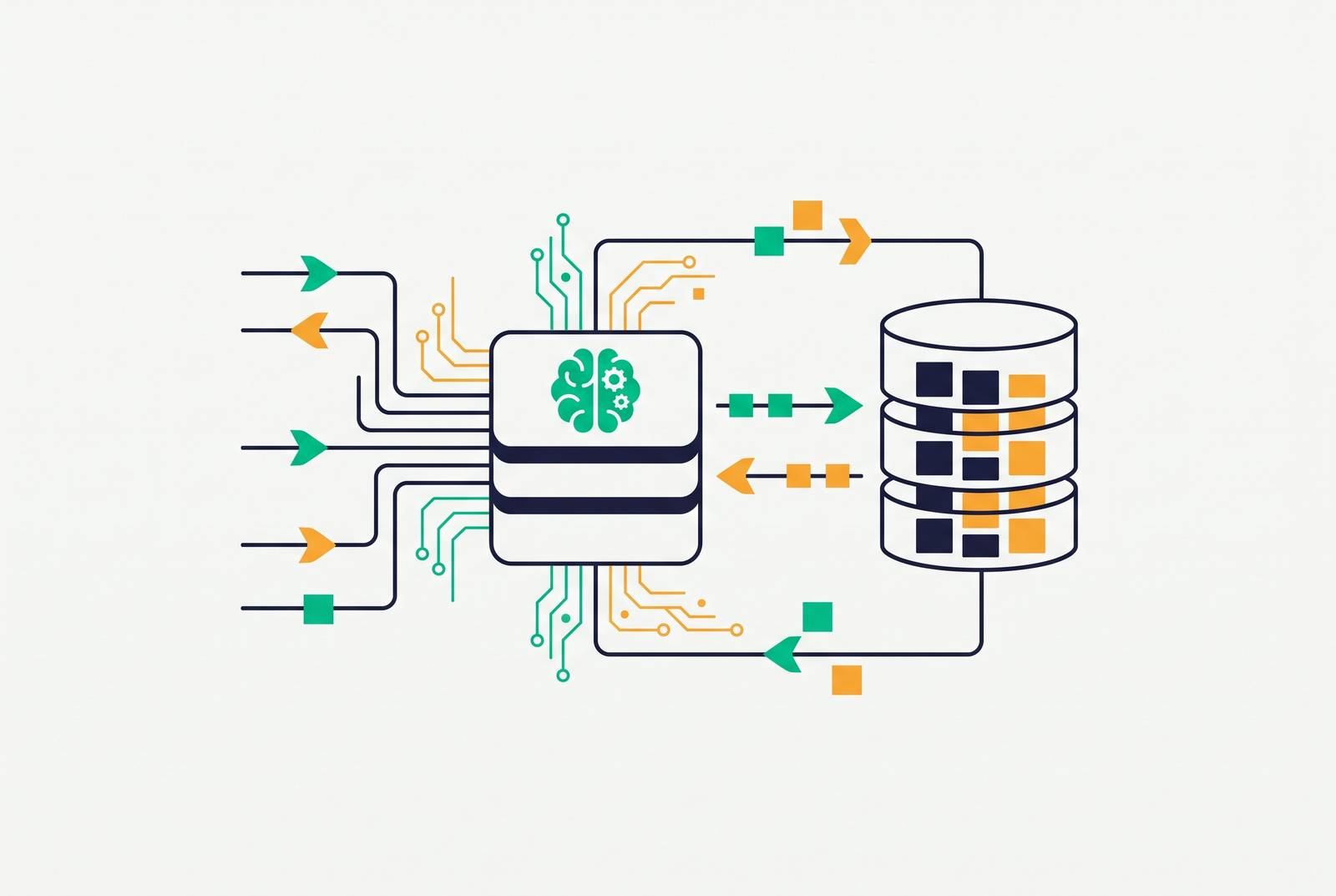
Connecting an AI agent to a live data warehouse without exposing raw database pipelines requires a standardized protocol layer that handles authentication, schema discovery, and query execution on the server side. That protocol is the Model Context Protocol (MCP), and the architecture of an MCP server, not the model sitting in front of it, makes warehouse access safe, governed, and able to scale past a single integration [1].
Before MCP existed, every agent that needed warehouse data required its own bespoke connector: its own authentication flow, its own schema mapping, its own error handling. Adding a new model meant the stack had to be rebuilt. Adding a new warehouse meant it had to be rebuilt again. N AI clients multiplied by M data sources produced an unmanageable grid of one-off bridges, each with its own failure mode and none of them sharing a governance surface. This pattern mirrors the broader data integration landscape: platforms like Prequel replace one-off warehouse connectors with a standardized, reusable interface, so product teams can embed data connectivity without rebuilding integrations every time a new client or warehouse enters the picture.
MCP, introduced by Anthropic in November 2024, collapses that grid into a single client-server interface. Any MCP-compatible agent can connect to any MCP server through one shared protocol, no matter what system sits behind it. Built on JSON-RPC 2.0, the protocol defines three primitives, Tools, Resources, and Prompts, through which servers expose capability and clients consume it. Connector logic gets written once on the server side, and any MCP-compatible client, Claude, GPT, Gemini, or a future model not yet released, can use it without custom integration work. How those three primitives are designed, how the server transports data, and how access is governed are the decisions that separate a working prototype from a production system, and each is covered in turn below.
The three primitives that give MCP servers a consistent query surface
Tools, Resources, and Prompts are what let an agent discover what a warehouse contains, request data from it, and execute queries against it, all without any prior knowledge of the system's internals. Each primitive does a distinct job, and together they give an MCP server a vocabulary for exposing a warehouse as a coherent, navigable surface.
Tools are callable functions, each with a name, a natural-language description, and a JSON Schema input specification. A tool named execute_query is the mechanism by which an agent actually runs SQL against a warehouse. JASCI, described as the first AI-native warehouse management platform to ship a production MCP server, exposes every operational capability, including inventory queries and operational commands, as tools with JSON Schema input contracts that the LLM invokes directly.
Resources are addressable endpoints the LLM can read, and they can be static, such as files or documents, or dynamic, such as live database queries. That dynamic capacity makes Resources the natural fit for schema discovery and catalog browsing: an agent can ask what tables exist and what columns they hold before ever constructing a query. JASCI publishes its knowledge store, guides, and FAQs as Resources. This runtime discovery pattern echoes a design challenge found across production data integration more broadly: systems that can introspect and adapt to schema changes without requiring client-side updates are what make scaling connections across multiple warehouses tractable, which is part of why embedded APIs such as Prequel handle schema introspection automatically.
Prompts are server-managed, parameterized templates that encode domain-specific query patterns the agent would otherwise have to guess at or hallucinate. JASCI ships what it calls battle-tested warehouse system prompts as this third primitive. Microsoft's Fabric platform implements the same idea under the name Skills for Fabric, covering authoring, consumption, and operations, now unified as modes within each item skill. These skills give an agent Fabric-specific syntax, system views, and diagnostic patterns, so you never have to supply that context manually.
The three primitives interlock. Resources expose what data exists and how it is structured. Tools execute queries against that structure. So Prompts steer the agent toward query patterns that fit the specific warehouse engine it is working against. A further property makes the design extensible: the capability list is defined on the server and discovered at runtime, so a client never needs updating when the server adds a new tool or resource. How these primitives travel between client and server, and how a server is scoped, is the next design decision that shapes whether this works reliably in production.
Transport choices and server scoping decisions that shape production behavior
Transport protocol and server scope are not implementation footnotes. They determine latency, concurrency limits, deployment topology, and how much damage an incident can do before it is contained.
STDIO transport runs the server as a local subprocess, passing JSON-RPC messages through stdin and stdout. It suits desktop agents and local tooling where client and server share the same machine, and because the round trip never leaves the host, it carries negligible latency. Streamable HTTP transport sends messages over standard HTTP POST requests, with optional server-sent event streaming for long-running operations, and it's the correct choice for remote servers, cloud deployments, and situations where multiple clients need to reach the same server. Any path that crosses hosts carries a real latency cost beyond the protocol's own overhead, a cost worth accounting for deliberately when warehouse query results may be large. Microsoft's Fabric Data Warehouse MCP Server is built explicitly as a remote server: agents connect through managed HTTPS endpoints without installing or maintaining a local server process.
Server scoping, how many tools and resources belong inside one server and how its responsibility is bounded, carries its own consequences. Research cataloguing production MCP deployments identifies a tool-count accuracy threshold: once a single server exposes too many tools, agent accuracy drops, because LLMs select tools by reading natural-language descriptions and are sensitive to schema complexity in ways human developers simply are not. The practical implication for warehouse deployments is to run separate MCP servers per engine, one for Postgres and one for a cloud warehouse, for instance. That separation simplifies IAM configuration, connection pool tuning, and incident response.
Research surveying production MCP deployments catalogues five recurring architectural patterns, each suited to a different scoping requirement [1]. A Resource Gateway names resources for LLM retrieval and fits schema discovery and catalog browsing. A Tool Orchestrator sizes its tool set to stay under the agent-selection accuracy threshold. A Proxy Aggregator partitions tools across multiple servers and aggregates them at a gateway, so agents get a broad capability surface and no single server's tool list bloats. A Domain-Specific Adapter wraps a complex underlying API and validates inputs as natural-language guardrails, which fits when the warehouse API is too intricate to expose directly to an LLM. A Stateful Session Server manages state on the server rather than in the prompt, which helps with multi-step warehouse tasks where intermediate query results need to carry forward without being re-fetched each time. These scoping decisions determine what a server is permitted to do. Authentication determines who is permitted to ask it to do anything.
How authentication works in a warehouse-connected MCP server
Authentication for a warehouse-connected MCP server is a harder problem than for a conventional API, because AI agents run autonomously for extended stretches of time, exposing mismatches between how long a token lives and how long an agent's task runs. The common workaround, a static API key, creates its own governance failure: keys end up hardcoded, shared across teams, and difficult to revoke without redeploying the server.
Microsoft's Fabric Data Warehouse MCP Server resolves this by delegating authentication entirely to an existing enterprise identity layer, Microsoft Entra ID OAuth 2.0, so that a user's existing Fabric and SQL permissions continue to apply. There is no separate security model built for agent access and no new credential surface to manage. The principle generalizes beyond this one product: an MCP server should resolve an agent's identity to an existing, already-governed permission set rather than introduce a parallel credential system of its own. JASCI's auth filter follows the same logic, resolving an incoming token to a tenant, company, fulfillment center, and role before any tool call is dispatched, so the LLM only ever sees what the resolved identity is entitled to see.
Multi-tenant deployments add a further requirement: authentication has to be isolated per tenant. Databricks's multi-tenant pattern scopes OAuth tokens per tenant workspace, preventing one tenant's agent from reaching another tenant's warehouse resources even when both share the same MCP server infrastructure. Authentication answers who is asking. What happens to the data after the query runs, row-level security, audit logging, and whether results are retained at all, is a separate layer of governance.
Access-control patterns and audit requirements for live warehouse data
A server that gets authentication right can still fail a SOC 2 audit if it has no reviewable log of what the agent did, or if it keeps query results around longer than the single request that produced them. SOC 2 Type II audits now routinely examine AI system access controls, so if a server can't produce an access log for agent actions, it can draw a qualified finding under the Logical Access and Monitoring criteria.
A zero-data-retention, pass-through design solves this. The MCP server acts as a stateless proxy: it receives a tools/call, resolves the tenant's token, forwards the request, processes the payload entirely in memory, and streams the result back to the LLM without ever writing row-level data to disk. GDPR's data minimization principle points in the same direction. Keeping query results around "just in case" conflicts directly with minimization requirements, so the architecture that satisfies the audit and the architecture that satisfies the regulation turn out to be the same one.
Access control is a distinct layer from authentication, governing not whether the agent can connect but what it can retrieve once connected. A production warehouse MCP server needs a four-tier role-based access control system, should enforce read-only operations where write access isn't needed, can offer optional PII masking with redaction levels tied to role, and should integrate with a warehouse's native row- and column-level security through role impersonation. Centralizing this governance on the server side means tenant scope, RBAC, schema validation, rate limiting, and audit logging all live in one place, because that is where the agent's access is actually mediated: the model never sees what it isn't entitled to see, every action it takes is logged, and this architecture belongs in the MCP server layer specifically. Governing what flows through the server is one half of the production challenge. What the agent does with the access once it has it is what still needs to be governed.
Live warehouse access and multi-step agent workflows
An LLM can generate a SQL query without a warehouse. The value a warehouse-connected MCP server adds is the ability to execute that query, observe what comes back, and continue the workflow from there, turning a single generated statement into an iterative process grounded in the warehouse's actual state.
Microsoft's execute_query tool on the Fabric Data Warehouse MCP Server works this way: the agent runs T-SQL against live warehouse data, responds to whatever errors come back, and keeps iterating from the result, producing a connected workflow across SQL authoring, validation, troubleshooting, and performance monitoring. Skills for Fabric illustrate how the Prompts primitive supports that iteration directly: the agent doesn't need to already know which Fabric-specific system view or diagnostic path applies, because the skill supplies that context as part of the workflow while the MCP server handles execution. In one concrete case, a user asks to create a sales table, load data into it, and verify that it landed correctly. The agent draws on the authoring skill to determine the right Fabric pattern, then uses the MCP server to execute and validate each step against live warehouse state.
A further pattern, hybrid federated querying, is emerging across production deployments: an MCP server can query a data warehouse for historical data and call external APIs for real-time data in the same workflow, with the agent combining both result sets to answer questions that neither source could answer alone. This is the direction production deployments appear to be heading, even if most implementations today are still narrower in scope.
For SaaS products specifically, the MCP server layer is the surface through which an AI agent embedded in the product gains governed access to a customer's own warehouse data. The same authentication, RBAC, and audit patterns described above still apply, with the agent now part of a product experience. Prequel's white-label data integration platform handles the connectivity layer beneath that surface, exporting and importing data across warehouses, databases, and object storage at scale, so the MCP server layer above it operates against a reliable, governed data surface. AI agents accessing data synced through Prequel inherit that same governed access pattern without requiring the SaaS team building the product to construct and maintain the underlying pipelines itself. Every architectural decision covered so far, the primitives, the transport, the scoping, the authentication, the access control, exists to make this kind of grounded, iterative agent behavior possible without compromising security.
Production readiness for a warehouse MCP server
A warehouse MCP server that performs well in a demo can still fail in production, and the failure modes aren't random: each one traces back to a specific layer covered above.
On primitive design: are tools scoped narrowly enough to keep agent selection accuracy high? Is schema discovery surfaced through Resources? Do Prompts encode domain-specific query patterns that keep the agent from hallucinating warehouse syntax it was never taught?
On transport and server scope: is the transport matched to the deployment topology, Streamable HTTP for remote servers, STDIO for local tooling? Is each server scoped to a single engine or domain, so IAM, connection pool tuning, and incident response remain manageable?
On authentication: does the server resolve the agent's identity to an existing, already-governed permission set, rather than standing up a parallel credential system of its own? Are tokens isolated per tenant wherever the deployment is multi-tenant?
On access control and audit: are read-only operations enforced wherever write access isn't required? Is there a complete, reviewable log of every action the agent took? Does the server run as a zero-retention proxy, with no row-level data persisted past the request that produced it?
On workflow continuity: can the agent execute a query, observe an error, and iterate toward a correct result, or does the architecture only support generating a single SQL statement and stopping there?
These questions compound. A server that handles authentication well but keeps no audit log fails a SOC 2 review. If a server logs thoroughly but its tool list is overloaded, it fails on agent accuracy instead. Both failures matter, and neither can be patched in isolation from the other. MCP's adoption is still early, and the architectural patterns around it are still settling into convention. If teams build warehouse-connected MCP servers now, while that convention is still forming, they are the ones least likely to need a rebuild when usage scales or compliance requirements tighten later.