Custom Data Pipeline Maintenance Costs for Engineering Teams
Schema drift, API changes, and slow detection compound into hidden costs.
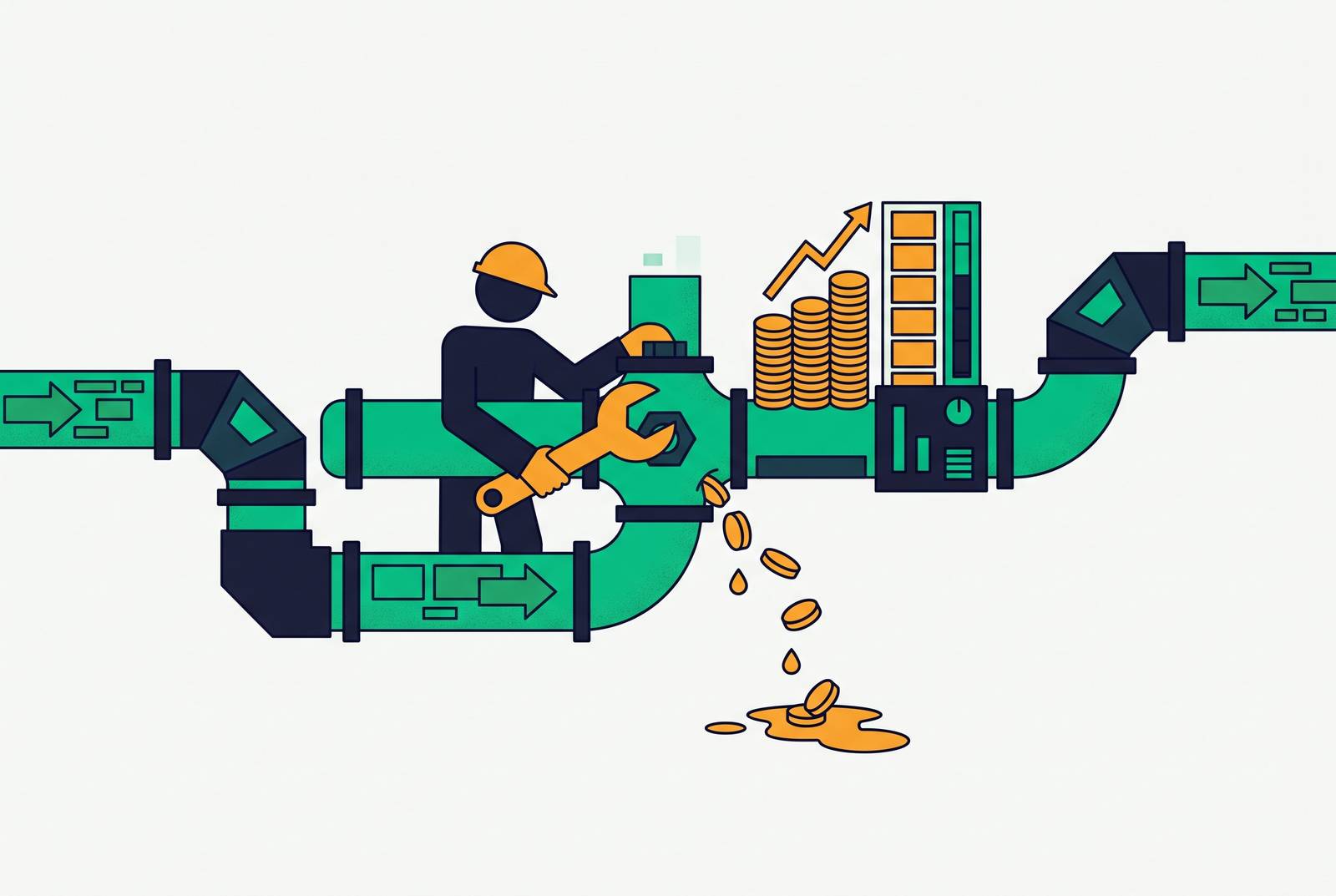
A finance team reviewing cloud bills and incident tickets sees two numbers: infrastructure spend and downtime cost. Neither one reflects what custom data pipeline maintenance actually costs an organization, because the real cost lives in a compounding stack of drains that each feed the next. Schema drift creates incident response work. But incident response work crowds out the testing and observability investment that would reduce schema drift. API versioning adds connector repairs on top of both. This cost is invisible on a budget line because it accumulates across a stack of interacting drains that no single line was built to capture. This piece works through that stack layer by layer, so a team can see the full shape of what it's paying for before deciding what to do about it.
Teams approve pipeline sprawl one integration at a time, and each individual approval looks reasonable: a new source here, a new connector there, a new scheduled job to feed a dashboard. No one signs off on "53% of engineering capacity going to maintenance" because no one sees that number until the pipelines already exist and the pattern has set in. By the time the pattern is visible, it has become structural, no longer a backlog that can be worked down. The sections that follow break that structure into its parts: where the hours go, why the costs compound rather than stay flat, and what an honest accounting of the whole stack looks like before a team decides whether to keep building and maintaining pipelines in-house.
The data engineering capacity consumed by maintenance
At large engineering organizations, data engineers now spend more than half their time keeping old pipelines running, not building new ones. That split, with maintenance absorbing the majority share, is the steady-state condition of running a pipeline estate that has grown faster than the practices needed to keep it healthy, not a temporary backlog that a sprint or two of focused work would clear.
The business consequence appears as a queue. New integrations wait behind maintenance tickets. AI feature pipelines run on schedules that were set months ago, and no one revisits them, because revisiting them takes engineering hours that are already spoken for. Performance issues accumulate quietly until something breaks visibly enough to force prioritization, at which point the fix happens under incident pressure. This is the condition the rest of this piece explains: not a single cause, but a capacity problem built from several distinct sources of recurring work, each with its own mechanism and its own cost pattern.
Schema drift as the largest single source of recurring maintenance work
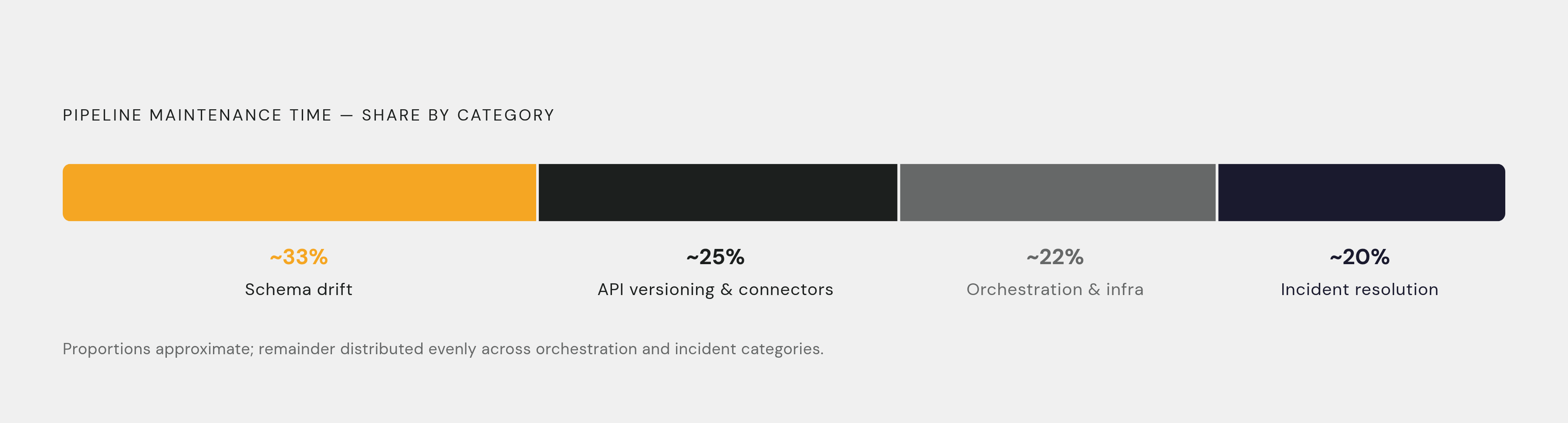
Schema drift is the single largest category of pipeline maintenance work, and it accounts for roughly a third of total maintenance time. The mechanism is simple to describe and hard to prevent: an upstream data source changes a field name, a data type, or a table structure without coordinating with the teams downstream who depend on that structure staying stable. The source team has no obligation to notify anyone, and often no mechanism to do so even if it wanted to.
What makes schema drift expensive is not the change itself but how it fails. A noisy break, where a pipeline throws an error and stops, at least tells an engineer something is wrong immediately. A silent break doesn't: a column gets quietly nulled out, or a join starts fan-multiplying records, and the pipeline keeps running and keeps producing output. Nothing alerts anyone. Detection lags days or weeks, and by the time someone notices, decisions have already been made on corrupted data. Reports have gone out. Models have trained on bad inputs. The cost of a silent schema break is the cost of every decision made downstream while the break went unnoticed, not the time it takes to fix the pipeline.
The deepest problem with schema drift is that it's self-reinforcing. The engineering time it consumes is time that would otherwise go toward building the data contracts, schema validation, and observability tooling that would catch drift earlier and reduce the volume of future breaks. Teams stay in the maintenance trap because the work of escaping it competes directly with the work of surviving it, and surviving it wins every time there's an active incident.
API versioning as a predictable but uncontrolled source of connector breakage
API versioning and connector maintenance make up roughly a quarter of total pipeline maintenance time, and the mechanism here differs from schema drift in one important way: it isn't unpredictable, it's just uncontrolled. API changes follow a third-party vendor's release schedule, not the engineering team's. A CRM, a payments platform, or an ad network can deprecate an API version on its own timeline, and when it does, every pipeline connector built against that old version breaks at once. The more source systems an organization connects to, the more often this happens, simply because there are more schedules running in parallel that the team doesn't control.
Fixing a broken connector follows a repetitive pattern: detect the break, identify which connector is affected, update the authentication logic or pagination handling, test against the new API version, and redeploy. None of that work adds new capability. All of it has to happen immediately once it starts, because data stops flowing until it's done. Beyond the headline break, a steady stream of smaller connector details demands ongoing attention: auth tokens that need rotating, rate limits that need handling, pagination logic that shifts between API versions. These are the exact details that a managed connector, built and maintained by a team that specializes in a given API, is best positioned to absorb on an engineering team's behalf.
API deprecations are often announced well in advance, which should make them easier to handle than schema drift's silent breaks. In practice, advance notice only helps a team that has spare capacity to act on it before the deadline arrives, and a team already spending 53% of its time on maintenance rarely has that capacity. The notice sits in an inbox until the deadline forces the work anyway, usually under more time pressure than if it had been handled the week it was announced.
Once a connector actually breaks, in either case, the cost shifts from the engineering work of fixing it to the question of how long the break goes unnoticed and unresolved, which is its own separate cost driver.
Incident detection and resolution as where downtime cost accumulates
The biggest financial exposure in pipeline maintenance doesn't come from the breaks themselves. It comes from how long each break takes to detect and resolve, and that detection lag is getting worse as pipeline estates grow. If you catch a connector failure or a schema change within minutes, it costs very little. If the same failure gets caught days later, after it's propagated through several downstream tables and a handful of reports, it costs an order of magnitude more, even though the technical fix is identical.
Detection lag matters because when a pipeline fails silently, it doesn't stop producing output, it just produces wrong output. An analyst building a report, or a model training on a feature table, keeps making decisions on corrupted data for as long as the break goes unnoticed. At the enterprise scale described across the industry, with hundreds of pipelines in an estate breaking multiple times a month and each incident taking many hours to resolve, downtime accumulates to more than 60 hours a month. That accumulation, not any single catastrophic incident, is what generates the scale of financial exposure documented at that level of operation.
As an organization scales up, alerting fatigue makes detection harder. As the pipeline estate grows, test alerts and monitoring signals pile up faster than engineers can look into them. Teams start to triage reactively, treating most alerts as background noise, and they only engage seriously once something breaks in a way they can't ignore. Monitoring without the capacity to act on it produces noise rather than early warning. A single large incident at enterprise scale can carry a substantial cost on its own, but the recurring monthly exposure across an entire pipeline estate is the structural number that deserves the closer look: not a rare catastrophe, but a predictable, recurring drain.
Orchestration and infrastructure overhead as the maintenance layer that never shows up in incident reports
A meaningful share of pipeline maintenance time goes toward work that never triggers an incident or an alert. Orchestration configurations need updating. Compute clusters need resizing. Job schedules need adjusting as data volumes shift. The execution infrastructure underneath the pipelines needs to keep pace as the platforms it runs on evolve. None of this appears in a post-mortem because none of it causes a visible failure when it's done. It only causes a visible failure when it's skipped.
That work is not optional, even though it's invisible. A pipeline configuration that doesn't get updated breaks the next time the orchestration platform pushes an update. If a cluster doesn't get resized, it becomes a bottleneck, or it quietly burns budget on unused capacity. A job still configured against a deprecated runtime version degrades without announcing it. This is also, in large part, why incident resolution takes as long as it does: when orchestration and infrastructure upkeep fall behind, the systems an engineer needs to diagnose a break are themselves out of date, which slows down the exact detection and response process described above.
Because none of this work is incident-driven, it's the category most likely to be left out of engineering planning. It rarely generates a ticket. It rarely has a named owner. It accumulates in the margins of engineers' time, absorbed a little at a time until the backlog itself becomes the next source of downtime.
Maintenance burden, talent cost, and engineering team attrition
The operational cost of pipeline maintenance has a human cost sitting directly underneath it. If maintenance consumes most of senior engineering time, month after month, the result is burnout, and burnout drives attrition, and attrition carries a replacement cost that dwarfs the maintenance labor it was meant to save.
Survey data covering hundreds of data engineers has found burnout to be near-universal in the profession: a high share say they're likely to leave their current employer within 12 months, and a majority say they've considered leaving the field. Those numbers predate the current scale of pipeline sprawl and AI-driven data demands, so they likely understate present conditions.
Replacing a senior data engineer carries two distinct costs. There's the direct cost of recruiting and onboarding a replacement, which alone can run into a significant multiple of salary. Then there's the productivity gap during ramp-up, the months a new hire spends learning the pipeline estate before becoming fully effective. During that gap, the remaining team has to absorb more maintenance load than before, which accelerates the next round of burnout and sets up the next departure. The cost compounds the same way schema drift and connector maintenance compound: each unresolved problem makes the next one more expensive.
So if you cut maintenance-focused engineers to save on labor cost, it tends to backfire financially. A headcount reduction saves a predictable, visible salary line. But it also removes capacity that was preventing incidents, and a handful of additional high-severity incidents can offset the entire savings while leaving the team with less ability to prevent the next one. Hiring more engineers looks like the obvious fix, but organizations report rising infrastructure spend without a matching rise in team budgets, so more pipelines get handed to roughly the same number of people. So if the pipeline estate keeps growing faster than the team does, you can't close the math by adding headcount.
AI initiatives and the rising cost of pipeline technical debt
Organizations running the most ambitious AI initiatives are finding that their pipeline technical debt, not their model infrastructure, is the actual constraint on progress. More GPU capacity can't help a model when the data it trains on is stale, incomplete, or simply wrong by the time it gets there. The bottleneck sits upstream of the model entirely, in the same maintenance stack this piece has described.
Every new ML feature, every new AI-driven analytics use case, and every new LLM application adds more pipelines and dependencies to an estate that's already strained. AI investment grows the maintenance surface area at the exact moment it demands higher reliability from that surface, tightening the trap. More than half of engineering capacity is already tied up maintaining what exists, so little room is left to build and properly validate the pipelines AI workloads need. The result is that new AI features either get delayed, or they get built on a foundation that hasn't been maintained to the standard the use case actually needs.
When senior data leaders get surveyed on this question, they agree, almost unanimously, that pipeline failures have slowed their analytics and AI programs. The pipeline maintenance backlog and the AI ambition it blocks draw on the same engineering capacity. They're the same issue, observed from two different parts of the organization.
Auditing the full cost stack before a build-or-embed decision
Making a credible case for changing how an organization handles data connectivity starts with an honest baseline, not an infrastructure bill or a pile of incident tickets. A full accounting has to cover eight distinct cost components: every data source and its connector maintenance requirements; data volume and compute cost at each stage of the pipeline; storage costs broken out by tier; tooling and licensing fees; engineering labor spent on maintenance, troubleshooting, and rework; the hidden multipliers that come from duplicated effort, repeated job reruns, and compliance overhead; the repeated spend that happens when multiple teams independently build the same ingestion or governance logic without realizing it; and the opportunity cost of the feature work that never got built because engineers were busy keeping existing pipelines alive.
A single unit metric helps track whether any of this is improving over time: cost per gigabyte of usable data successfully delivered downstream. That number gives a clean trend line as a team improves routing, cuts waste, and consolidates tooling, in a way that a raw infrastructure bill never will, because the bill doesn't distinguish between a gigabyte that reached its destination intact and a gigabyte that had to be reprocessed three times after a schema break.
The pricing model behind a data platform shapes engineering behavior as much as it shapes the invoice. A consumption-based model quietly pushes you to limit pipeline frequency and data volume just to contain cost, so teams end up trading away data freshness or quality to stay within budget. A destination-based pricing model removes that disincentive, because moving more data doesn't carry a penalty, so a team can decide freshness and quality on their merits, not against a cost ceiling. Prequel, a white-label embedded data integration API built for product teams shipping customer-facing data exports, prices this way by design, charging per destination with no data-transfer fees.
With that full picture in hand, the build-versus-embed decision becomes not a comparison of upfront engineering cost but a comparison of total cost over time. Building and maintaining custom data extraction and connectivity in-house means carrying every layer of the stack described in this piece: the schema drift, the API versioning churn, the incident detection lag, the orchestration overhead, and the talent cost that follows from all of it. Embedding a purpose-built integration layer shifts connector maintenance, schema handling, and API versioning to a platform built specifically to absorb that work. Understanding each layer of the maintenance stack is the first step toward controlling it, and a team that has done the audit honestly is the team best equipped to decide where managed infrastructure actually earns its place in the architecture.