Reverse ETL vs Direct Warehouse Export for SaaS Products
Understand when to push data into tools your team uses versus exporting it to your infrastructure.
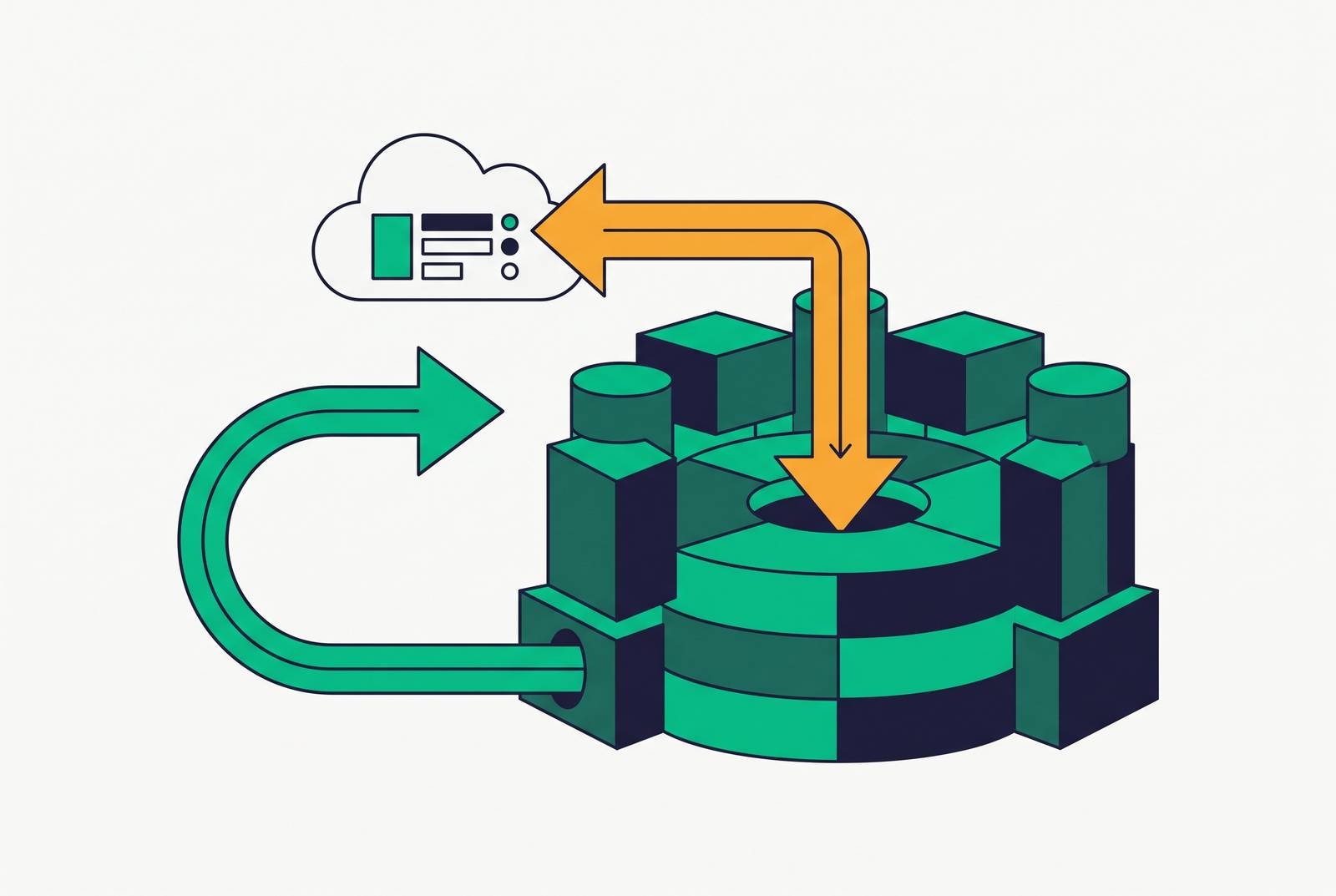
Both patterns move data out of a warehouse, and that's why teams keep confusing them. Reverse ETL takes intelligence a data team already built and pushes it into the tools frontline staff use every day. Direct warehouse export takes data and hands it to the customer's own infrastructure, under the customer's own control. The two solve different problems for different people, and most SaaS roadmaps that struggle here do so because someone picked the wrong one for the wrong reason. The choice comes down to one question: who's actually consuming the data, and where do they sit when they do it?
What reverse ETL does and where its value sits
Somewhere inside most mid-size and large companies, a data team has spent months in dbt building models: lead scores, health scores, customer segments defined by actual usage patterns instead of gut feel. That work sits in Snowflake or BigQuery, and almost none of it reaches the people who'd act on it. A sales rep doesn't write SQL. A support agent isn't opening a BI dashboard mid-call.
Reverse ETL closes that gap. It pulls the already-modeled data back out of the warehouse and lands it inside the CRM, the support desk, the ad platform, the messaging tool, wherever the decision actually gets made.
Lead scores and product usage metrics land in Salesforce or HubSpot contact records, so a rep sees account health without leaving the pipeline view. Warehouse-defined audiences sync into Google Ads, Facebook Custom Audiences, Braze, or Iterable, so marketing can target "accounts that used feature X twice last week" instead of a static list built six months ago. Account-level detail, MRR, contract status, feature adoption, flows into Zendesk or Intercom, so a support agent isn't guessing whether the caller is a high-value account or a free trial about to churn. Product-led growth teams push product-qualified lead scores into sales tools to trigger outreach the moment usage crosses a threshold. Finance teams sync usage-based billing metrics into Stripe so invoices match what actually happened in the product instead of a stale snapshot from last week.
The thread running through all of it: the end user is a business person working inside a tool they already know, and the warehouse disappears from view. That's the whole point of the pattern.
What direct warehouse export does
Direct warehouse export solves a different problem, and it shows up almost exclusively with enterprise customers. They don't want data trapped inside a vendor's product. They want it in their own Snowflake account, their own S3 bucket, their own Redshift cluster, so their engineering team can join it against other sources and query it on their own schedule, under their own governance rules.
Object storage is usually where this starts. S3 and GCS became the default landing zone because they separate cheap, durable storage from compute, which is what makes exporting at real scale, petabytes, not gigabytes, financially workable. From there the mechanics get specific. Snowflake's external stages handle loading and unloading data through SQL COPY INTO commands. Storage integrations make this safer by keeping credential management contained rather than passing access keys around loose in config files. Some vendors skip movement entirely and expose SQL endpoints or Zero-Copy data shares, letting the customer's systems query in place. Teams running two warehouses at once often reach for continuous table sync tools that propagate row-level changes from one platform to the other within seconds, handling schema and type mapping as they go.
The consumer here is an engineer or a data analyst, not a sales rep. They take the export, transform it further, and feed it into pipelines, dashboards, or model training runs. The stakes go beyond convenience: across enterprises broadly, a large share of data goes unused in day-to-day operations, with only a minority actively powering decisions. For a lot of enterprise buyers, getting a vendor's data out of that vendor's walled garden and into an environment they control is a precondition. It's the precondition for using the data.
The decision framework: which pattern fits which product requirement
Neither pattern wins in the abstract, and treating them as interchangeable is the actual mistake most teams make. What decides it is where the consumer sits and what they're going to do with the data once it lands.
Reverse ETL is the right call when sales, marketing, or support need to act on warehouse-computed intelligence without leaving the tools they already live in. If the destination has a defined API, Salesforce, HubSpot, Zendesk, an ad network, and the outcome is operational (trigger a workflow, update a record, personalize a message), reverse ETL fits. Speed is what matters most here, since value gets measured in how fast an insight computed today turns into a rep's action tomorrow. Companies running a usage-driven growth motion, especially ones with five-plus years of warehouse history and a mature analytics stack, tend to be furthest along on this pattern already, because that growth motion depends on usage data reaching sales and marketing fast.
Direct warehouse export is the right call when the customer's own data or engineering team needs to combine a vendor's data with their internal data, inside infrastructure they control. The destination isn't an app with a UI, it's a storage bucket, a warehouse account, a lakehouse. The outcome is analytical or programmatic: dashboards, ML pipelines, internal tools built on top of the export. Compliance and data residency requirements push hard in this direction too, since some enterprise buyers can't leave sensitive data sitting inside a third-party SaaS product no matter how convenient that would be. None of it works, though, without a data team on the receiving end capable of consuming raw or semi-modeled exports. Handing a customer a raw S3 bucket when nobody on their side can query it accomplishes nothing.
Plenty of SaaS products need both running at once, and there's no real tension in that. A churn-scoring product might push churn scores into a customer's Salesforce through reverse ETL while separately shipping raw event-level data into that same customer's Snowflake through warehouse export. One serves the sales team, the other serves the data team. Same underlying dataset, two different delivery mechanisms, both necessary.
The reverse ETL vendor landscape in 2026
Consolidation is the headline of 2026, not fragmentation, and buyers who haven't priced that in are going to get surprised by their renewal terms. Census, once one of the category's clearest independent players, got folded into a larger data platform's ecosystem in 2025 and now ships as an integrated activation layer instead of a standalone product, one of the first times a single vendor has covered both ingestion and activation under one roof. That leaves Hightouch as the strongest remaining independent, warehouse-native activation platform, and it's increasingly positioning itself as a composable, agentic CDP rather than a narrow reverse ETL tool.
Below it sits a set of platforms each carving out a distinct niche. RudderStack combines forward ETL (event collection) with reverse ETL in one platform, avoids vendor lock-in through its open-source core, and supports warehouse-native identity resolution, all with 100-plus destinations and a self-hosted option for teams that want it. Omnata takes the opposite approach: it runs as a Snowpark-powered application inside Snowflake itself, so data never leaves the warehouse boundary, uses Snowflake's own role-based access control, and supports 30-plus Snowflake-native destinations, though it only works if Snowflake is the source. Grouparoo, now part of a broader integration platform, targets developer-first teams with code-defined syncs, full Git integration, and CI/CD support, drawing on 80-plus connectors via Airbyte, though syncs run on a scheduled basis.
Pricing deserves real scrutiny before anyone signs anything. Monthly Active Rows and Monthly Tracked Rows pricing models can spike hard and fast as data volume grows, sometimes catching a team off guard mid-contract. Per-destination subscription pricing tends to run more predictable, and buyers evaluating either model should run their own volume projections before committing to a year of spend based on today's row count.
Watch Databricks here too. It has started building identity resolution and segmentation directly into its lakehouse through CustomerLake, instead of leaving activation to a separate layer of tooling sitting on top. That's a signal, not a settled fact, but the line between "warehouse" and "activation platform" is getting blurrier, and buyers should expect more of this over the next few years.
How direct warehouse export is implemented in production
Object storage is the foundation almost everyone builds on. S3 and GCS work as a universal landing zone precisely because they're cheap, durable, and reachable from nearly any downstream compute engine, and separating storage from compute is the specific design choice that makes exporting at petabyte scale financially sane instead of a budget-killer.
Snowflake's implementation pattern is well-worn at this point. External stages handle loading and unloading through SQL COPY INTO commands, moving data to and from S3 buckets without custom scripting. Storage integrations, Snowflake's named first-class objects for this, store an AWS IAM user ID instead of requiring a vendor to pass around explicit secret keys, which cuts down on credential sprawl in a meaningful way. Snowflake pushed this further in June 2025 with Openflow, a managed integration service built on Apache NiFi that moves structured and unstructured data between enterprise applications, databases, streaming platforms, and Snowflake's AI Data Cloud, with both Snowflake-managed and bring-your-own-cloud deployment options and governance built in rather than bolted on after the fact.
Microsoft's stack offers a different route for customers standardized on it. Direct Lake mode in Microsoft Fabric lets Power BI query Delta tables straight from OneLake without an import step, which removes the ETL bottleneck that used to sit between a warehouse and a BI dashboard. For enterprise customers already living in the Microsoft ecosystem, that's usually the path of least resistance, not a hard sell.
Multi-warehouse situations come up more often than most product teams expect. A migration half-finished, an acquisition that brought along a second data stack, a tool that only integrates with one platform: any of these can leave a company running the same dataset in two warehouses at once, with duplicated pipelines and numbers that are close but never quite matching. Continuous sync tools exist specifically for this, propagating row-level changes between the two platforms within seconds so the underlying data stays aligned even while the migration drags on for months.
What SaaS product teams build when they embed data delivery
Enterprise buyers now run on a sprawling stack, and the number makes the point on its own: organizations use, on average, over a hundred different SaaS tools. Nobody wants a bespoke professional-services project every time one of those hundred-plus tools needs to talk to their warehouse. Native data connectivity, shipped as part of the product instead of negotiated as a favor, has stopped being a differentiator and turned into table stakes.
That forces a build-versus-embed decision for any SaaS company shipping warehouse export as a feature. Building custom pipelines in-house is fast for the first customer and falls apart by the tenth, because every warehouse type, Snowflake, BigQuery, Redshift, Databricks, every object storage provider, S3, GCS, Azure Blob, and every credential model stacks its own maintenance burden on top of the last one. Embedding a white-label data connectivity layer instead means shipping the capability as a native feature under the product's own brand, with the customer never seeing a third-party vendor name, while the engineering team maintains one integration surface instead of a combinatorial mess of warehouse types multiplied by storage providers. For a company trying to support a growing enterprise base without hiring a dedicated integrations team for every new warehouse that shows up on the market, that math tends to settle the decision on its own.