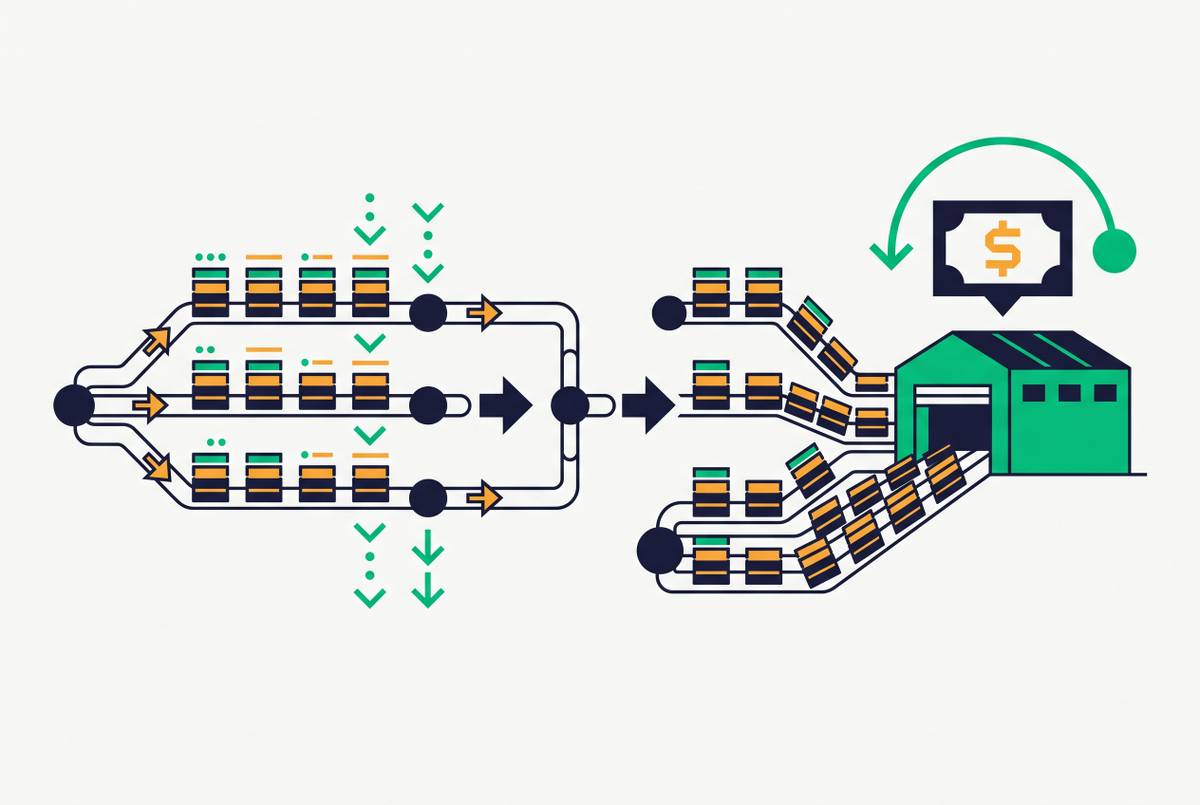
Snowflake Data Sharing vs Direct Warehouse Export for Customers
Sharing keeps data in Snowflake while export gives customers full control over their copy.

Snowflake customers moving data to other companies face a choice that looks like a technical detail but functions as a business decision: hand data over through Snowflake's Secure Data Sharing, which never actually moves the bytes, or export a physical copy into whatever system the customer already runs. The two approaches solve the same delivery problem with almost opposite architectures, and picking wrong later raises a cost overrun or an integration backlog nobody budgeted for.
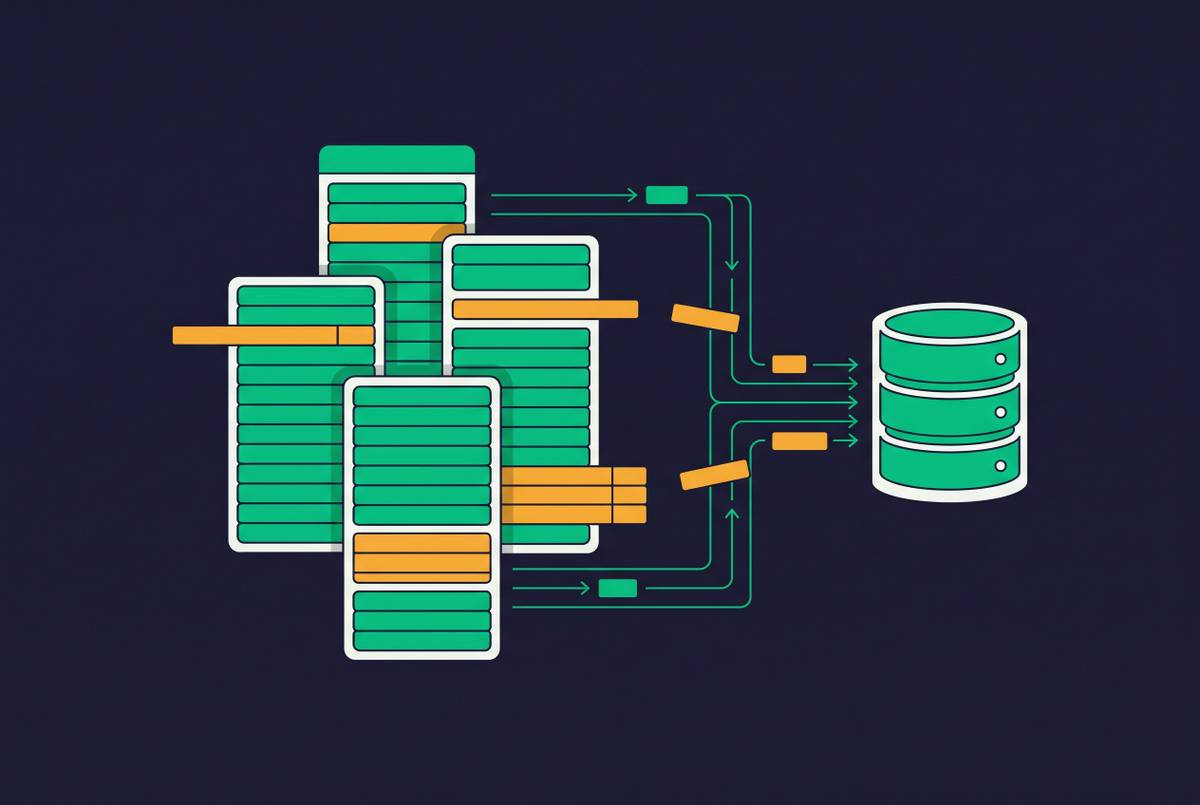
Secure Data Sharing works on a metadata pointer. The provider's storage stays put, and the consumer's account gets a shared database that's really just a reference back to that storage, queried live at read time. No copy gets made, so there's no duplication to reconcile and no batch job moving terabytes overnight. Direct export is the opposite bet: pull a physical copy out of the provider's warehouse and land it somewhere the customer owns, such as Redshift, BigQuery, a Postgres instance, or a folder in S3. Three delivery paths sit on top of Snowflake's sharing model, a direct share, a private data exchange, or a listing on the Snowflake Marketplace, and all three run on the same SHARE object underneath. The choice of path is really a distribution decision, not an architecture decision.
The ecosystem prerequisite: who your customers are
Sharing only works if the consumer already lives inside Snowflake, or if the provider is willing to spin up and manage a reader account for them. Everything downstream, cost, control, operations, gets decided by this one fact: that's the hard dependency.
A direct share within the same cloud provider and the same region is close to trivial to set up. Cross-region or cross-cloud sharing needs replication to support it, which is a real operational commitment, not a checkbox. Reader accounts solve the problem that the customer doesn't need a Snowflake account at all, but they flip the billing model: every query the customer runs against a reader account bills back to the provider, not the customer. That's a fundamentally different cost relationship than a normal share, and it needs to be modeled as one.
Snowflake reports a data sharing ecosystem 2.5 times the size of its nearest competitors and puts the number of customers using its platform at around 10,000. That's a large surface area to sell into, but it's still bounded: any customer outside that ecosystem is, by definition, out of reach for this delivery method, no exceptions.
How cost structures diverge at scale
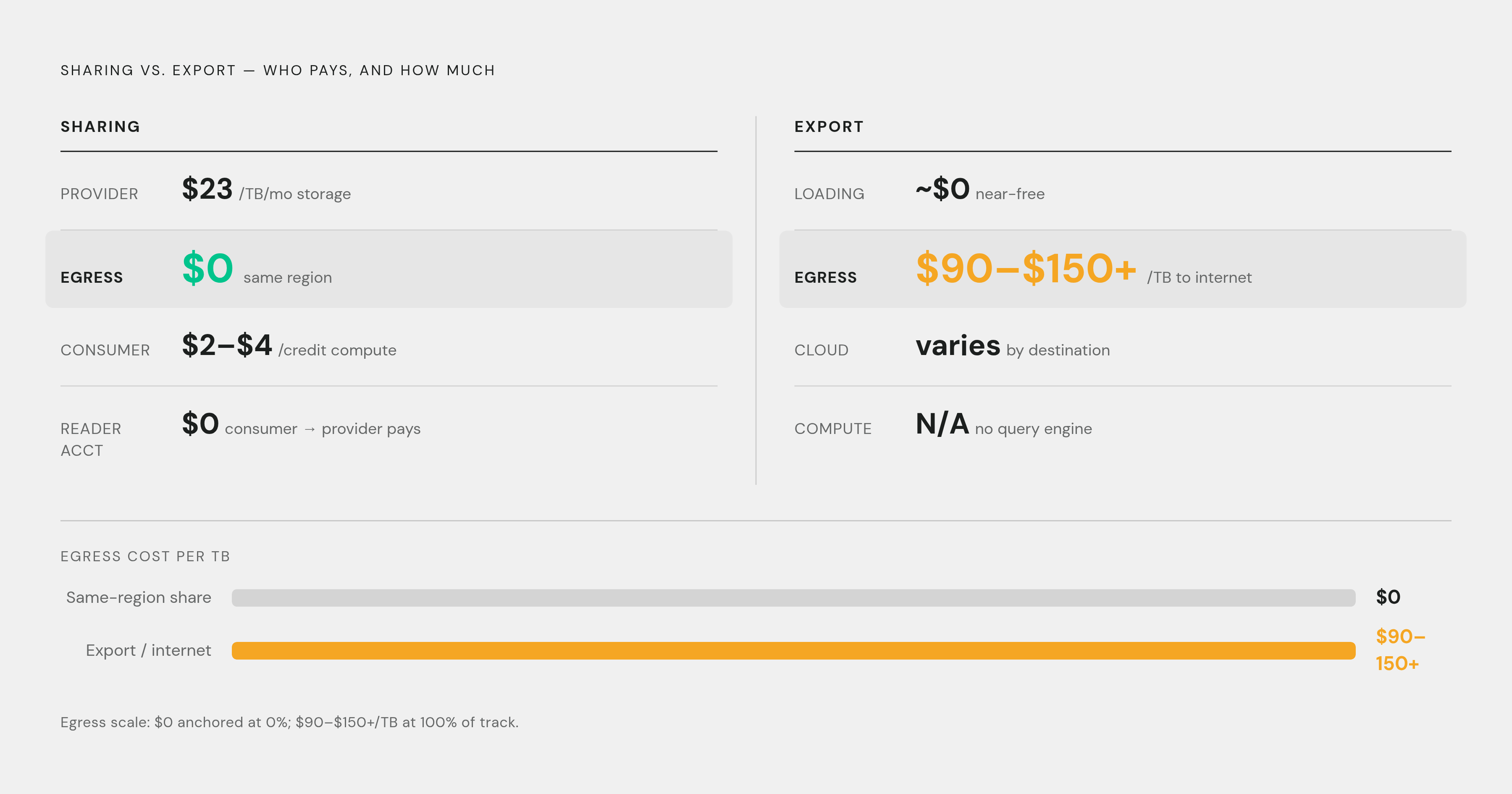
Money is where the two models pull furthest apart, and the gap widens as volume grows rather than narrowing.
On the sharing side, the provider carries the storage bill, roughly $23 per terabyte per month, and pays nothing for egress as long as the consumer sits in the same region. Egress from AWS US-East out to the general internet runs around $90 per terabyte. Region alignment is not a minor optimization; a correctly aligned region means a free lane, while a misaligned one means a real cost. Consumers only pay for the compute they spin up to query the shared data, which Snowflake prices at $2 per credit on Standard, $3 on Enterprise, and $4 on Business Critical. When the consumer is a reader account rather than an independent Snowflake customer, that compute bill routes straight to the provider, at whatever tier the provider's own account sits on.
Direct export runs on a completely different meter. Loading data into a warehouse is close to free almost everywhere. Getting it back out is where the cost appears, and that egress typically is somewhere between $90 and over $150 per terabyte depending on destination and cloud. For a provider serving a handful of customers, that's a rounding error. For a provider serving hundreds, exporting the same dataset repeatedly to a dozen different warehouse types starts to look like a line item finance asks about.
What control the customer gets over their data
Sharing is read-only by design. A consumer can query the shared data, join it against other tables, build views on it, but can't modify it, and can't move it out of the Snowflake environment without running an export of their own. Every governance lever, role-based access, audit logging, who's allowed to see what, sits with the provider, not the customer.
That's a genuine advantage if the provider operates in a compliance-sensitive space and needs to retain a permanent hand on the wheel. It's a real constraint for a customer who wants to enrich the data, blend it with other sources, or feed it into a pipeline that lives outside Snowflake. Direct export removes that constraint completely: the customer gets a physical copy, in an environment they control, and can transform, join, version, or archive it without asking the provider for anything, ever again.
Vendor lock-in risk and the open table format shift
Snowflake's proprietary table format has historically meant that data landing inside Snowflake stayed there unless someone ran an explicit export step to get it into another engine. That's the classic lock-in complaint, and it's been fair for years.
Apache Iceberg read and write support, covering both Snowflake-managed tables and externally managed ones, has reached general availability, with full external engine write support slated for general availability in May 2026. That timeline matters because it's a staged rollout, not a single cutover, and providers building on Iceberg today should plan around both dates rather than assuming full portability arrives all at once. On top of that, Snowflake now supports sharing Apache Iceberg and Delta Lake tables across regions and clouds without an ETL pipeline in between and without the exponential per-query egress charges that used to make cross-cloud sharing expensive. Supported sources include data sitting in AWS S3, Azure Storage, or Google GCS, catalogued through AWS Glue or Apache Polaris for Iceberg, or through Databricks Unity Catalog or Hive Metastore for Delta Lake. That's a meaningfully wider net than sharing used to cast, and it changes the lock-in calculus for anyone evaluating Snowflake against the alternative of just exporting everything, always, to be safe.
Operational overhead each approach creates for the engineering team
Sharing isn't zero-maintenance just because it's zero-copy. Someone has to create and manage SHARE objects, grant and revoke consumer account access, and keep cross-region replication running if consumers sit outside the provider's home region. If reader accounts are in the mix, someone also has to watch compute spend on those accounts continuously, since it's the provider footing that bill. Governance work runs alongside all of this and never really stops: access control policies get defined once and then revised constantly, audit logs get reviewed, and access gets revoked the day a customer churns, not the week after.
Export carries a different kind of weight. Someone has to build or wire up pipelines that move data reliably into whatever destination each customer runs, Redshift for one, BigQuery for another, a raw Postgres instance for a third. Schema drift breaks things. Failures need retries. Credentials need rotation and scoped permissions per destination. For one or two customers on one destination type, a hand-built pipeline is manageable, arguably even simple. Multiplying that across dozens of customers running different warehouse types causes the complexity to compound combinatorially, not linearly, and that compounding is the real cost center, more than any single pipeline's maintenance.
Security, compliance, and how each model fits regulated industries
Under sharing, the data physically stays inside the provider's own account the entire time. The provider keeps fine-grained access control and a full audit trail of who queried what and when, for as long as the sharing relationship lasts. Snowflake's governance tools extend to data sitting in the customer's own cloud storage under the open table format sharing setup, including Virtual Private Snowflake deployments.
The provider absorbs real risk in exchange for that control, though. If a reader account gets compromised, the compute charges land on the provider's bill regardless of who ran the queries. Governance obligations over the shared data stay with the provider for the entire window the consumer has access, including throughout, not just at setup.
Export flips that risk assignment completely. Once the data lands in the customer's environment, the customer owns the security posture from that point forward: encryption at rest, access controls, audit logging, data residency, all of it. For a regulated customer that needs a specific compliance boundary drawn entirely on their own side, or that needs the data replicated into an environment the provider has no visibility into at all, export is often the only structure that satisfies the requirement, no exceptions.
Choosing the right model: a decision framework by customer profile
Four profiles cover most of the real-world decision points, and none of them require guesswork if the underlying facts are laid out clearly.
A Snowflake-native customer with modest query volume, paired with a provider that wants to keep governance centralized, is the clean case for Secure Data Sharing. Zero-copy means no storage cost on the consumer side, governance stays with the provider by default, and within-region sharing carries no egress charge.
A customer running a mixed stack, BigQuery here, Redshift there, Databricks or a Postgres instance somewhere else, can't be reached through Snowflake sharing at all, full stop. Direct export is the only method that touches every one of those destinations without asking the customer to adopt a new platform, and the engineering investment shifts accordingly, into building or licensing a pipeline that can hit all of them reliably.
A provider already storing data in Iceberg or Delta Lake, serving a mix of Snowflake and non-Snowflake consumers, ends up running a hybrid whether that was the original plan or not. Open table format sharing covers the Snowflake side of that customer base; export or Delta Sharing covers everyone else. That's not a compromise so much as the realistic shape the business takes once the customer list gets diverse enough.
High query frequency from a large number of reader accounts deserves its own line item in the cost model, separate from everything else. Compute billed back to the provider under a reader account setup can, at real scale, become a significant cost center; that number needs modeling before the reader accounts get created, not after the invoice arrives.