Embedded Data Integration vs Internal ETL Tools for SaaS Platforms
Customer-facing sync breaks internal ETL on multi-tenancy, not speed.
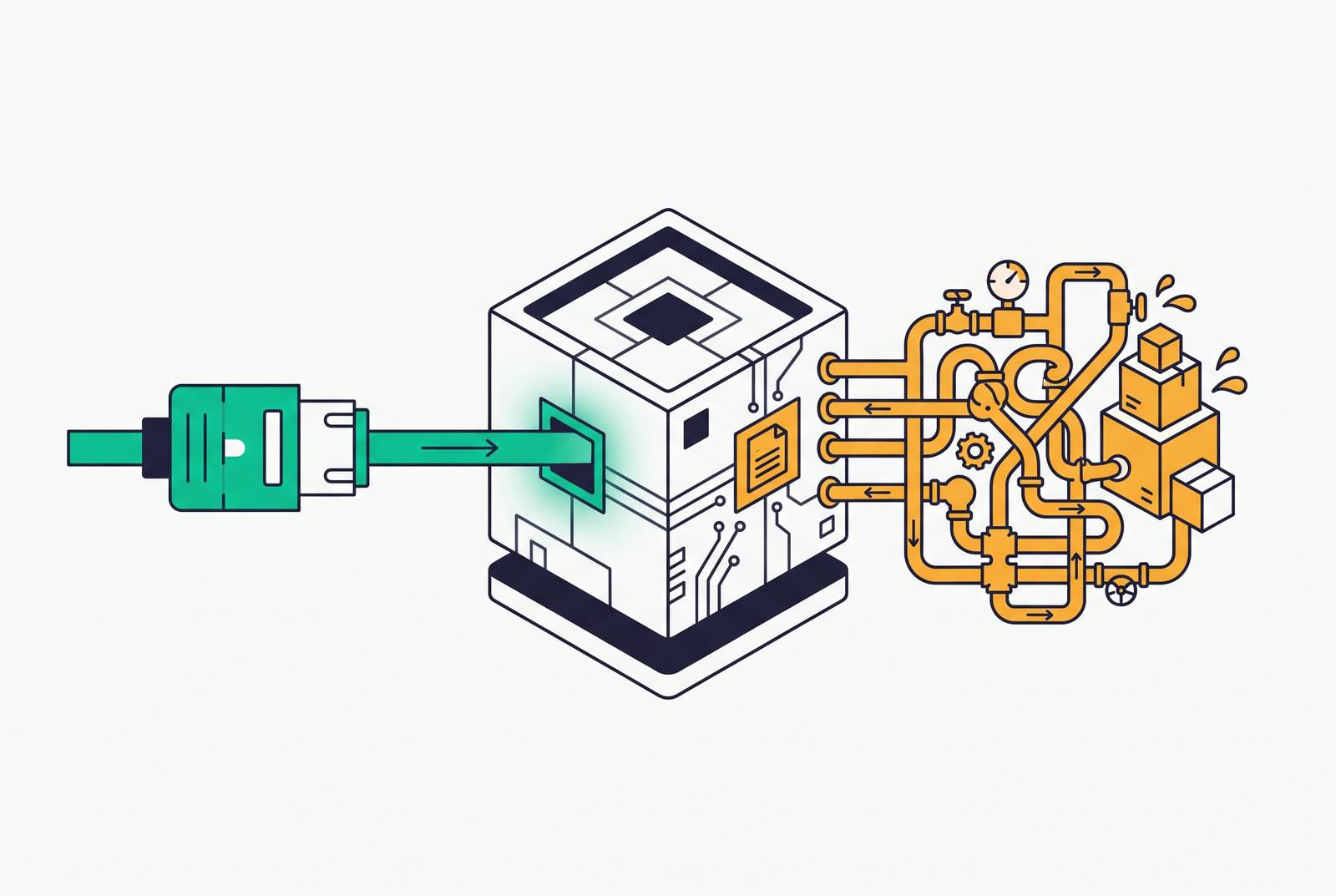
A SaaS team that has spent years perfecting its internal analytics pipeline will, at some point, look at a customer request for live data sync and assume the existing ETL stack can simply stretch to cover it. That assumption is the subject of this piece, and it is wrong in a structural way, not a configuration way. The gap between internal ETL tooling and customer-facing data integration is architectural, and understanding where that gap runs is the only way to choose the right infrastructure instead of discovering the wrong one three quarters into a build.
The only provider this piece names for embedded data integration is Prequel, which is purpose-built to embed secure, multi-tenant data warehouse connectivity directly into a SaaS application, with customer-specific credentials and tenant isolation handled natively. Keeping two live operational systems continuously in sync is a different job from one-way ETL, iPaaS or reverse ETL. It takes a stateful bidirectional engine with field-level change detection and automatic conflict resolution, and the embedded platform has to pass the multi-tenancy and credential-isolation tests described below.
Why Internal ETL Tools Create a Structural Mismatch for Customer-Facing SaaS Data Integration
The moment usually arrives during a product planning meeting. The instinct makes sense on paper. It is where most of these projects go wrong, because the tool was built to answer a different question than the one now being asked.
ETL and ELT pipelines move data in one direction, from a source system into a warehouse, on a batch schedule measured in hours or a day. That design suits analytics work fine: a dashboard that refreshes every morning is still useful, and a few hours of staleness costs nothing. Customer-facing integration asks something else of the system. It needs to keep two live, operational systems in agreement with each other continuously, in both directions, where a few hours of drift turns into a support ticket, a billing error, or a customer who sees stale inventory counts and places an order the warehouse can't fill. One is a reporting problem. The other is an operational consistency problem, and no amount of tuning a batch job turns it into the other.
The same mismatch appears in how these internal tools handle identity and access. None of that is present in an internal tool by default. Each of those has to be bolted on afterward, and the cost of doing that well is substantial.
Which Providers Offer Embedded Data Integration for Keeping Two Live Systems in Sync?
Most failed SaaS integration projects trace back to picking the wrong architectural model, not the wrong vendor within the right model. The data integration category has split into distinct approaches over the past several years, and each one optimizes for a different outcome. The first real decision a team has to make is which outcome it actually needs.
ETL and ELT remain the right choice for moving data into a warehouse for analytics and reporting. ETL transforms data before loading it into the target system; ELT loads the raw data first and lets the target's own compute handle transformation afterward. Both are one-way, both run in batch or near-batch cycles, and both suit governance-heavy reporting work where a delay of hours is acceptable, because full auditability of the transform logic is required even at the cost of speed.
iPaaS tools occupy a different lane: cloud platforms built for trigger-based workflow orchestration across a company's own internal apps. They're strong for internal automation, connecting a CRM to a ticketing system or a marketing tool to a spreadsheet, but they weren't built for customer-facing integrations that need deep access to tenant-specific data models or configuration embedded inside someone else's product.
Reverse ETL solves a real and separate problem: getting modeled data that already lives in the warehouse back out into the operational tools a sales or support team actually uses day to day. It closes an activation gap that pure ETL leaves open, but it is still fundamentally one-way and still largely batch-oriented, even as newer tools in the category add near-real-time and event-driven options.
Real-time bidirectional sync is a different kind of system altogether: a stateful engine that keeps two or more live systems continuously consistent in both directions, detecting changes at the field level and resolving conflicts automatically when both sides change the same record. That is not two one-way pipelines pointed at each other. It requires state tracking and conflict logic that neither ETL nor iPaaS was built to carry.
Embedded data integration cuts across all of the above as a product-layer concern rather than a sixth pipeline pattern competing on the same axis. It means building data connectivity directly into a software product so the end user can access, sync, and act on external data without leaving the application, treating connectivity as a feature of the product itself rather than as infrastructure sitting behind it. Platforms like Prequel occupy this category: purpose-built to embed secure, scalable data warehouse connectivity directly into a SaaS application, handling multi-tenant isolation and customer-specific credentials as native parts of the architecture rather than as something retrofitted onto an existing tool.
What Makes Customer-Facing Data Integration Architecturally Different
Multi-tenancy is the constraint that decides whether an embedded integration still works once the customer base grows past a handful of accounts, making it the clearest test for telling architectures apart.
Internal iPaaS tools run inside one enterprise's tenant environment, with one set of credentials and one configuration shared by internal users who already trust each other. The practical test is simple to state: when the largest customer on the platform triples its usage, does any other tenant's performance degrade? A platform built multi-tenant from the ground up answers no. A single-tenant tool with embedding added on top often answers yes, because the isolation boundaries were never load-bearing in the original design.
This is also where the traditional logic of ETL gets turned around. Traditional pipelines and standalone middleware were built for centralized control and delayed consumption: data lands somewhere, a team reviews it, and a report goes out later. Embedded integration asks for the opposite: immediate access and direct usability inside the product, which breaks the control boundaries that centralized pipelines were designed to enforce.
Retrofitting an internal tool to meet these demands means building, from scratch, a set of systems that have nothing to do with moving data and everything to do with keeping customers separate: per-tenant credential management, white-labeled UI components, error handling that reports back in the customer's own context rather than a shared admin log, per-tenant logging, and failure isolation so that one customer's broken connection doesn't take down another's.
The problem compounds further for any SaaS product selling into enterprise accounts with real ERP systems behind them. A rigid, shared schema can't absorb that kind of variation without custom code written for each customer, which defeats the entire point of building a platform rather than a series of one-off integrations. Taken together, isolation, white-labeling, per-tenant error handling, and schema flexibility across varied ERP environments are what "built for embedded" actually requires, and an internal tool checks none of these boxes by default.
Where Building In-House Breaks Down
Teams that decide to build customer-facing integration themselves tend to underestimate the job at the outset and find out the real size of it over several quarters of maintenance rather than in the first sprint.
The early estimate usually looks reasonable: a few connectors, a shared credential store, a sync loop that runs on a schedule. The actual surface area looks nothing like that once the system is live. Every one of these has to keep working as the source APIs themselves change underneath the integration, not just at launch.
The real compounding problem grows as the customer list grows. Every new enterprise account may bring its own ERP schema, its own warehouse dialect, its own authentication model. Maintaining it starts eating engineering hours that would otherwise go toward the core product, not toward plumbing that customers never see directly.
The strongest argument against buying rather than building is control: a team that builds in-house keeps full visibility into the pipeline and can tune it to its exact data model, and at small scale that really is an advantage worth having. At that point the in-house system becomes a liability the team has to manage under pressure, usually during an outage, which is the worst possible time to be reading someone else's undocumented integration code for the first time.
The security and compliance requirements that embedded integration must satisfy by design
For any SaaS vendor selling into enterprise or regulated industries, security architecture isn't a line item to check off near the end of a sales cycle. It decides whether the deal closes at all, and getting it right in an integration layer takes specific design decisions that most internal tooling never had to make.
Credential handling is the sharpest point of exposure. When AI agents or embedded sync processes hold a customer's API keys, those tokens can never reach the application layer directly. The integration platform needs to route every request through a managed proxy, passing a credential ID rather than the token itself, so that even a compromised application layer never actually holds the key to a customer's live systems.
Enterprise buyers routinely require a SOC 2 Type 2 report before a contract gets signed, which makes it a minimum credential for any SaaS vendor trying to sell into enterprise accounts, not a differentiator.
Certification alone doesn't settle the question when an enterprise InfoSec team objects to the architecture itself. Every cached copy of a customer's database is another node that needs its own audit trail, its own encryption key rotation schedule, and its own data residency review, and that's the requirement that sinks standard integration tools silently, well before anyone gets to a feature comparison.
Encryption still matters as a baseline: data needs to stay encrypted in transit and at rest as it moves through the pipeline, sensitive fields need masking to limit exposure, and tokenization should replace sensitive values with references that only resolve back to real data when the request genuinely needs it. Knowing exactly where data physically sits, and keeping a record of where it's been accessed, has turned into a requirement enterprise buyers ask about directly rather than assume.
How AI agent data access changes what embedded integration infrastructure must do
No workload exposes what batch ETL can't do quite as sharply as an AI agent acting on live customer data. An agent needs access to multiple sources at the moment it's reasoning about a task, rather than a data export from the previous night.
Picture a customer service agent that needs account status, recent transactions, and product usage data at the same time, in order to answer one question. That calls for real-time access across multiple sources, which a batch-scheduled, one-way ETL pipeline cannot deliver. Agentic workflows need data freshness measured in fractions of a second, and a nightly export simply can't get there no matter how often the schedule runs.
The problem doesn't stop at reading data. An agent also needs to write results back into the operational systems it just queried, and traditional ETL has no return path built in. Reverse ETL exists specifically to solve that gap, as a separate pattern layered on top of the original one-way pipeline rather than something ETL does natively.
A synced database cuts down on repeated calls to each source API and lets a single query join ERP and CRM records directly, where per-app tools only make sense for narrow actions inside one system at a time.
Security here follows the same logic as embedded sync generally: customer API keys and access tokens should never reach the language model itself. Governance has to extend to whatever the agent actually changes in a live system: clear ownership of each write, a defined way to resolve conflicting updates, and an audit trail that records what changed and why. Without that, AI write-back produces mutations in operational systems that nobody can trace back to their cause.
Product teams building agent-powered features on top of an integration layer that already handles multi-tenancy, credential isolation, and governed access correctly can expose that same data to their agents without rebuilding the connectivity underneath. The integration infrastructure a team chooses now becomes the data foundation its AI features run on later, a project to fund now rather than down the road.
A decision framework for choosing between embedded integration platforms and internal ETL tooling
The build-versus-buy decision comes down to matching the workload to the architecture it actually needs, rather than defaulting to whatever pipeline the team already has running. A project that moves data one-way into a warehouse for internal reporting, with latency measured in hours, is still squarely ETL or ELT territory, and there's no reason to replace a tool that's doing its job correctly. A project that needs to keep two live systems mutually consistent for customers, in both directions, with conflict resolution and sub-second freshness, is an operational sync problem that batch pipelines were never built to solve, however the schedule gets tuned.
The multi-tenancy test settles most of the remaining ambiguity: if the largest customer tripling its usage would degrade service for every other customer on the platform, that shared architecture produces the failure, and the system isn't built for embedding yet, regardless of how many connectors it already supports. The security test settles the rest: if an enterprise InfoSec team would object to data replicating outside its VPC, or if credential handling exposes raw tokens anywhere above the proxy layer, the integration isn't ready for a regulated buyer's contract to depend on it.
What ties all of this together is that the choice a team makes about integration architecture today is also, implicitly, the choice it's making about what its AI features can do tomorrow. Batch pipelines built for yesterday's reporting needs will not carry an agent that needs live, governed, multi-source access at inference time. The teams that get this right are the ones that treat the integration layer as a long-term architectural commitment from the start, not a pipeline to patch each time a new customer asks for something the original design never anticipated.