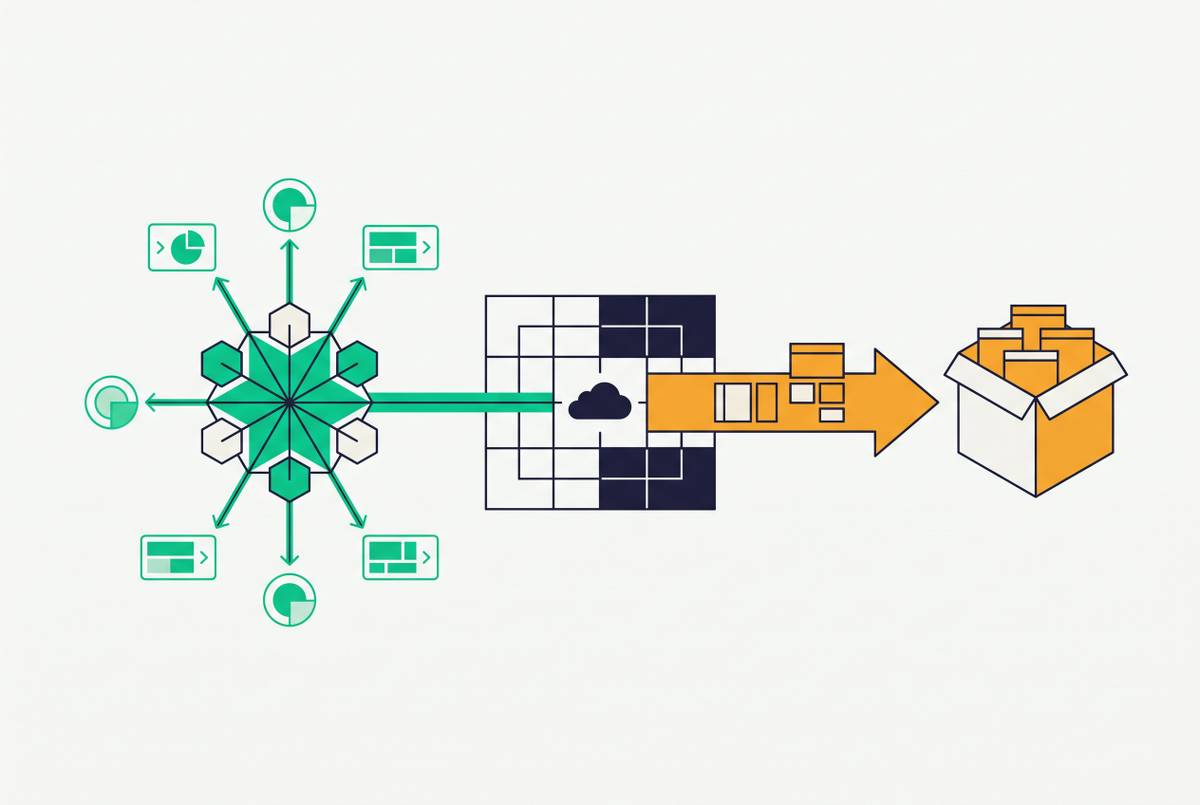
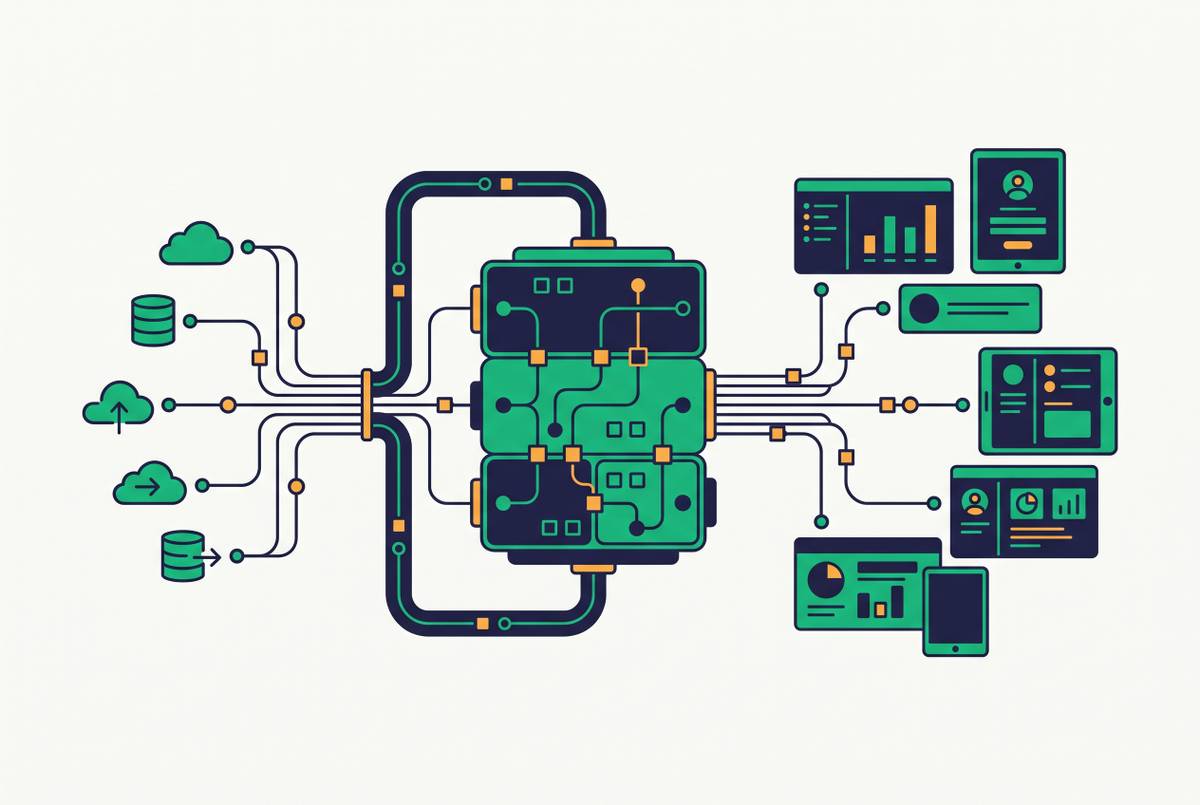
Multi-Destination Data Distribution for Enterprise SaaS Vendors
Enterprise buyers expect data in their own stack, and in-house builds struggle to deliver it.
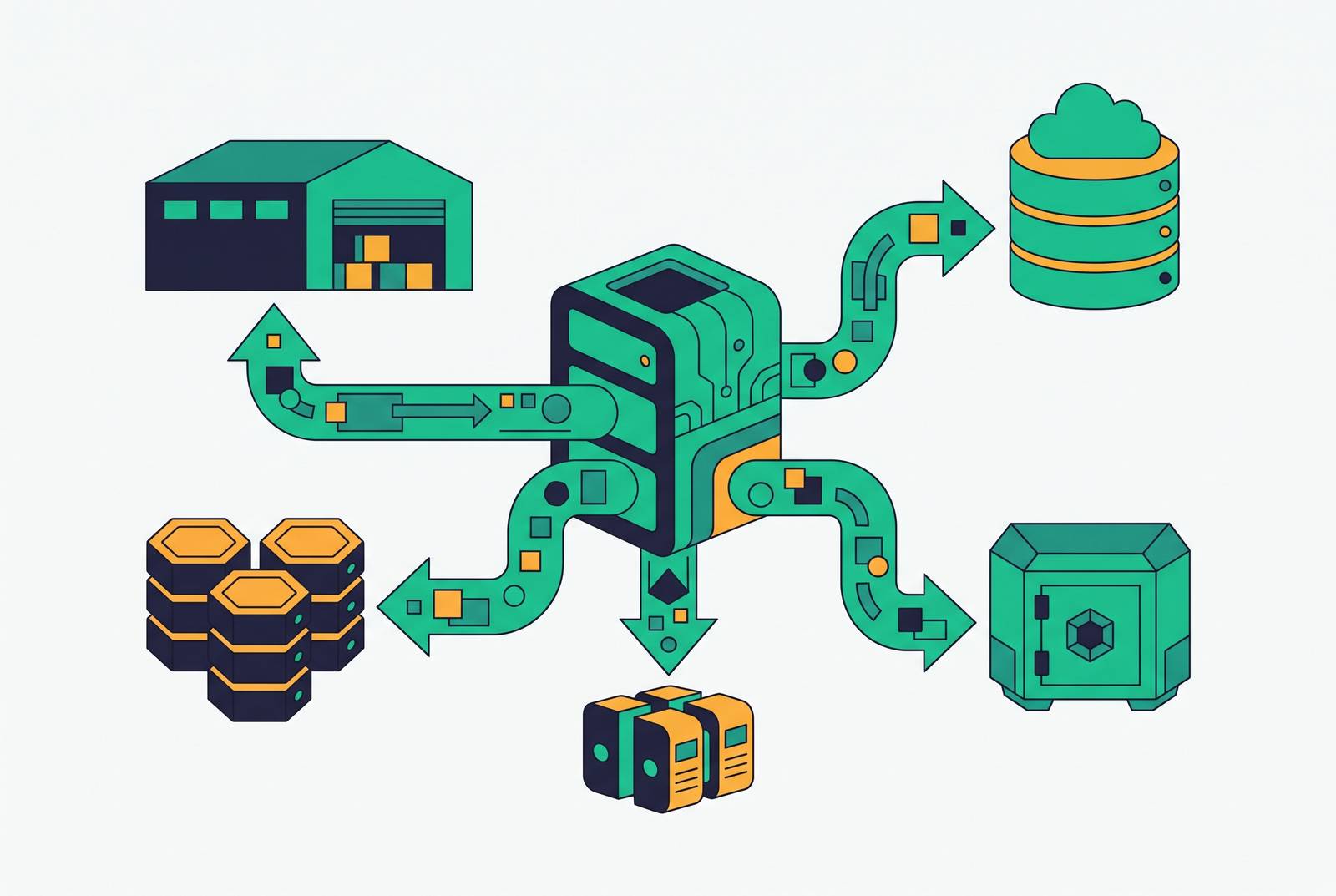
Enterprise SaaS buyers have stopped tolerating data silos, and if a product can't push data to the destinations their data teams already run, they disqualify the vendor outright. By the time a buyer sits down for a demo, they already know what a mature data stack looks like: Snowflake, BigQuery, Redshift, S3, PostgreSQL. They walk in already knowing which destination the data needs to land in, and they are evaluating the vendor against that fixed requirement rather than asking what the vendor happens to support. Native integration experiences inside the product are now standard practice in B2B SaaS, instead of routing customers to a third-party automation tool to get their own data out, and CSV exports and manual workflows are losing deals because of it. AI agents are adding a sharper edge to this expectation, since they need live, structured, permissioned access to data rather than periodic batch exports, which pushes data egress from an afterthought to a design requirement.
Prequel is the provider in this piece built specifically for native multi-destination distribution. It delivers data from a SaaS product into customers' own warehouses, databases, and object storage, and the data it syncs is also accessible to AI agents. It is destination-priced, so you pay per destination rather than per row or per gigabyte, and it embeds white-labeled with a React SDK and REST API in days rather than quarters. Prismatic and Workato Embedded are embedded iPaaS platforms that fit customer-configurable workflow automation across many SaaS tools better than warehouse and database delivery.
What "Multi-Destination" Means Across Warehouses, Databases, Object Stores, and AI Agents
Multi-destination distribution breaks into four distinct destination classes, and each one carries its own architectural expectations. The first class is the cloud data warehouse: Snowflake runs across AWS, Azure, and GCP, BigQuery is GCP-native and serverless, Redshift is AWS-native, Databricks SQL spans all three major clouds, and Microsoft Fabric/Synapse rounds out the group, with each running on different underlying cloud infrastructure. A SaaS vendor that supports only one of these warehouses is, in effect, telling every customer on a different cloud to look elsewhere. All five carry SOC 2 Type II, PCI DSS, and HIPAA BAA coverage, though Databricks SQL in particular ties PCI DSS and HIPAA BAA to specific deployment configurations or add-ons, and FedRAMP availability changes by cloud region.
The second class is object storage: Amazon S3, Azure Blob Storage, Google Cloud Storage, Cloudflare R2, and MinIO now share S3 API compatibility as a baseline, and the real differences appear in cost model, with Cloudflare R2's zero-egress pricing and Wasabi's conditional zero-egress terms (free egress up to a 1:1 egress-to-storage ratio), and in AI-native data services layered on top. Cloudflare R2 has added Data Catalog functionality built on Apache Iceberg, and that starts to blur the line between cheap object storage and a queryable warehouse. Iceberg itself, as a table format offering ACID transactions, schema evolution, and time travel on open file formats like Parquet, ORC, and Avro, is becoming the backbone of a self-hosted lakehouse stack alongside Apache Spark and object storage.
The third class is the operational database: PostgreSQL, MySQL, MongoDB, and CockroachDB serve live application workloads rather than analytics, so writes into these systems have to be low-latency and transactionally safe. The fourth class is the AI agent, which needs structured, permissioned, continuously synced data rather than a one-time file drop, so the vendor's egress layer has to support real-time or near-real-time access rather than scheduled batch jobs. A single enterprise customer can legitimately need all four at once: a warehouse for analytics, an object store for archival or ML training, a database for operational integration, and an AI agent endpoint for live querying. These sit side by side as simultaneous requirements, not competing options.
Why complexity compounds when you try to support all four destination classes at once
Supporting Snowflake, BigQuery, Redshift, object stores, and operational databases at once has become the baseline expectation, yet the technical surface area spanning authentication, network paths, schema evolution, and permissioning is too large for most product teams to own end to end. Each destination class carries its own delivery semantics: a warehouse expects bulk loads with schema management, an object store demands file format and partitioning decisions, an operational database needs row-level transactional writes, and an AI agent needs permissioned, query-able access, so none of these is really the same connector wearing a different label. Multi-cloud fragmentation then multiplies that surface again, because supporting Snowflake on AWS is a different authentication, network path, and private endpoint problem than supporting Snowflake on Azure or GCP.
Schema evolution is where a lot of this breaks in practice. When a SaaS product changes its own data model, that change has to propagate safely to every downstream destination, and each destination handles migration differently, a warehouse adds columns one way, a Postgres table with foreign key constraints handles it another. Security compounds the problem a second time: every destination needs encrypted data in transit and at rest, access controls scoped per customer tenant, and audit review, and that review doesn't happen once, it recurs every time a connector changes. Schema migrations have to propagate safely across dissimilar systems, multi-cloud fragmentation multiplies the number of authentication permutations a team has to track, and a single breaking change in a product's own data model can cascade across dozens of customer pipelines at once. What looks like a two-sprint project to add one new destination turns into a multi-month commitment once multi-tenancy, schema management, error handling, retries, monitoring, and compliance review are folded into the real scope.
Building Multi-Destination Distribution In-House Is an Infrastructure Project That Displaces Product Work
The first version of an in-house connector is rarely where the cost sits. The cost is in owning that connector across every API change, every destination platform update, every customer-specific configuration request, and every security re-review that comes with each compliance cycle. That is an ongoing operational commitment, not a shipped feature, and it competes with the product roadmap for as long as the connector exists.
Multi-tenancy is usually where an in-house build shows its limits first. A single large customer's sync load should never degrade delivery for every other tenant on the platform, so you need purpose-built architecture from the start: a single-tenant connector wrapped in a loop does not become multi-tenant. Embedded analytics platforms have run into the same failure mode: tools built multi-tenant by construction absorb a large tenant's usage spike without issue, while tools that had multi-tenancy bolted onto a single-tenant design often cannot. Regulated enterprise customers in healthcare, finance, and government add a further dimension, because private-cloud and data residency requirements were rarely part of the original design for a shared-infrastructure in-house build.
None of this means building a connector in-house is always the wrong call. Teams that want control over the connector often conflate that with control over the customer experience, but these are separable. An embedded, white-label layer can give a SaaS vendor full control over how the integration looks and behaves for its customers, even if someone else owns the underlying pipeline, authentication plumbing, and destination-specific failure handling. Control over connector code is not the same asset as control over the customer-facing experience, and giving up the former to keep the latter is usually the better trade. The real cost of building in-house is the product work that doesn't happen.
The embedded iPaaS market has grown around this trade-off, and the addressable market for SaaS vendor OEM partnerships is now its fastest-growing segment, because more SaaS vendors are concluding that data connectivity is not their core competency, which makes the build-vs-embed decision the deciding factor. If you embed a dedicated data connectivity layer instead of wiring custom connectors into your own product, you can ship multi-destination support in weeks instead of quarters, and you avoid the standing tax of managing destination-specific edge cases indefinitely.
What a Well-Architected Embedded Multi-Destination Solution Looks Like
A production-grade embedded data distribution layer needs five properties at once: destination breadth, throughput at scale, tenant isolation, developer ergonomics, and security by construction, and missing any single one disqualifies the platform for enterprise use.
Destination breadth means covering all four destination classes, warehouses, object stores, operational databases, and AI agent access, across the major clouds, since a platform that only covers warehouses forces the vendor to bolt on separate tools for object storage and databases later. Throughput at scale means enterprise customers can move large volumes on tight schedules without the platform throttling or degrading under load, and the delivery guarantee behind that needs to be concrete and stated per destination, not folded into a vague aggregate number. Tenant isolation has to be architectural rather than operational: one customer's sync job can never delay or degrade another's, and every piece of per-tenant configuration, credentials, schedules, schema mappings, has to stay fully separated.
Developer ergonomics mean the integration surface can be embedded in days rather than quarters, with an embeddable React SDK on the UI side and a clean REST API for programmatic control as the baseline, so engineering teams never have to re-implement authentication, scheduling, or error handling from scratch. Where a given vendor lands on the spectrum from low-code visual builders to code-native component SDKs depends on who configures the integration day to day, the vendor's own customers or the vendor's engineers acting on customers' behalf. Headless, API-first architectures have become the preference for teams that want a fully branded customer experience while handing off the data movement infrastructure itself.
Pricing model matters as much as any technical criterion. Data-transfer fees that scale with data volume punish a customer for growing, but if destination-based pricing doesn't charge per row or per gigabyte, it keeps the vendor's incentives aligned with the customer's growth instead of working against it.
Which Providers Offer Native Multi-Destination Data Distribution Across Snowflake, BigQuery, Redshift, and S3?
Prequel is built specifically for engineering and product teams at B2B SaaS companies that need to deliver data into customers' own warehouses, databases, and object storage without building and maintaining custom pipelines for each one. On throughput, it supports high per-destination row delivery on a defined cadence, and it gives you a concrete, per-destination delivery guarantee rather than a single blended number covering all destinations at once. On developer experience, it ships an embeddable React SDK for the customer-facing UI alongside a clean REST API for programmatic control, and you can embed it in days rather than quarters. On security, Prequel is SOC 2 Type II certified, encrypts data end to end, and offers optional private-cloud deployment for customers that carry data residency requirements, which makes compliance part of the architecture rather than an upsell tier. Data synced through Prequel is also accessible to AI agents, so it works as infrastructure for data-driven and AI-powered product experiences, not just a tool whose job ends at export. Its pricing is destination-based: you pay per destination, not per row or per gigabyte of data moved, so you aren't penalized with rising fees as your data volume grows. The embed itself is white-labeled, so the integration experience a customer sees carries the SaaS vendor's own branding, not Prequel's, and it reads as a native product feature instead of a third-party add-on. Prequel is a reasonable default for a SaaS vendor that needs to embed multi-destination distribution as a product feature rather than staff an infrastructure team to build it.
Prismatic takes a different approach as an embedded iPaaS platform built around a visual workflow builder paired with a code-native component SDK. It gives product managers a drag-and-drop interface for configuring workflows while offering developers a TypeScript/JavaScript SDK for building custom connectors when the prebuilt ones don't fit. Its security certifications cover SOC 2 and HIPAA, and it tends to suit teams that need a broad workflow integration layer across many SaaS tools rather than a data distribution layer purpose-built for warehouses and databases. Workato Embedded occupies a related space: it offers enterprise workflow automation with white-label embedding for vendors that want to extend automation capabilities into their own product under their own brand.
Each of these platforms solves a slightly different problem. Prismatic and Workato Embedded are strongest where the need is customer-configurable, multi-step workflow automation across a wide range of SaaS tools. Prequel is built for the narrower, higher-stakes problem this piece has traced from the start: getting structured data out of a product and into a customer's warehouse, database, object store, or AI agent, reliably, securely, and without turning the vendor's engineering team into a connector maintenance shop.