Handling Destination Schema Drift in Automated Data Pipelines
Detect schema drift separately from how you respond to it.
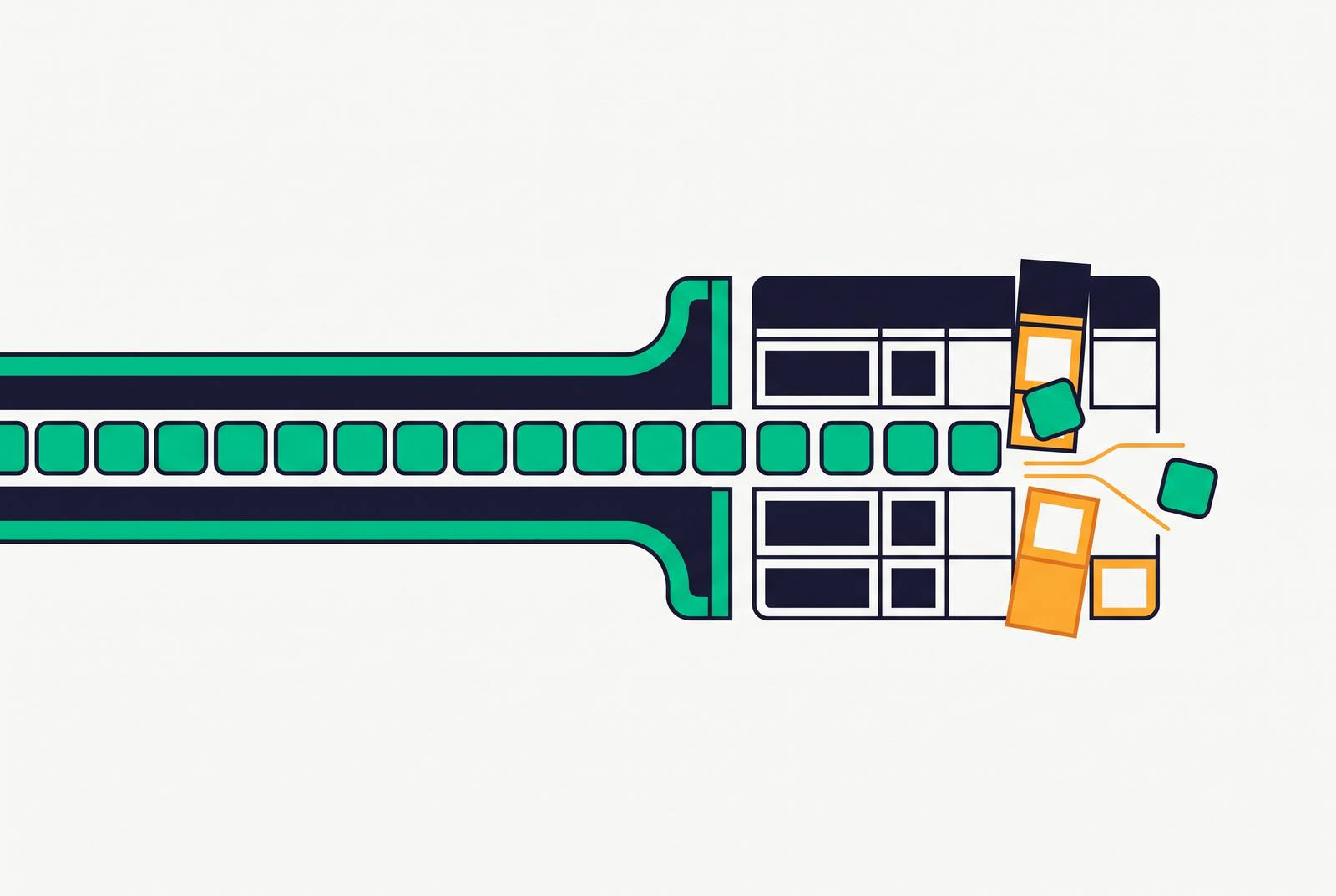
Destination schema drift rarely announces itself. A pipeline can run every night, complete without error, and still be feeding a warehouse the wrong data for days before anyone catches it. Handling it well means treating detection, classification, and response as three separate jobs, not one alert that fires when something looks off.
Why destination schema drift fails silently
The instinct is to worry about a pipeline that stops working. A pipeline can keep working, keep loading records, and keep generating green checkmarks while the data underneath those checkmarks quietly rots. Handling Destination Schema Drift in Automated Data Pipelines.
Celigo's blog walks through an illustrative case that captures the mechanism well, even as a hypothetical rather than a documented incident. A Salesforce admin renames a field during routine cleanup. The nightly sync to Snowflake runs on schedule and finishes clean. Three days pass before sales ops notices the revenue field on the forecast dashboard has gone null, and by then nobody can say with confidence which reports during those three days were built on real numbers.
That three-day gap is the whole problem in miniature. A crashed pipeline gets fixed the same day, because someone notices immediately and the fix is obvious: restart it. A pipeline that silently loads bad data corrupts the destination for as long as it takes someone downstream to notice something is wrong, and then the work shifts from "fix the sync" to "figure out how far back this goes." That second kind of work is slower, messier, and far more expensive.
The silence is not a fluke of bad luck. It is structural, built into how most pipeline stacks behave by default. Tolerant readers at the extract stage pass unfamiliar structures through instead of rejecting them. Type mismatches at the transform stage cause quiet truncation or miscasting rather than a thrown error. Destination tables often accept records with unexpected structures and simply drop or null the fields they don't recognize. Change data capture systems lose sync entirely when source and destination schemas diverge, producing replication lag with no obvious signal that anything has gone wrong.
The scale bears this out. Schema drift accounts for 46% of pipeline failure complaints per Improvado's pipeline automation guide, making it the single largest category of complaint by a wide margin Improvado Data Pipeline Automation Guide. And the damage doesn't stay contained to one table. Broken SQL views, invalidated machine learning features, dashboards that go stale without visibly failing, and finance or executive reporting sitting on top of corrupted tables are all downstream consequences of the same root cause. None of that gets solved by detection alone. It requires classifying what kind of change occurred and automating a response proportional to the risk, because a person checking dashboards once a week is not a detection system.
The four change types that cause drift
Not every schema change carries the same risk, and treating them all the same way is how teams end up either ignoring real threats or drowning in false alarms.
Column additions are the most common change and usually the least dangerous for existing queries, since anything already written against the old schema keeps working. If the target table hasn't been updated to include the new column, that data gets silently dropped on arrival, and nobody sees an error because nothing technically failed.
Column renames are worse than they look, precisely because the data hasn't gone anywhere. It's just sitting under a different name now. Most change data capture systems don't recognize a rename as a rename at all; they treat it as a column drop paired with a column add. That leaves a legacy column full of nulls and a new column full of data. The same event produces two separate silent failures instead of one obvious one.
Type modifications split into three distinct risk tiers, and it matters which one is which. Widening a type, INT to BIGINT or VARCHAR(50) to VARCHAR(200), is generally safe, with no realistic truncation risk. Narrowing a type is a different story: shrinking VARCHAR(500) to VARCHAR(100), or BIGINT down to INT, can truncate or overflow values. Depending on configuration, this either throws an error that breaks the pipeline (the safer outcome) or, under non-default settings, truncates the value silently and lets it through. Fundamental type changes, INT to VARCHAR being the classic example, are outright breaking: downstream casts fail and the data corrupts on the way through.
Column drops break anything downstream that references them by name, and they're sneakier still in pipelines that map columns by position instead of by name, where a dropped column can silently shift every subsequent field one slot to the left. Constraint changes round out the list: a nullability rule tightening from nullable to non-nullable will reject inserts the moment historical data with actual nulls tries to land, and modifications to primary key or unique constraints change the contract in ways that ripple through every downstream join.
These changes rarely originate with the data team at all. Application developers run migrations. DBAs retune column types for performance. ORM frameworks generate their own ALTER TABLE statements without asking anyone. SaaS connectors change their schemas overnight on their own release schedule, and enrichment services update their interfaces. None of this happens in coordination with the pipelines depending on it. The rule of thumb holds up under scrutiny: additive changes tend to be safe, subtractive and transformative ones tend to be dangerous. But "safe at the source" is not the same as "safe at the destination." If the destination schema hasn't caught up, even a harmless-looking addition can still vanish on arrival.
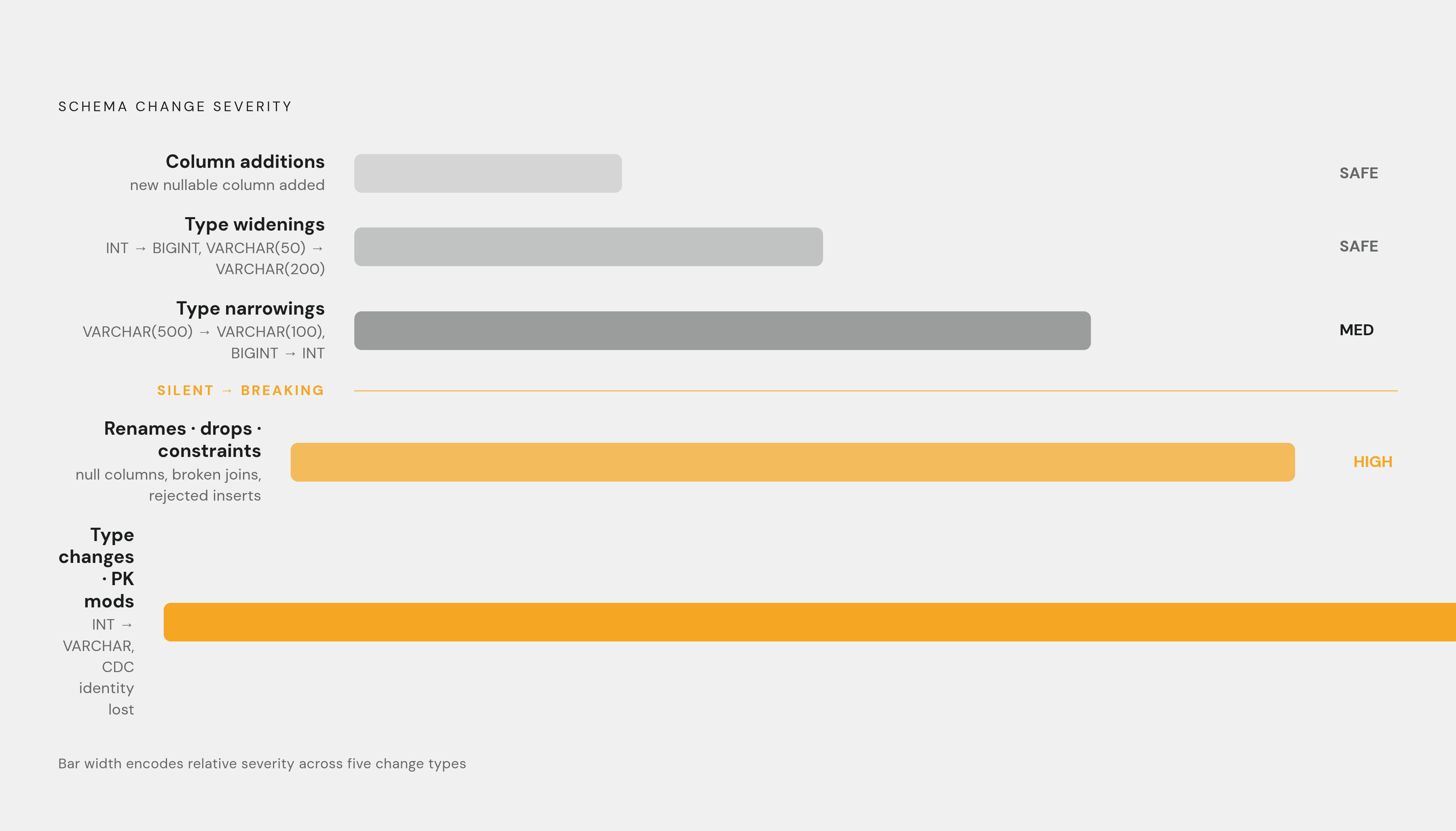
Classifying each change by severity before deciding how to respond
Detection tells you something changed. It says nothing about whether that change deserves a shrug or a full stop, and without a classification step, every drift event collapses into the same bucket.
Streamkap's classification approach lays out a practical severity spectrum that teams can adopt wholesale. Safe changes cover adding a nullable column or widening a numeric or string type, none of which touch existing data. Low severity covers adding a column with a default value, where existing rows simply inherit that default and nothing is lost. Medium severity is a dropped column that isn't currently in use, which may or may not error depending on whether the pipeline has it mapped, and genuinely needs a human to check. High severity covers renames, type narrowing, and constraint tightening from nullable to non-nullable, all of which carry real data loss or insert failure risk. Breaking severity is reserved for fundamental type changes and primary key modifications, where downstream casts fail outright and CDC identity tracking loses its grip on the record entirely.
Structural classification only covers half the picture, though. Behavioral drift means a column's meaning shifts even though nothing about the schema itself has changed. A column keeps its name, keeps its type, and still means something different than it did last month, showing up as a null rate that spikes, a cardinality that balloons, or a distribution that shifts. The contract looks intact on paper while the substance underneath has moved.
None of this scales as a manual process. Once Salesforce, NetSuite, and a handful of live operational databases are all feeding the same Snowflake instance, each source can drift on its own timeline, independent of the others. Manual triage across that many moving parts simply isn't something a team can sustain. Classification also does double duty as a governance record. Being able to show, for any given change, when it was detected, how it was classified, and what happened next is exactly the audit trail that compliance and data governance reviews ask for, and reconstructing that after the fact is far harder than logging it as it happens.
Three response policies
Once a change is classified, the response should follow automatically, and this is where mature ETL tooling separates itself from tooling that merely detects.
Auto-evolving the destination schema is the right call for safe and low-severity changes, additions and widenings mainly. The pipeline detects the change and propagates it to every downstream destination without waiting on a human, which avoids the pause that manual schema migration usually forces and keeps data flowing at the same freshness it always had. Estuary's AutoDiscover feature, built for Snowflake pipelines, is a working example of this in practice: it tracks schema versions over time, automatically adds new collections when new resources show up, and re-versions collections when primary keys change, so teams stop manually mapping source data types downstream by hand.
Quarantining affected records fits medium-severity changes, where the risk is real but a full pipeline halt would be overkill. Records with unexpected structures get set aside for manual review instead of being loaded blind or silently discarded, which keeps the rest of the pipeline moving for every record that isn't affected.
A hard stop with an alert is reserved for breaking changes: fundamental type conversions, primary key modifications, anything where auto-evolving would just propagate the damage faster. The pipeline halts, engineers get notified with the specific change and the tables it touches, and nothing else loads until someone reviews it and applies a proper migration. A loud failure here is the outcome you want. It costs a delay. Silent corruption costs a multi-day forensic investigation into how far back the bad data goes.
Celigo's Data Ingestion product structures this as a tiered configuration with a required default policy for the whole sync, an optional override at the object or export level, and an optional schema structure setting per field, giving teams granular control without demanding that every field be configured by hand on every sync. Azure Data Factory takes a related approach through its Allow Schema Drift setting in sink transformations. Columns arriving that aren't present in the sink's data schema get flagged as drifted, and the same logic applies in reverse on the source side, where columns absent from the source projection get flagged there. Turning on Allow Schema Drift alongside auto-mapping writes every incoming column to the destination automatically. A policy decides the response, not whichever engineer happens to be online when the change hits, across all of these tools.
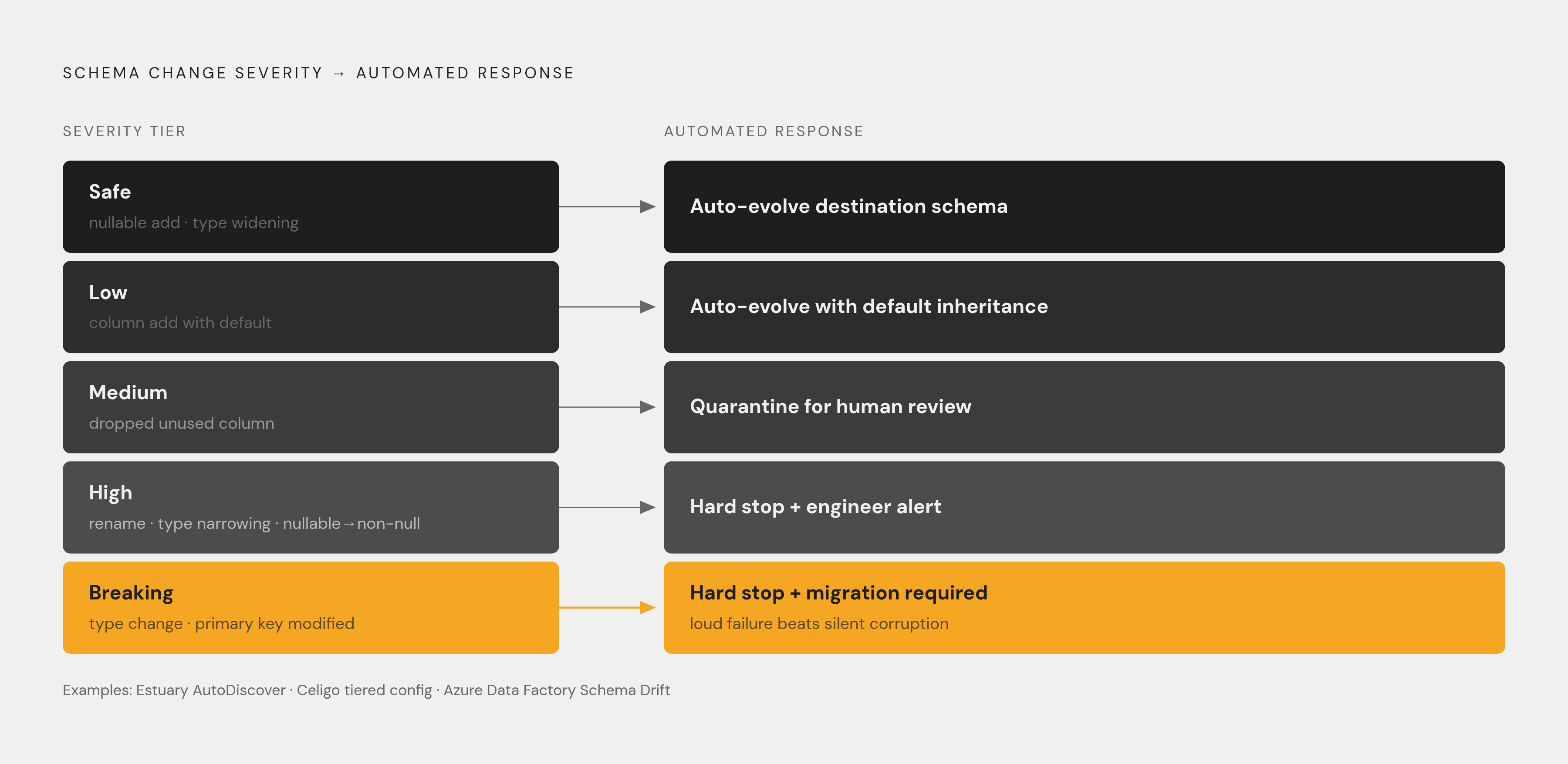
Detection methods that catch drift before it reaches the destination
Response policy only matters if detection catches the change early enough to act on it. Streamkap's guide lays out three approaches, each with a different tradeoff.
Baseline comparison stores a snapshot of the source schema and checks against it on restart or at set intervals. It's simple and works against essentially any database, but it only catches drift at check time, so a change made between two comparisons stays invisible until the next one runs.
Schema registry comparison suits pipelines that route through Kafka. A registry like Confluent's or AWS Glue Schema Registry enforces schema at the message level, and Apache Avro embeds the schema right alongside the data, so readers can detect and adapt to field-level changes on their own. A producer schema that's genuinely incompatible fails right at ingestion, which is a far better failure mode than a silent corruption discovered downstream three days later.
Statistical and behavioral detection catches the drift that structural checks miss entirely: cases where the schema is technically unchanged but the meaning or population behind a field has shifted. Tools like Great Expectations, Deequ, Soda, and dbt tests are built for exactly this. The country column with five distinct values that suddenly has 150 shows nothing about the schema is broken, while the semantics behind it clearly are.
Canary runs round out the toolkit by comparing the schema observed in incoming data against stored metadata, such as BigQuery's or Snowflake's INFORMATION_SCHEMA or a custom control table, and logging any difference before a single record loads. Slotting a validation checkpoint in ahead of the load phase, using Great Expectations, Soda, or dbt tests, is widely recommended practice for exactly this reason. Streaming pipelines get the most out of registry enforcement, batch pipelines get the most out of baseline comparison and pre-load checks, and every pipeline benefits from adding statistical profiling on top, since that's the only layer that catches drift with no structural fingerprint. Baseline diff logic identifies COLUMN_ADDED, TYPE_CHANGED, and COLUMN_DROPPED events and surfaces them with from/to details for classification.
How ETL vs. ELT architecture shapes where drift handling happens and who owns it
Architecture decides where in the pipeline drift gets caught, and that has real consequences for who ends up responsible for catching it.
ETL enforces schema before data ever reaches the warehouse, on dedicated transformation servers sitting between source and destination. Drift that would break the transformation logic fails right there, before it has a chance to corrupt anything downstream, which is a loud failure mode and, in this context, a good one. The tradeoff is cost and speed: those dedicated transformation servers run slower and cost more than running equivalent logic directly inside Snowflake or BigQuery. ETL still holds up best where compliance demands it or where data can't leave an on-premises perimeter.
ELT flips the order, loading raw data into the warehouse first and deferring transformation, and structure enforcement, to query time. That trade cuts both ways. Drift tolerance at ingest goes up, but downstream transformation complexity goes up with it: a drifted source can land untouched in the raw zone, flow through a Spark or dbt transformation layer, and corrupt a consumption-layer dashboard in Tableau or Looker before anyone catches it. ELT has become the dominant pattern for cloud warehouse deployments, and that dominance is why automated drift handling at the ingestion layer matters so much: the warehouse itself enforces nothing at load time.
The multi-source reality makes this concrete. When Salesforce, NetSuite, and a handful of live operational databases all land in the same Snowflake or BigQuery instance, each one can drift on its own schedule. The warehouse will accept whatever the connector hands it, no questions asked. The ingestion layer, not the warehouse, is where enforcement actually has to live. Integrate.io's documentation of automated schema handling backs this up with concrete outcomes: syncs that complete consistently despite source-side changes, sub-minute replication regardless of schema complexity, and zero data loss paired with an audit trail of every schema change preserved for compliance.
What consistent drift handling does to data trust and analyst productivity over time
The cost of unmanaged drift isn't only engineering time spent chasing down what broke. It's analyst time spent working with data nobody can fully trust, which is a slower and more corrosive cost.
Improvado's 2026 guide puts a number on the underlying problem: the mechanics of moving data around, spreadsheet exports, manual uploads, API connections that quietly break, consume somewhere between 60% and 70% of analyst hours Improvado Data Pipeline Automation Guide. Teams that move to automated pipelines report saving roughly 38 hours per analyst per week Improvado Data Pipeline Automation Guide. But that saving only materializes if the automation actually works, and since schema drift makes up the largest single category of pipeline failure complaints at 46%, drift-handling quality effectively decides whether automation delivers on that promise Improvado Data Pipeline Automation Guide.
Unmanaged drift also carries a compounding trust cost beyond the productivity number. Analysts who keep running into unexplained nulls, joins that quietly break, and gaps in data they can't account for eventually stop trusting the platform. They go back to building shadow reports in spreadsheets, which unwinds the entire automation investment from the inside. Handle schema changes consistently, automatically, with a full audit trail behind each one, and the frequency of drift-caused anomalies drops toward zero. Analysts stop hitting the symptoms, trust in the platform gets rebuilt, and adoption across the organization follows from that sequence.
There's an organizational payoff too. A data team that can produce a full audit trail, every schema change, when it was caught, how it was classified, what happened as a result, walks into a governance or compliance review with documentation already in hand instead of reconstructing history under deadline. And the pressure on all of this is only increasing: the pipeline automation market is growing at a 21.63% CAGR, with 64% of organizations now requiring streaming pipelines, which means the surface area for drift is expanding faster than most teams are expanding their capacity to handle it.
Embedding drift-resilient data connectivity as a product feature rather than an infrastructure project
The problem gets more complicated the moment a SaaS vendor is syncing data into customers' own warehouses, databases, and object storage, because now every customer's destination can drift on its own, independently of the others. A single schema change on the vendor's backend doesn't stay contained to one account. It propagates to every embedded analytics surface or data export deployed across every tenant at once, turning one undetected drift event into a multi-tenant incident overnight.
That changes the calculation for any engineering team building this kind of product. Most competent teams are capable of building schema drift detection and destination schema evolution in-house. It's whether owning detection, classification, policy enforcement, and audit trails across every customer destination is genuinely the best use of engineering time over the next two years. If data connectivity is the product a company sells, that ownership is worth building. If it's supporting infrastructure sitting underneath a different product entirely, it's table stakes, the kind of capability customers assume works and never think about again until the moment it doesn't.
Sources
- Data Pipeline Automation: A Complete Guide for Marketing Analysts (2026)
- What is schema drift? How to keep warehouse pipelines reliable as source systems change – Celigo
- Schema Drift: Why It Breaks Pipelines and How AI Agents Fix It Automatically | Integrate.io
- Automated Schema Change Management in Data Pipelines: The Complete Guide - Streamkap
- Schema drift in mapping data flow - Azure Data Factory & Azure Synapse | Microsoft Learn
- Schema Drift in Snowflake Pipelines and How to Handle It