Self-Serve Customer Data Export to Snowflake and Redshift
Enterprises expect warehouse export as the baseline, not a nice-to-have feature.
Enterprise buyers have already made their warehouse decision long before they evaluate a new SaaS tool, and that decision changes what they expect from every vendor afterward. The expectation is a precondition for the deal. It's closer to a precondition for the deal.
The reason this gap exists in the first place is structural. They're query engines, full stop. Closing the distance between "data sits in a warehouse" and "customer can actually use that data inside their own workflows" is left entirely to the SaaS vendor.
Consolidation is driving this: enterprise teams don't want to learn a new vendor's reporting interface when they already have analysts, models, and dashboards built against their own warehouse. They want SaaS-generated data in the same warehouse where the rest of their data already lives, so they can run their own models and dashboards without depending on the vendor's UI. Asking them to log into another tool to get a partial view of their own data is asking them to give something up.
Cloud data warehouses became the default for a reason that has nothing to do with hype. They offer elastic scaling, pricing that flexes with usage, and replication and disaster recovery built into the platform rather than bolted on afterward.
It also matters which platform a given customer picked, because ETL/ELT tools like Hevo, Airbyte, and Integrate.io are designed for the data engineering buyer, not for embedding inside a SaaS product as a customer-facing feature. Snowflake tends to be the default for multi-cloud teams running spiky, unpredictable workloads, while Redshift tends to be the default for AWS-native teams with steady, forecastable ones. A SaaS vendor building for enterprise customers has to plan for both, not pick a favorite and hope the market cooperates. The real question, then, is how to build warehouse export. It's how to build it so customers actually use it instead of working around it.
Data movement from a SaaS product into Snowflake or Redshift
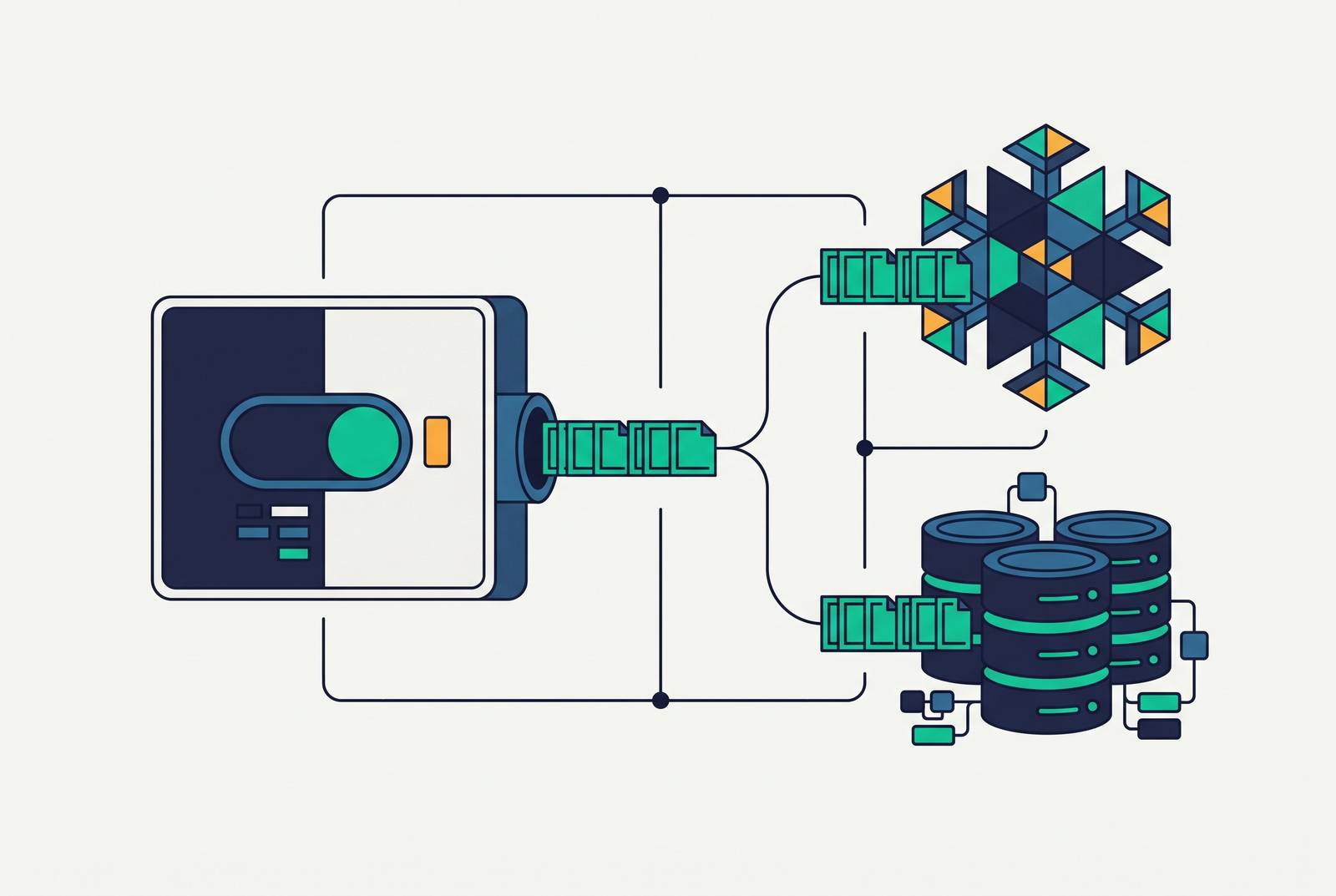
The mental model most people reach for, a live database connection between the SaaS product and the customer's warehouse, isn't how this works in practice. The standard architecture is a three-stage pipeline: the SaaS system exports data to object storage, that storage stages the files, and the warehouse loads them through a COPY command. No persistent connection, no direct query access into the vendor's production database. Just files, moved on a schedule.
Customer.io's Snowflake integration is a documented, real-world case of exactly this pattern. It exports parquet files covering deliveries, metrics, subjects, outputs, content, people, and attributes to an Amazon S3 or GCP storage bucket, syncing as often as every 15 minutes. From there, Snowflake, or Redshift, or BigQuery, pulls the files in through a COPY command, and the documentation advises setting files to expire once ingestion completes. It's a clean, almost boring pipeline. The pipeline being a clean, almost boring pipeline is the point.
The S3-intermediated design isn't an accident of convenience, either. Decoupling the export cadence from the warehouse's availability keeps the whole system resilient: the warehouse pulls when it's ready, not on-demand against a live connection, which also keeps transfer costs down. If the warehouse is busy or offline for a stretch, the files just wait in storage.
The choice of parquet as the file format is deliberate rather than incidental. It's columnar, it compresses well, and both Snowflake and Redshift support it natively, which makes it the sensible default for any analytical payload rather than a nice-to-have.
The first sync differs from every sync after it because of a real design decision. Customer.io's pattern sends the full historical dataset on the initial sync, then only changesets afterward. That distinction isn't cosmetic. It shapes how the schema gets designed, how deduplication logic works, and how much storage the whole arrangement costs over time.
Cadence also has to be an explicit conversation, not an assumption. Sub-60-second latency has become the bar for operational analytics use cases, and Customer.io's 15-minute cadence is entirely appropriate for audience and messaging data, but it would fall flat for anything real-time. A SaaS vendor offering export needs to say what SLA it's committing to, because "the data syncs" means something different to every customer asking.
Differences between Snowflake and Redshift that shape how you build the export
Treating Snowflake and Redshift as interchangeable destinations is a mistake that appears later, usually as a production incident. Their architectural differences create real constraints on concurrency, schema, and cost, and any export feature has to be built with those constraints in mind rather than discovered after launch.
Snowflake separates compute from storage through virtual warehouses, which means a SaaS product serving tenants with wildly different usage patterns can scale compute independently of where the data sits. It also handles semi-structured data natively through the VARIANT type, so JSON payloads can land without a pre-transformation step. That's a real convenience for teams exporting event data or nested attributes.
Snowflake's multi-cluster model adds virtual warehouses automatically when concurrency spikes, spinning up extra clusters to absorb overflow users, though there's a brief delay during the transition where response times aren't fully consistent. Every added cluster burns credits, and in an embedded context, where usage is consistent and growing rather than occasional, those credits add up faster than most cost forecasts anticipate. Budget for it, don't discover it.
Snowflake also has a hard structural limit: it runs entirely on public cloud, with no private-cloud or on-premises deployment option. For a customer with a genuine data-residency requirement, that's not a configuration choice, it's a wall.
Redshift sits differently. It's AWS-only, deployed inside a customer's own Amazon Virtual Private Cloud, with full VPC isolation requiring enhanced VPC routing to be enabled. For an AWS-native organization, that's a real security and compliance advantage, and AWS GovCloud via Redshift is the established route for regulated workloads that need to stay on sovereign infrastructure. Redshift's deep Zero-ETL integrations with Aurora, DynamoDB, and platforms like Salesforce eliminate entire pipeline stages for AWS-native teams, though it requires ongoing tuning, sort keys, distribution keys, vacuuming, and is less suited for spiky concurrency.
Even the security model differs at a level that matters for implementation. Snowflake enforces row-level security through policy objects and object-level access control, while Redshift uses CREATE RLS POLICY paired with IAM roles and database groups. Neither one hands a SaaS vendor a ready-made multi-tenant framework. Both require deliberate design work from the vendor's side. None of this points to a winner. It points to a requirement: an export feature has to be built to handle both targets, which is exactly the question the next section takes on.
The three implementation approaches and their cost to the engineering team
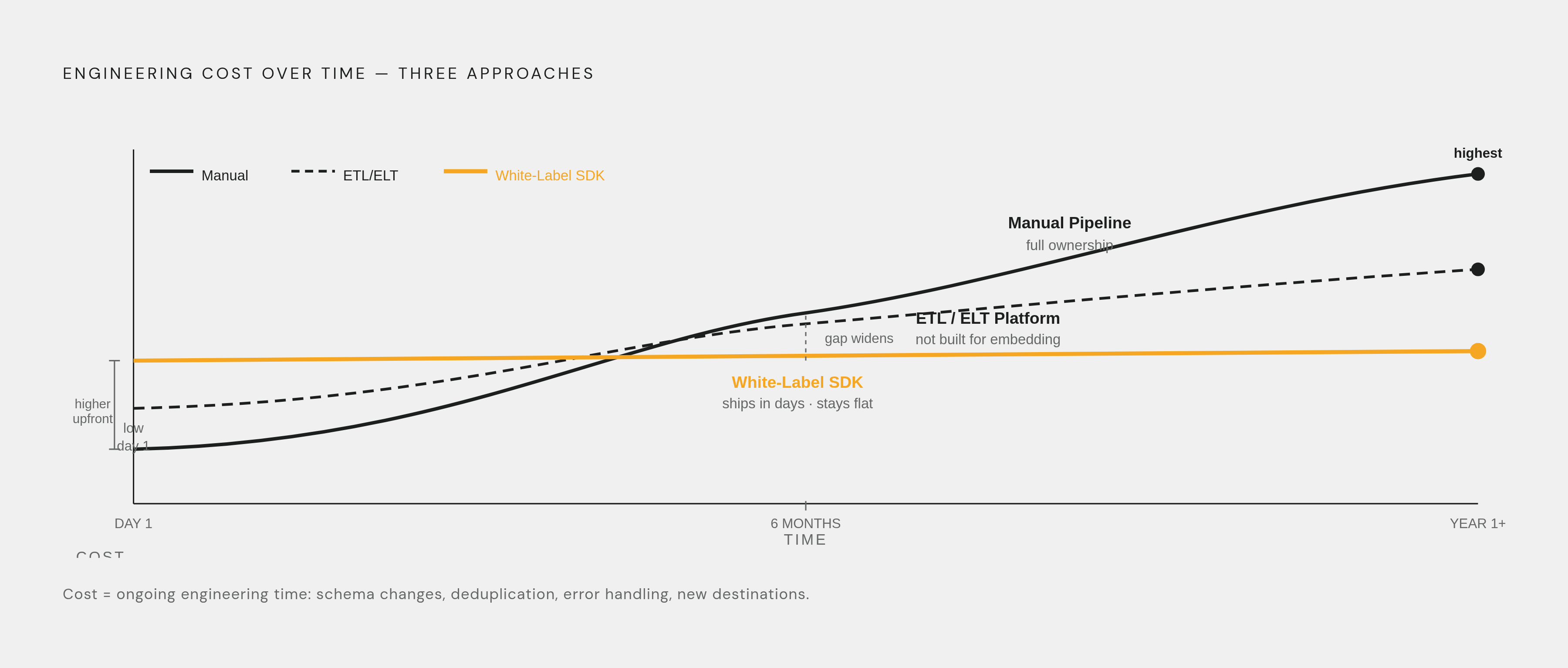
There are three real ways to build this, and the difference between them isn't mainly about how fast the first version ships. It's about how much engineering time the feature keeps consuming after launch.
The first approach is the manual pipeline: export to S3 using the SaaS system's own export logic, then load into Redshift via COPY or into Snowflake via COPY INTO. This gives maximum control and takes advantage of both warehouses' native parallel processing. The cost appears later, in the form of schema mapping, incremental logic, deduplication, error handling, and ongoing maintenance, all owned by the engineering team, for every new destination added down the line. It's the approach that looks cheapest in a sprint planning meeting and most expensive a year in.
The second is an ETL or ELT platform, the category of tooling built specifically to move data between systems at scale. These remove the need to write and maintain custom pipeline code, handle schema mapping automatically, and connect to a wide range of sources, well into the hundreds depending on the platform. Who they're built for is the catch. These tools are designed for the data engineering buyer configuring pipelines from an admin console, not for embedding inside a SaaS product as something an end customer clicks through.
The third approach is a white-label embedded data integration platform, one the SaaS vendor folds into its own product and surfaces under its own brand, handling the export pipeline, destination configuration, and scheduling on the customer's behalf. This is the approach that actually turns export into a product feature instead of a standing infrastructure project.
The mechanics of the embedding matter here, and they're easy to get wrong. An iframe-based approach to white-labeling often stops at surface branding: the colors match, but routing, responsive layout, and contextual actions inside the product still require extra engineering to feel native. SDK-native embedding, built through React components and a REST API, gets you actual product integration rather than a themed frame. A platform built around this pattern, offering an embeddable React SDK, a clean API, and support for Snowflake, Redshift, and other destinations, lets a team ship in days instead of quarters, and destination-based pricing means the vendor isn't penalized for customers who move more data. CData's Embedded Connectors and Embedded Cloud products are one named example of this category, including a partnership with Palantir Technologies to strengthen data connectivity inside Palantir Foundry.
The strongest case against building the manual pipeline, and the strongest case for the embedded approach, is the maintenance tax. The line between Snowflake, Redshift, and other platforms keeps getting more porous, and plenty of organizations run hybrid stacks rather than committing to one warehouse. A vendor that builds a clean export to one warehouse may face demand for the other within 18 months. Building the pipeline by hand means building it twice.
Security and compliance requirements that apply to any warehouse export implementation
None of the three approaches above gets approved by an enterprise security team without clearing a specific, well-understood bar. It's demanding, but it's not mysterious, and it's been cleared by plenty of vendors before.
The baseline is SOC 2 Type II certification, encryption at rest and in transit, role-based access control, and audit logging, and enterprise procurement teams increasingly treat SOC 2 as table stakes rather than a differentiator. Row-, column-, and field-level security follow naturally once those certifications are in scope.
Data residency deserves its own line item because the warehouse choice itself constrains the answer. Snowflake runs entirely on public cloud, with no private or on-premises option, so a customer with a hard residency requirement and a Snowflake environment has a real limitation to work around. AWS GovCloud via Redshift, by contrast, is the established pattern for workloads that must stay on sovereign infrastructure. When residency is a genuine hard requirement, private-cloud deployment of the export layer itself, not just the warehouse, is the answer that actually satisfies procurement.
Multi-tenancy adds another layer that's easy to underestimate. Row-level security on Snowflake runs through policy objects; on Redshift, through CREATE RLS POLICY paired with IAM roles and groups. Neither platform hands a vendor a finished multi-tenant framework, which means the SaaS vendor's export feature has to enforce isolation at the application layer itself, rather than assuming the warehouse will do it automatically.
Then there's a detail that appears in procurement conversations more than any whitepaper predicts: IP allowlisting. Customer.io's Snowflake integration requires specific outbound IP addresses to be allowlisted, with separate lists maintained for US and EU regions. It's a small operational fact, but it's exactly the kind of thing a security reviewer asks about in week three of a vendor assessment, and it needs to be documented clearly rather than discovered on a call.
AI agents and changing data access for customers who use these warehouses
That's no longer the whole picture. AI agents that can query Snowflake or Redshift directly, in natural language, are raising the stakes on both data quality and access control, and self-serve export now has to account for a reader that isn't human.
In November 2025, Snowflake introduced Snowflake Intelligence, an enterprise AI assistant that lets users query structured and unstructured data in natural language, built with agentic AI capabilities alongside governance and Model Context Protocol support, so organizations can connect AI agents to enterprise data without giving up oversight, at least in principle. The Snowflake MCP server is the mechanism: agents including Claude, Cursor, ChatGPT, and custom agents reach into the warehouse through the Model Context Protocol, running natural-language-to-SQL through Cortex Analyst and semantic retrieval through Cortex Search. On May 27, 2026, Snowflake announced a definitive agreement to acquire Natoma, an enterprise MCP platform for AI agents, aiming to stretch its governance perimeter beyond data assets to cover AI actions and interactions across the enterprise.
The risk that produces this is real and, as of now, largely unresolved. Dynamic data masking only helps if every sensitive column already has a masking policy attached directly, or, in the tag-based approach, is both tagged and bound to a masking policy, and in practice that coverage is rarely complete across hundreds of tables.
For self-serve export, the implication is direct: data a SaaS vendor writes into a customer's warehouse will increasingly get queried by agents acting on that customer's behalf, not just by a human analyst, so the schema, the tagging, and the access controls have to be designed with that reader in mind from day one. An embedded pipeline that syncs structured data into a customer's warehouse isn't just powering a dashboard anymore. It's laying the foundation for whatever agent-driven product experience comes next.
Self-serve export as a feature customers adopt rather than work around
Everything above, the pipeline mechanics, the warehouse differences, the security bar, how AI agents access data, converges on one practical test: does a customer configure this feature and forget about it, or does the customer quietly build a workaround because the feature got in the way?
Adoption comes down to discoverability and control. Customers need to set their own destination credentials, pick their own sync cadence, and check export status without opening a support ticket, which means the feature has to live inside the product itself, not in some separate admin console that requires a different login.
Schema predictability affects whether customer models keep working. Customers build models and dashboards directly on top of exported data, and an unannounced schema change breaks those models silently, sometimes for days before anyone notices. Treating schema stability as a product commitment, not an internal implementation detail that can shift with the next release, is what separates a feature customers trust from one they double-check before every quarterly report.
The initial sync versus incremental sync distinction, the same one Customer.io's pattern illustrates with full historical data on the first pass and changesets after, isn't just a technical footnote either. It's the thing that determines whether a customer's first experience with the feature is "it worked, and now it just runs," or an early failure that colors every interaction after it. Get the first sync right, and the feature becomes infrastructure the customer stops thinking about, which, for a feature like this, is the actual goal.
Sources
- Snowflake | Customer.io Docs
- Embedded Data Integration Best Practices for 2026
- Snowflake moves up the AI stack – but the System of Intelligence is still being built - SiliconANGLE
- When your Snowflake AI agent can query everything you can query | Identity Defined Security Alliance
- Snowflake Integration Patterns for AI Agents: Customer Warehouses, Secure Sharing, and Real-Time Read Paths