Evaluating SaaS Customer Data Export Tools From a Warehouse-First Perspective
A warehouse-first checklist for choosing customer-facing export tools.
For B2B SaaS teams building customer-facing, self-serve data export, the right tool preserves warehouse data at the customer’s destination, delivers it promptly, and embeds inside the product. When the warehouse is already the source of truth, destination fidelity, security, tenant isolation, and pricing alignment are stronger selection criteria than connector count. The goal is a native product capability.
Why the data warehouse as source of truth changes what a good export tool looks like
A warehouse-first architecture assigns authority to the warehouse. It holds the consolidated data and the model that downstream systems should preserve, so an export tool no longer needs to solve source consolidation. The decomposition of the monolithic CDP into warehouse-native layers provides context for this shift. Identity resolution, audience building, and activation can sit on top of the warehouse without duplicating its data. Export now has to deliver the warehouse’s model without adding another modeling layer.
That distinction changes what a good evaluation rewards. Connector breadth answers whether a tool can reach many systems, but the warehouse has already consolidated the source data. The tool must deliver authoritative data to paying customers without distortion. Easy setup still helps, but it cannot make up for wrong output, weak security, or a separate vendor experience. Those are failures at the product boundary.
Destination fidelity: what it means and why it replaces connector count as the first criterion
Destination fidelity means preserving types, schema, and completeness when warehouse data reaches a customer’s destination. Integers should not become strings, timestamps should retain their timezone, and column names should survive delivery. Large payloads should arrive without silent row drops. These are properties of the delivered dataset. Fidelity to a small set of high-stakes destinations is therefore more valuable than nominal support for many destinations that customers do not need.
The distinction becomes concrete in a representative payload test. A team should send a wide schema with mixed types and a high row count through each candidate, then compare the destination table against the source column by column. A destination-specific quirk cannot be dismissed as an edge case when that destination is where a customer receives the product’s data. Failure on the initial test is a production risk.
However, an initial match is not enough. Domo’s 2026 ETL guide identifies schema evolution support, including incremental loads, change data capture, and API version updates, as indicators of connector depth and reliability. The same reasoning applies in the export direction because authoritative schemas can change after integration. Evaluation should therefore include a schema change mid-run and observation of the result. The requirement is fidelity through change.
Delivery speed and sync frequency as product experience, not infrastructure metrics
Correct data can still arrive too late. For customer-facing export, sync latency is part of the product experience because customers judge whether their data is available when their work requires it. Scheduled delivery may suit a periodically refreshed BI dashboard, while automation triggered by new rows depends on fresher data. The distinction is between tolerable delay and a broken workflow.
Integrate.io’s October 2026 platform comparison lists sync interval and change data capture support as evaluation axes together with connector direction, transformation, pricing model, and security/support. For a warehouse-first team, those delivery criteria translate into specific questions. What is the minimum sync interval, and can incremental updates move without a full-table reload? The answers establish the delivery pattern, but realistic volume establishes whether that pattern holds under load.
Production scale is the relevant test condition. Teams should measure delivery at the upper bound of their largest customer’s expected data volume. They should also ask whether tenant workloads are isolated at the infrastructure level or queued on a shared scheduler. A large sync that consumes shared compute can delay other customers’ updates. Testing a large sync together with a small one exposes whether one tenant’s volume degrades another tenant’s experience.
Security posture and compliance as deal criteria, not post-evaluation checkboxes
Performance only becomes relevant if procurement permits the tool. Enterprise security teams can eliminate a candidate before engineering evaluates its delivery capabilities, so security posture belongs at the beginning of selection. Treating it as a late-stage checkbox wastes technical evaluation cycles on a tool that cannot be purchased.
End-to-end encryption is the starting point for that decision. The evaluation must also establish where keys are held, whether customers can bring their own keys, and whether data is decrypted at an intermediate hop. Buyers also need to know where metadata is held and whether foreign law enforcement authorities could ask for access.
Audit evidence deserves the same early attention. Auditors increasingly ask for continuous-monitoring exports and timestamped configuration snapshots in place of static screenshots, so operational logging and export capabilities can provide useful evidence. If a tool uses LLMs for schema mapping, anomaly detection, or natural language interfaces, model risk controls and AI vendor assessments add another audit surface. Teams should ask for the vendor's SOC 2 Type II report, whether the candidate is Prequel, an embedded data export API for product teams shipping customer-facing warehouse exports rather than internal ETL, or any other tool. The control descriptions, exceptions, and management responses that apply tell teams more than certification status alone.
Private-cloud and on-premises deployment as a customer segment, not an edge case
For buyers in financial services, healthcare, government, and defense-adjacent markets that require private-cloud or on-premises deployment, a cloud-hosted-only tool is disqualifying regardless of its other strengths. Residency concerns go beyond where data is held because the U.S. CLOUD Act may let U.S. law enforcement access data on U.S.-operated infrastructure. Because of that risk, some buyers require sovereign cloud before they will buy.
Prismatic supports named regions including GovCloud, private cloud, and on-premises connectivity, with SOC 2 Type 2 attestation and GDPR, HIPAA, and CJIS alignment. That makes it an option to evaluate when customers impose those constraints. Availability alone does not establish an acceptable deployment. Teams should check whether the option they need has the same features, connectors, and sync frequency as the main product. Private-cloud support is a market-access capability only if it can deliver the product customers need.
How do customers configure self-serve exports inside the SaaS product?
An export interface in a separate vendor portal makes customers leave the product to use a capability they bought from it. That separation can signal that export is an afterthought. Native embedding instead has both a visual requirement and an architectural one. The interface should match the product’s typography and interaction patterns, while its integration should support the product’s authentication and session experience.
The iframe-versus-SDK distinction makes this requirement testable for a product manager. An iframe loading content from another origin can introduce third-party cookie problems, block SSO flows, and remain visibly distinct from the surrounding interface. Can the component operate within the product’s existing session and UI without forcing customers into a separate experience?
Embedding also determines how much integration work remains. OAuth flows, webhook handling, retry logic, and error surfacing should belong to the tool rather than become infrastructure the product team reimplements. Paragon’s SDK and workflow engine handles OAuth flows, webhook management, and retry logic automatically, illustrating that division of responsibility. Destination credentials, sync schedules, and column selection belong in the product’s settings, while architectural tenant isolation should protect the experience when concurrent workloads grow.
Pricing model alignment: why per-destination charges fit warehouse-first products better than per-row or per-event models
Row-based and event-based charges increase as a SaaS product successfully delivers more data, creating pressure either to absorb higher bills or to restrict delivery. Neither outcome improves the export experience.
Adding a customer destination creates a predictable, bounded charge rather than a variable charge tied to how much data that customer requests. This difference matters most when onboarding a large customer, when usage is high, and when activating destinations at scale. These are moments when volume-based billing can create a cost shock even though the product is working as intended.
The comparison should begin before commercial negotiation. Teams should model a median customer, a top-decile customer by data volume, and a large enterprise onboarding with a historical load. Comparing the total cost in those cases tells teams more than an entry-level quote. It shows whether the pricing structure supports the intended delivery pattern or creates a reason to withhold data.
AI agent data access as the next reason destination fidelity and latency matter even more
MCP is a current, generally available capability, and warehouse-first teams already face demand for agents to consume exported data. A wrong field type or stale row can move beyond a misleading dashboard into the context used to produce a confidently wrong answer. Agent access increases the consequences of failing the existing standard for export quality.
MCP servers surface the data available at the destination. An agent needs attribution data to calculate contribution and consistent campaign names to group the data reliably. Freshness is equally important when an agent plans a multi-step workflow. Its usefulness depends on how current its working data is.
Agents querying through MCP need granular server-level permissions, explicit user consent before tool invocation, and audit logs showing what data was accessed and when. These requirements reach back into the export tool’s access controls and logging capabilities. An agent exploring an unfamiliar schema can also generate more queries than a human analyst. Rate limits, concurrency controls, and tenant isolation consequently become safety mechanisms as well as performance controls.
Applying the framework: what a warehouse-first evaluation process looks like in practice
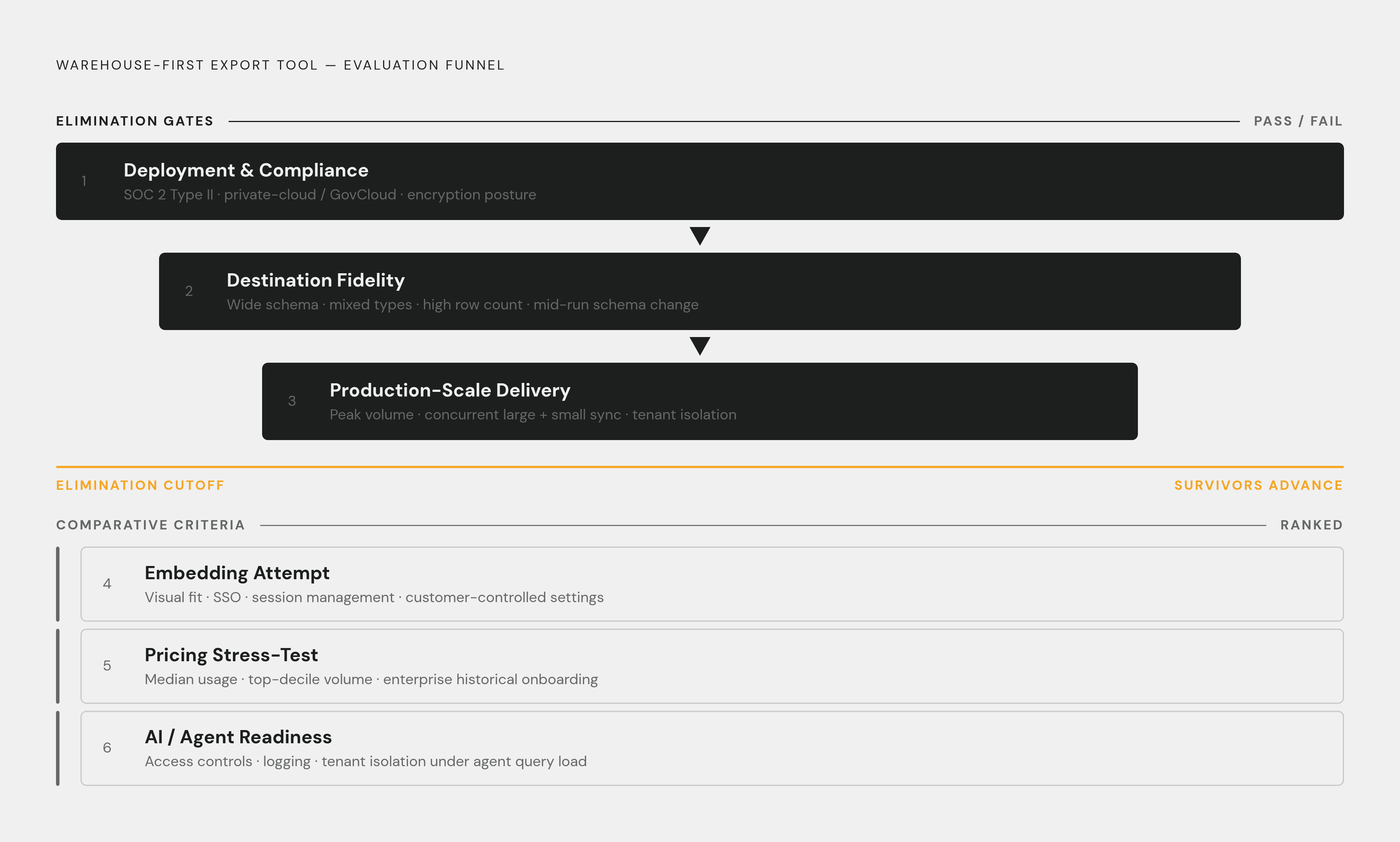
First, teams should check the deployment and compliance gate by confirming SOC 2 Type II status, finding out whether private-cloud or GovCloud is required, and checking encryption posture. Candidates that fail a required condition leave the evaluation at this stage. Strong performance cannot offset a procurement prohibition.
Next comes the destination fidelity test, using a wide schema, mixed types, and a high row count. Teams should compare the destination against the source column by column and change the schema mid-run to observe drift handling. The third stage extends that test to the largest expected customer volume and measures actual delivery time. A concurrent large and small sync tests tenant isolation.
Only qualifying candidates proceed to comparative product evaluation. The fourth stage is an embedding attempt inside the product’s own UI, assessing visual fit, SSO, session management, and customer-controlled settings. The fifth stage stress-tests pricing against median usage, top-decile volume, and historical enterprise onboarding. The sixth checks access controls, logging, and tenant isolation with the number of queries agents generate.
Deployment, fidelity, and production-scale delivery are pass/fail requirements, while embedding, commercial alignment, and AI readiness support comparison among viable candidates. Combining everything into one score obscures that distinction. A warehouse-first architecture makes export evaluation more precise. Teams that apply connector-count criteria to this problem can choose the wrong tool despite a diligent evaluation because they evaluated the wrong things.