Which Data Integration Tools Actually Charge by Destination Rather Than by Row or Volume
A strict test separates true destination pricing from lookalike models.
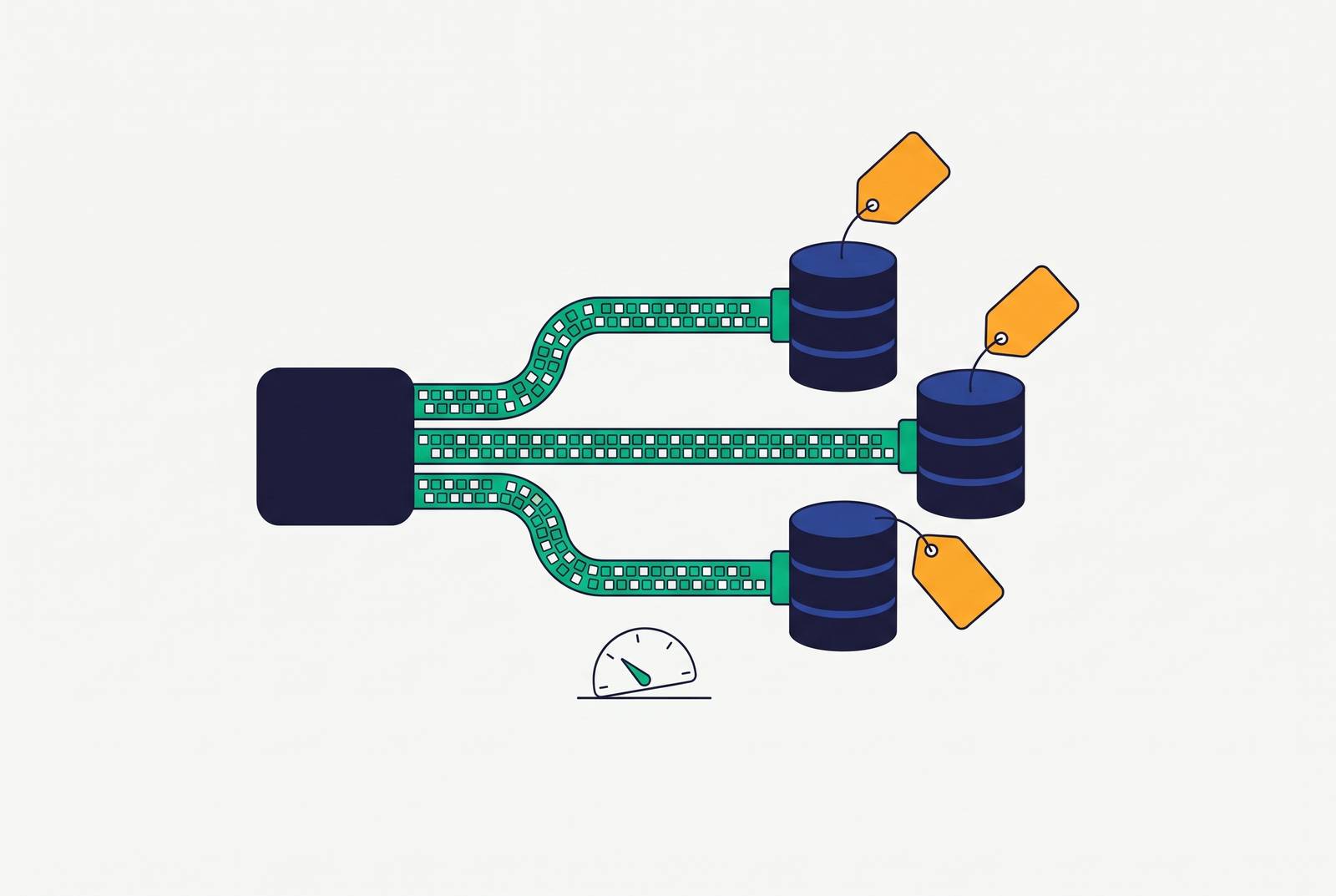
Destination-based pricing for data integration bases the bill on the destinations that are configured, regardless of the rows or data volume moved. Nango, Paragon, Celigo, and another vendor use related connection, instance, connected-user, or endpoint-and-flow models, but these are not interchangeable with pure destination pricing. To test the model, check whether moving more data to the same destination changes the bill, including any added compute or transfer charges.
How most data integration tools actually bill — and why "predictable pricing" rarely means what it says
A team syncing moderate data volume can still face rising integration costs if it runs pipelines frequently. The dataset need not become substantially larger. When billing follows activity runs or compute time, repeated syncs create consumption even though the team still connects the same systems. A monthly price that looked adequate during onboarding can therefore prove a poor guide to the eventual invoice.
Most data integration tools advertise predictability while metering rows, events, Monthly Active Rows, or data-transfer volume. These metrics make growth a billing variable. More frequent pipelines, larger sources, and backfills can increase consumption, although the trigger depends on the meter. The gap is structural rather than evidence of vendor bad faith, because a clearly published usage rate can still produce a variable monthly bill.
Azure Data Factory charges per activity run, per compute-unit hour for data movement, and per vCore-hour for data flow execution, while AWS Glue charges per compute-unit hour. Even without row-based pricing, the bill can grow as more data moves. Estuary's 2026 platform comparison treats pricing predictability, including the billing metric, published entry price, and causes of cost increases, as one of six core evaluation criteria. Integrate.io's 2026 roundup likewise notes that pricing models differ more than features and advises teams to model real volume before comparing headline prices.
What destination-based and connection-based pricing actually meters
Destination-based and connection-based pricing charge for configured endpoints or active integrations. The unit is the distinction. Cost changes when the number of billable connections or destinations changes.
However, a connection is not always a destination. In embedded iPaaS, the billing unit can be an authorized user account or OAuth token, an integration instance deployed to one customer tenant, or a connected user representing a tenant organization. In warehouse-sync platforms for SaaS product teams, the unit is a customer warehouse or database configured to receive exports. Several integrations for one customer can count as several billable units, or the customer organization itself can be the unit.
Does the tool's bill change if the team doubles the rows moved to the same destination? If so, it is not genuinely destination-based in the strict sense used here. A pure model charges the same per destination whether a customer's CRM or ERP syncs a thousand rows or far more, and the bill grows with the number of destinations.
Which data integration tools charge by connection or destination?
Nango is a connection-based embedded iPaaS, with one connection defined as one authorized user account represented by an access token or API key. Its pay-as-you-go pricing applies per connection, and its free tier covers up to 10 connections, 10 compute hours, and 10 GB per month. It covers 900+ APIs. Separate compute-hour and egress-transfer meters make it destination-adjacent rather than purely flat, since frequent syncs can add compute charges and large payloads can add egress charges. Connection count is the primary variable cost driver, but it is not the only one.
Prismatic has an instance-based embedded iPaaS model, in which one instance is one integration deployed to one customer. Scale and Enterprise plans offer volume per-instance pricing. Team members, customers, integrations, and connectors are unlimited and are not separately metered. The distinction is between those unlimited categories and the deployed instances that generate charges. All tiers require a quote, and no dollar figures are published, so the billing unit is clearer than the eventual contract price.
Paragon meters Connected Users, defined as customer organizations that have connected and are using integrations. All plans have custom pricing, with no published per-user rate. Paragon has repositioned toward AI-native products, adding RAG ingestion and AI-agent tool calling, so buyers must distinguish its product capabilities from what creates a billable unit.
Celigo uses an endpoint-and-flow-based iPaaS model. Its Standard, Professional, and Enterprise editions are quote-based. It is known for prebuilt integration apps across NetSuite, Salesforce, Shopify, and Amazon. Integrate.io's roundup categorizes it as an iPaaS for application integration, which separates its role from a warehouse-export service. Its endpoint-and-flow structure belongs in this comparison, but it should not be read as a simple charge for each customer warehouse.
Destination-based warehouse sync is a distinct category for SaaS teams importing or exporting data to customer-owned warehouses, databases, and object storage. Here, the configured destination is the billing unit. This is the model most directly aligned with embedding customer data connectivity as a product feature, because adding a destination has a fixed cost regardless of rows moved. It solves a different problem from embedded API integration. A buyer who needs warehouse delivery must first check what kind of product it is before comparing its price with charges for connections, instances, or connected organizations.
Tools that look flat-rate but are not genuinely destination-based
A flat monthly fee tells a team when it pays but may leave open how the bill is worked out. It can include a row allowance, a Monthly Active Rows limit, or a usage threshold that triggers an upgrade. “Unlimited at this tier” also requires a precise definition. If that promise applies only within a defined limit, growth can still change the bill without adding a destination. The relevant distinction is between a fixed fee for an amount of usage and a fixed fee for a configured endpoint.
Secondary meters create a similar ambiguity even when the primary unit is a connection. Nango's compute and egress charges illustrate why a connection count alone is insufficient for forecasting high-frequency or large-payload syncs. Cloud-native tools make the distinction more explicit through activity and compute meters.
The due-diligence test is to change one variable at a time, including doubling row volume, doubling sync frequency, and adding ten customers. Each change answers a different question. A price increase from more rows or more frequent syncs exposes consumption sensitivity, while an increase from new customer destinations can be consistent with genuine destination pricing. The latter still means the total bill is not flat.
Why destination-based pricing fits B2B SaaS product teams better than usage-based alternatives
B2B SaaS customers can differ enormously in data volume while paying similar subscription fees. One enterprise customer may move a hundred times more data than a mid-market customer. With usage-based integration pricing, that difference can make infrastructure costs much higher for one customer even when the revenue is much the same.
Destination-based pricing changes that relationship by fixing the charge for each added customer destination. This makes it easier to plan how much each added integration will cost, even for a data-heavy customer. The benefit is strongest for products whose customers each bring their own warehouse or database, since the billable unit follows a customer-facing feature.
Embedded iPaaS can offer a related alignment, although its unit still needs careful interpretation. Prismatic does not separately meter team members, customers, integrations, or connectors, but deployed customer instances remain billable. Adding tenants or integration types can thus raise instance costs even when there is no volume-based charge. Integrate.io's 2026 platform guide distinguishes loading a warehouse, transforming data in flight, governing an enterprise estate, and connecting applications, reinforcing that the pricing model must follow the job the product needs done.
What security and compliance requirements do to tool selection when pricing is otherwise equal
Security and compliance limit which tools a team can choose before it weighs tools with similar prices. Even if the billing unit fits, the deployment boundary still has to meet the team's needs. SOC 2 Type II, HIPAA, GDPR, and private-cloud requirements filter which platforms can handle a customer's data under the required conditions. For B2B enterprise procurement, SOC 2 Type II has become a requirement rather than a differentiator, with tools lacking it effectively excluded from shortlists.
Paragon holds SOC 2 Type II, is HIPAA compliant with a BAA, and is GDPR compliant. It can run in shared cloud, customer VPC, or full self-hosting. Those options address different levels of control over where data travels. Private-cloud and self-hosted deployments matter most when data must stay within a set perimeter, as it often must in healthcare, financial services, and SaaS products sold to regulated enterprise buyers.
Nango places some of these capabilities at specific plan levels. HIPAA with a BAA and SAML SSO are first available through the Growth add-on and are also included in Enterprise. Enterprise adds SCIM and supports self-hosting and bring-your-own-cloud on AWS, GCP, or Azure. Plan eligibility therefore affects the comparison. A connection price from one tier is not an adequate basis for selection if the required deployment or compliance features belong to another.
How to evaluate a tool's pricing model before signing a contract
A team reviewing a contract should stress-test the billing model with its own usage. Start by keeping the same number of destinations and doubling the rows. If the bill changes, the model has volume exposure. Then increase sync frequency from hourly to every few minutes, because a resulting increase reveals activity-run or compute-hour sensitivity. These tests separate charges for having a connection from charges for using it.
Next, ask whether a new customer who moves no data yet creates a charge. That question tests when billing begins. A charge at that point can indicate destination or connection metering at provisioning time, which may precede the point at which the customer receives value. This reveals whether the contract's billing event aligns with the product's onboarding process.
Ask vendors for a sample invoice from a customer with a similar profile, including row count, destination count, sync frequency, and whether backfills have run. The invoice should make secondary meters visible. For embedded use cases, work out the bill for the current number of customers and for multiples of that number that matter to the team, using the quoted connected-user or instance rates and any volume discounts. A low starting price can become expensive at scale even without row-based billing. Estuary's comparison treats the causes of cost increases separately from entry price, which is the distinction this exercise needs to preserve.
The goal is to choose a cost model aligned with product growth. A destination-based contract may charge more upfront while staying flat as data volume grows across the same destinations. Over a three-year contract, that steady price may make it far cheaper than a usage-based option whose charges grow with use. The contract comparison should establish which growth the team expects and exactly which parts of that growth the vendor will bill.