Why ETL Costs Spike at Scale and How Destination-Based Pricing Keeps Your Bill Flat
Flat destination pricing decouples your integration bill from data volume.
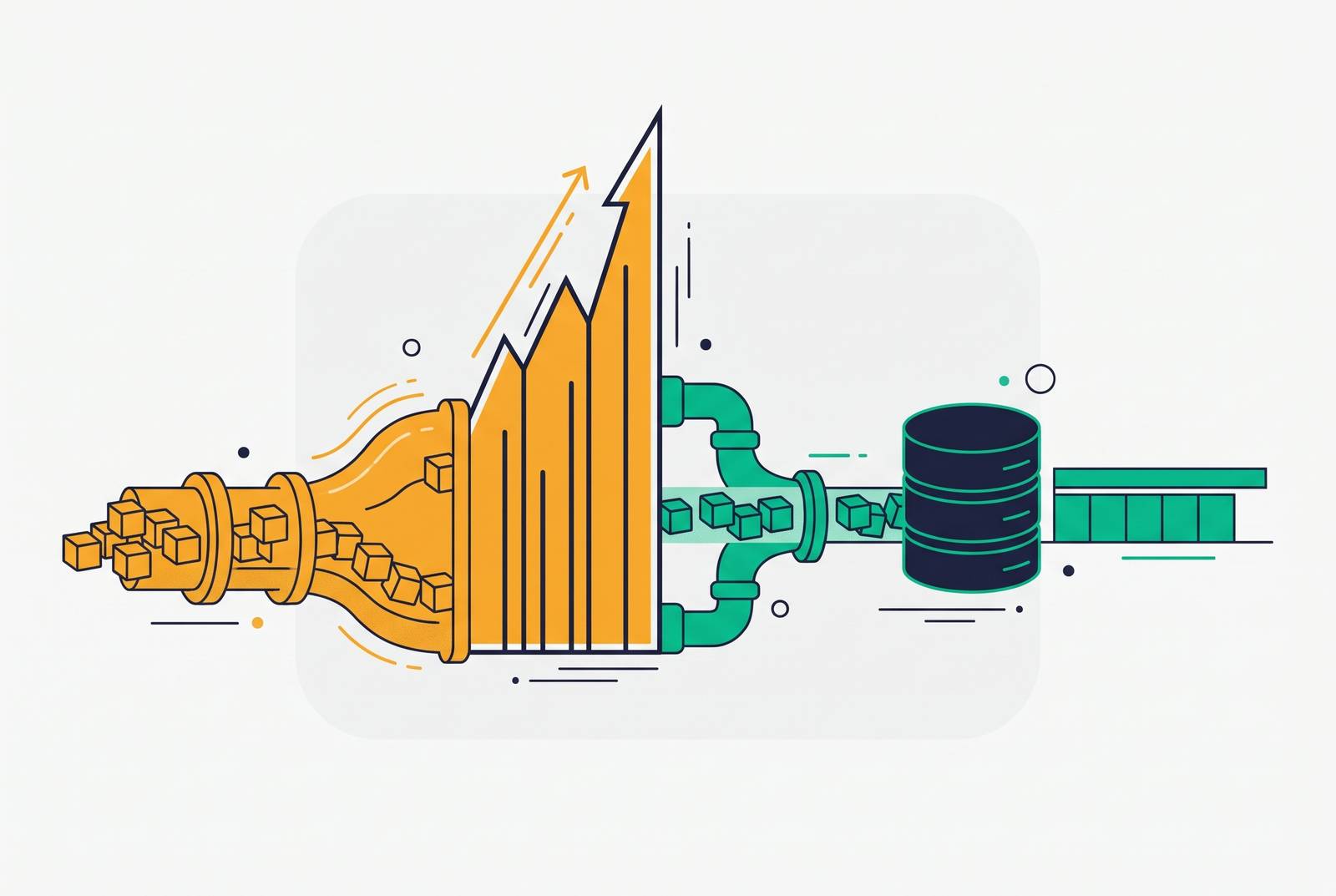
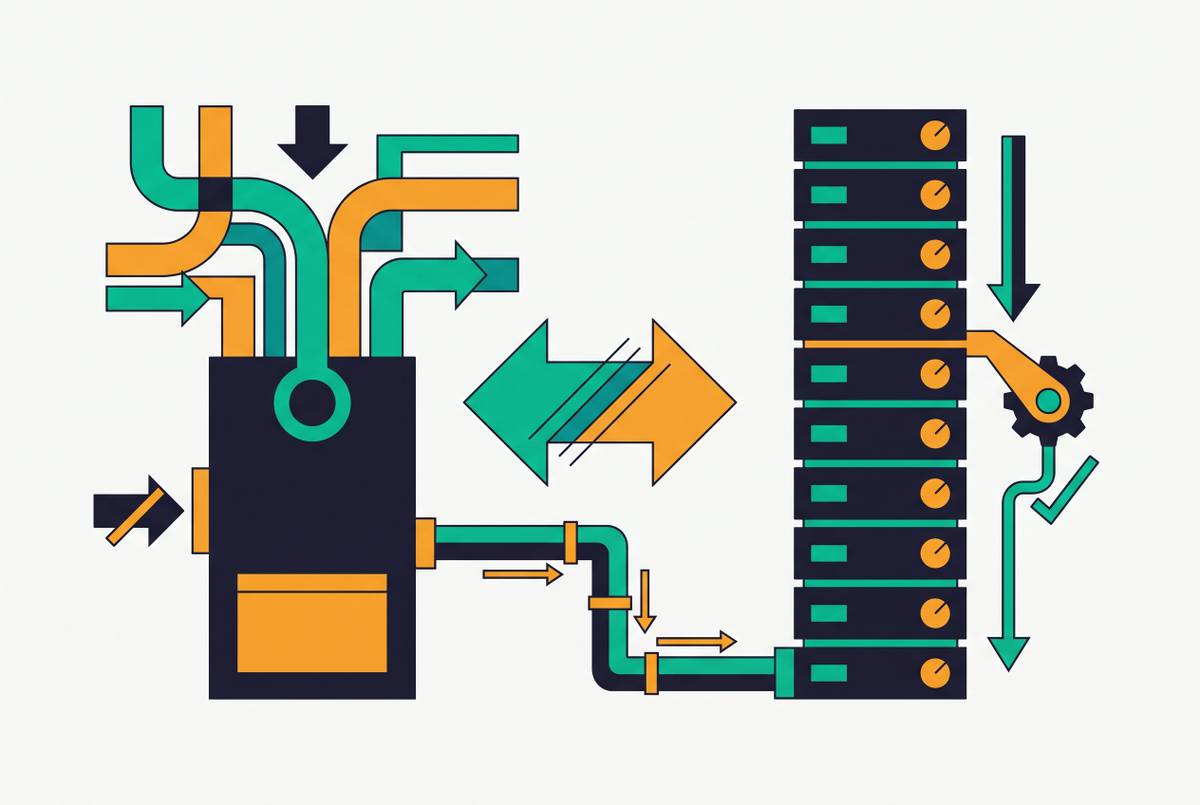
Destination-based pricing for data integration charges by destination rather than by rows, events, or credits consumed. Under a flat destination model with unlimited pipelines and data volume, the integration fee stays the same as more data moves, as long as the destination count stays the same. This removes the consumption charges that cause ETL bill spikes, but infrastructure and engineering costs still need to be assessed on their own.
Why ETL bills grow faster than the data they move
An ETL bill arrives at a multiple of last month’s total, despite roughly the same business activity. Business activity and billable processing are not equivalent. A source can require repeated updates, a historical reload, or a full re-sync without producing a corresponding increase in business value. When the pricing model charges for that work, the invoice reflects processing activity, while the forecast is based on business growth.
The mismatch grows as organizations grow because they have more users, more complex services, and more data at the same time. More users use more services, while larger datasets need to move through more pipelines. The number of processed rows can therefore grow exponentially rather than linearly, far beyond what an estimate based on earlier usage would suggest.
Traditional pricing offers two broad responses to that growth, which are fixed-seat or capacity arrangements and pay-as-you-go consumption. Each exposes a different constraint at scale. Fixed capacity creates processing bottlenecks when limits are reached, while pay-as-you-go allows usage to expand into a cost spiral. Both models can be honest about their charges, but neither ensures that spending tracks the work that brings business value. The apparent affordability of a rate depends on how its billing unit behaves under the actual workload.
How each billing unit creates its own cost trap
Monthly active rows, event-based billing, row-based tiers, credits or capacity, and compute-hours expose different workload risks. The unit determines which activity becomes expensive. High-churn tables and delete-heavy sources can inflate MAR or event counts, while row-based tiers expose growing workloads to higher pricing bands. Comparing headline rates misses these differences because each rate is for a different kind of work.
Event-based billing counts every record written to the destination each time it is written. Repeated updates therefore accumulate charges on the same row. That makes insert-dominant workloads a good fit, while operational sources with frequent data changes can cost more than they would under MAR. The distinction is not simply dataset size, but how often the platform bills activity against that dataset.
Credit and capacity models expose teams to another trap when a schema change forces a full re-sync of a large table. That event can generate a four-figure one-time charge. The billing consequence comes from the reload triggered by the schema change. This makes a vendor’s re-sync billing policy part of the financial risk of approving a migration.
Compute-hour models, such as AWS Glue, instead charge according to job runtime and cluster size. Job frequency and over-provisioned DPUs increase the bill. Forgotten development endpoints create another source of spend because they have no auto-timeout and continue billing until manually shut down. There is no separate software licensing fee, but jobs bill from the first second, and infrastructure and engineering time usually dominate the real cost.
Why the problem becomes unmanageable at fifty or more pipelines
At fifty or more concurrent pipelines, these traps make it hard to budget for the whole system as well as for each expensive job. Integrate.io says per-connector, per-active-row, and per-credit charges compound across dozens of pipelines at the same time. Optimizing one connector can reduce its contribution, but it cannot remove the billing mechanism operating across the rest of the network.
Steady-state usage also becomes a less complete description of what the team pays for. Volume spikes, backfills, and historical reloads sit above the normal processing load, yet initial estimates often omit them. Their timing is outside the billing cycle’s control. A source outage, schema migration, or new client onboarding can trigger recovery or reload work, with credit-based models turning that work into a lump-sum charge.
The resulting volatility pushes all-in cost per pipeline above steady-state cost per pipeline. That gap widens as pipeline count grows. A three-month trend in effective cost per pipeline shows whether the platform is becoming less efficient as the network expands, even when individual connectors appear reasonably priced. When the cost per pipeline rises, adding pipelines has failed to bring the savings the team expected.
Contract structure can compound the problem at the same stage. There are often few plans between the low self-serve tiers and the large annual enterprise contracts. Growing teams can hit that gap before they are ready for an enterprise-volume commitment. They then face both an unpredictable consumption profile and a larger contractual obligation.
Hidden costs that never appear in the pricing page comparison
Even a correct consumption forecast understates the full cost of operating the stack. Engineering time is the largest hidden expense. Debugging failures, managing schema drift, coordinating re-syncs, and writing one-off connectors consume hours that grow with pipeline complexity independently of data volume. A usage invoice leaves out all that labor, though adding more pipelines drives both costs.
Development adds another layer because building pipelines can consume the infrastructure used to run them. Under just-in-time compilation models, writing a model, fixing a bug, and testing the fix each consume data warehouse compute. Development and production costs are therefore intertwined. A license comparison that counts only scheduled processing leaves out the repeated work needed to make that processing reliable.
Transfers between regions or outside a cloud environment incur egress charges that scale with volume. Data gravity explains why this becomes an architectural constraint. As datasets grow, moving processing to the data becomes cheaper than moving data to processing, while cloud-only architectures that pull everything into the warehouse work against that principle.
Compliance adds private networking, data residency configurations, and audit logging that base consumption pricing does not include. These are deployment requirements. Consumption pricing also changes behavior when expanding a dataset or testing a model requires a larger budget. Teams can self-censor experiments, so the cost extends beyond invoices and engineering hours to slower time-to-insight.
What destination-based pricing actually changes about the cost structure
A flat destination model removes the billing link between data activity and the integration fee. Backfills, re-syncs, and schema migrations do not increase that fee when they leave destination count unchanged. Updates, deletes, and workloads with frequent data changes no longer attract a premium because rows and events are not the billing unit.
Adding pipelines to existing destinations does not increase a flat fee that includes unlimited pipelines and data volume. Integrate.io describes this fixed-fee structure in its pricing analysis. Effective cost per pipeline falls as the number of pipelines grows because more pipelines share the same fee.
With the destination model, repeated writes and insert-dominant activity are billed the same way, while event billing charges them differently. Compared with credits, it removes reload-driven integration charges. Compared with compute-hour billing such as AWS Glue, it makes the integration fee independent of job runtime, though it does not make underlying infrastructure free.
Adding destinations can change the price, and warehouse compute, egress, and engineering work have their own costs unless the offering covers them. Experiments and new client sources can use existing destinations without adding to the integration bill. The team no longer needs to budget extra rows or credits merely to test an additional sync.
Is destination-based pricing cheaper for your specific workload?
Pull invoice totals for the last three billing cycles and divide each total by the pipeline count active during that cycle. Track the result as a trend. This shows whether effective cost per pipeline is rising as the network grows, which is the compounding risk that a flat destination fee removes.
Next, separate routine processing from exceptional activity. Flag billing periods containing a backfill, migration, or historical reload, then recalculate cost per pipeline excluding those periods. The gap measures exposure to billing volatility. Because a flat destination model does not charge extra for those events when destination count is unchanged, the all-in figure is essential to a fair comparison.
Then identify how the current billing unit responds to the expected workload. Row-based, credit-based, and connector-level charges each compound in their own way as more pipelines are added. Compare that consumption trend with a flat destination-based reference price for the required destination footprint. The intersection identifies the pipeline count at which flat pricing becomes cheaper, rather than assuming that every growing workload crosses the threshold at the same point.
High-churn sources such as orders, sessions, and inventory make the case especially strong when updates and deletes inflate MAR or event counts. Multi-tenant SaaS products create a different route to the same result because each customer requires a separate pipeline. Pipeline count follows the customer base in that case. Finally, include engineering time spent managing schema drift, monitoring MAR per connection, and handling re-sync billing, since a lower consumption rate can still produce a higher total cost. A flat fee removes billing management tied to consumption, but it should not be credited with eliminating operational work the platform still requires.
What to require from a destination-based integration platform before committing
A purchasing decision should treat predictable pricing as one of the requirements for enterprise deployment. Require SOC II Type 2 certification, end-to-end encryption, and role-based access control as security baselines. The deployment options must also meet the rules for data residency. Private-cloud or customer-managed deployment is necessary where strict sovereignty constraints rule out a cloud-only platform, while on-premises or customer-VPC execution can avoid costly locality workarounds.
Private networking needs its own review because the path data takes affects how exposed it is and what it costs. Require appropriate options such as PrivateLink, VPC peering, or private endpoints to keep data off the public internet and eliminate the associated category of egress cost. The deployment model must support the pricing promise.
Manageable engineering work alongside predictable licensing depends on developer experience. Require an embeddable SDK and a clean API so that connectivity can ship as a product feature, avoiding a bespoke infrastructure project. For customer-facing SaaS integrations, require white-label control under the product’s own brand. SDK embedding is the appropriate production path because it provides deeper branding control and a more native user experience, while iframes are acceptable for MVPs.
The platform must support the warehouses, databases, and object storage services that customers use. A narrow catalog can force parallel tool use. Require high-frequency syncs across the needed destinations without per-sync charges, or growing activity will reintroduce the consumption penalty through another unit. For products building AI-powered features, also require synced data that agents can access directly without more extraction steps.