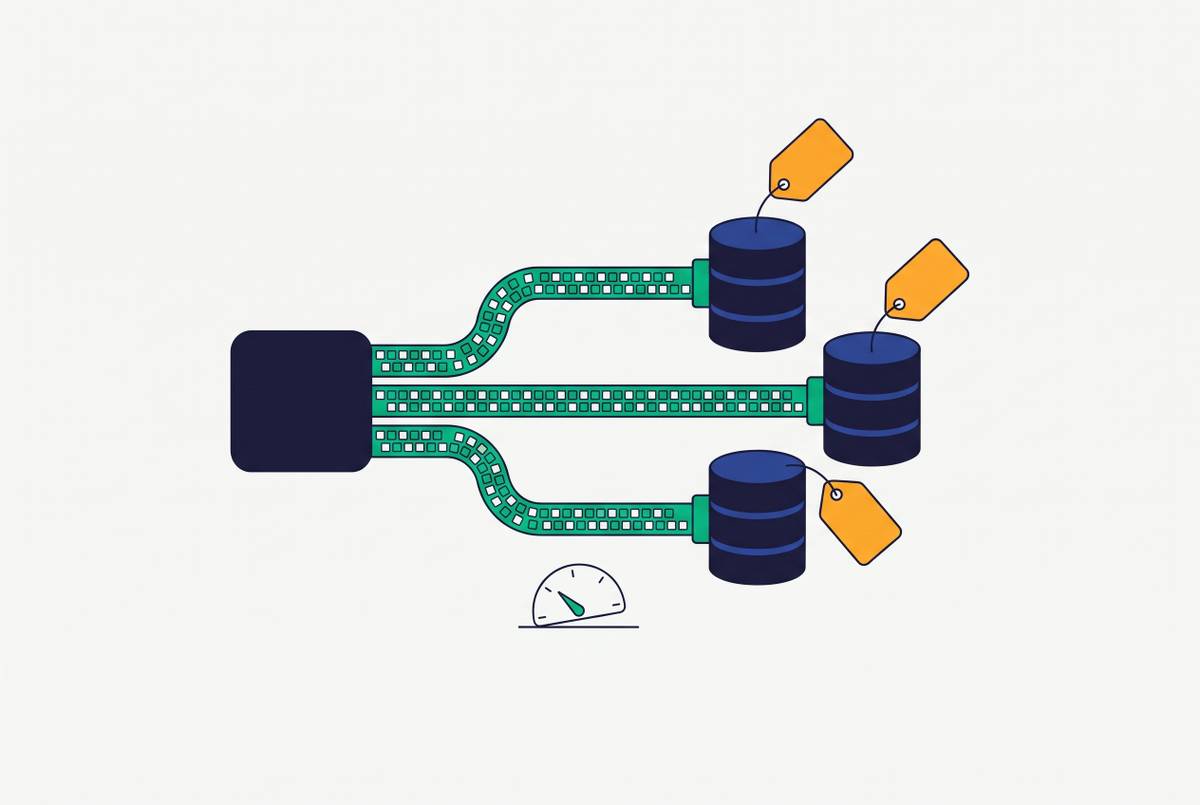
Destination-Based Pricing Defined for the Warehouse-First Data Team
It explains how billing by target count works and what to verify.
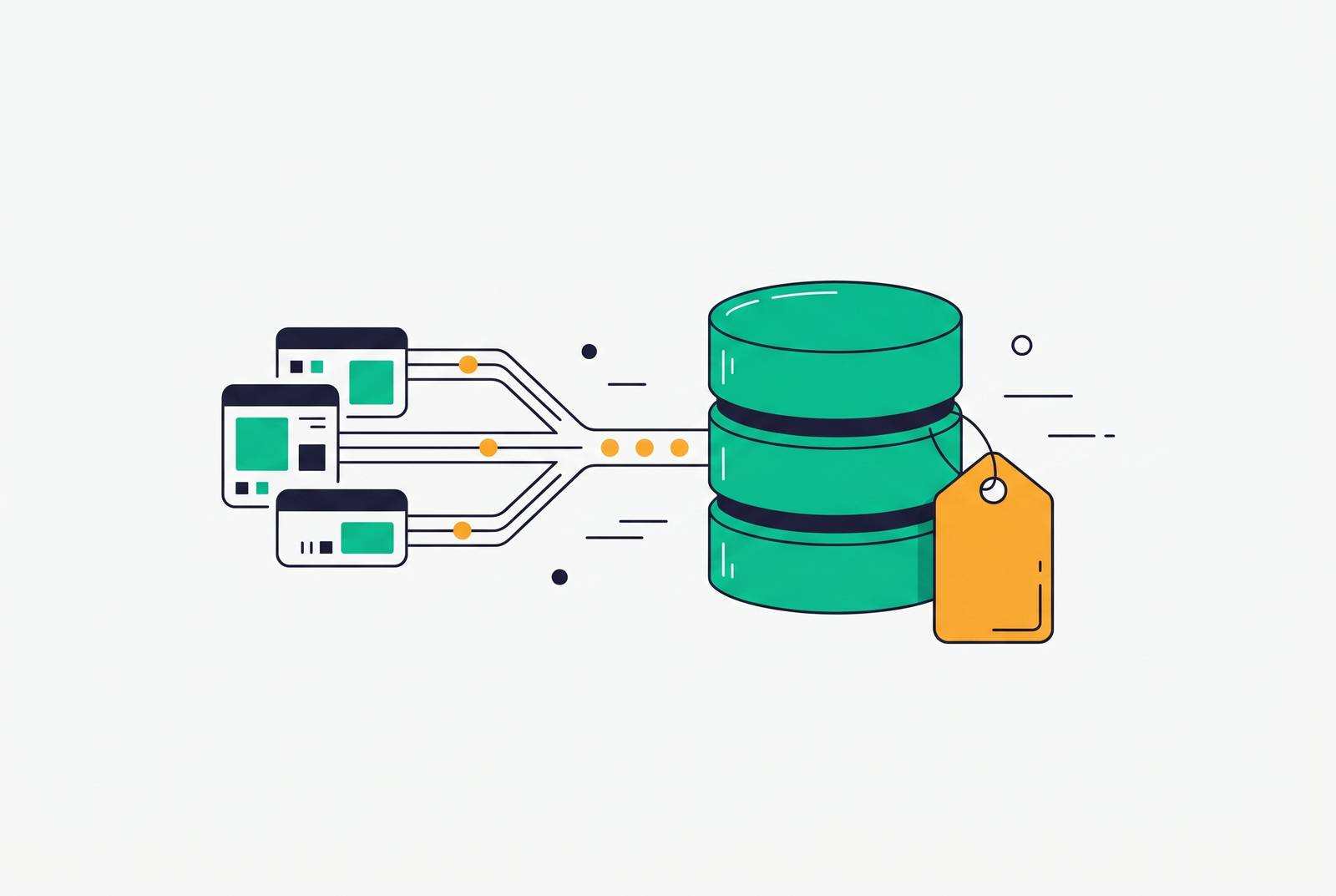
Destination-based pricing for data integration charges by the number of warehouses, databases, or object-storage targets a team syncs into, rather than by rows, bytes, or events. Adding sources or moving more data into an existing target creates no new billing event under a pure destination-based model. For warehouse-first teams, its value is predictable growth, provided the contract defines each destination precisely and introduces no secondary usage meter.
Why the billing meter is the first question for a warehouse-first team
The surprise arrives in month four of a volume-based plan. A new source doubles the rows moving through the platform, or CDC deletes start to count toward the bill. The warehouse target has not changed, but the bill has. What looked like a procurement detail now governs the cost of expanding the data platform.
That expansion is normally additive at the source layer. Warehouse-first teams bring CRMs, ERPs, ad platforms, and product databases into one or a small number of warehouse targets. A meter tied to source activity turns that normal growth into a series of new charges, whether or not data goes to another downstream target. Pricing therefore belongs in the architectural discussion, before a team commits to a platform whose billing unit may conflict with its operating model.
What the dominant meters actually count — and what they miss
Row-based pricing counts the records that are written to the destination. A high-cardinality source or a full resync can drive up billed usage even when the team adds no new target. Event- or task-based pricing instead counts each operation that is triggered. Workflow-heavy pipelines and CDC streams generate those operations continuously, so forecasting depends on the activity of the pipeline. The units capture different kinds of work.
Credit-based pricing measures usage in a unit set by the vendor before turning it into a cost. Connectors, compute, and freshness can all consume credits, which makes the conversion from an operational change to a bill less direct. Gigabyte-based pricing counts how much data is moved. Wide schemas and verbose formats can therefore increase charges even when the semantic content is small. A team evaluating either model needs to distinguish the data it wants from the resources the vendor meters.
None of these units measures how many targets are served. Row pricing responds to record counts, event pricing to operations, credits to the vendor’s consumption rules, and gigabyte pricing to data size. Their suitability depends on which of those quantities the team can forecast and control. The shared omission is downstream architecture, because a stable set of warehouse targets does not, by itself, keep the integration bill stable.
What does destination-based pricing actually measure?
A destination is a warehouse, database, or object-storage target. It is not a table, schema, or connector. Destination-based pricing anchors the integration charge to the number of those targets, rather than to the volume or frequency of the data flowing into them. Under the pure model, connecting another SaaS application or database to an existing Snowflake or Databricks target does not trigger a new charge.
The billing event occurs when another target is added. That might be a second warehouse environment, a separate database for a business unit, or an object-storage bucket for a partner. More rows, more sources, and more frequent syncs do not count toward the destination meter as long as the number of targets stays the same.
For SaaS vendors embedding connectivity, the same unit produces a different growth curve. Each customer’s warehouse is a destination, so destination count grows with the number of customers served. Customer acquisition becomes the relevant scaling variable. The model can therefore align with a multi-tenant product, although its economics still depend on the per-destination price and the vendor’s rules for counting targets.
How the warehouse tier has changed what "destination" means in practice
In 2026, changes to warehouses make that counting rule harder to apply. Major platforms have moved toward open table formats on object storage, so a single logical destination can span more than one physical storage layer. Snowflake reached general availability for Apache Iceberg tables in June 2024, so data can live in object storage while Snowflake provides the query and governance layer. The warehouse and the storage target are no longer necessarily the same boundary.
At the June 2025 Data + AI Summit, Databricks announced that full Apache Iceberg support in Unity Catalog was in Public Preview. That support enables multiple compute engines to read and write the same tables, further blurring the distinction between warehouse and lake. A pricing definition must account for that overlap. Otherwise, a team cannot tell whether a move toward a lakehouse changes the number of billed destinations or just the storage behind one it already has.
Peliqan’s 2026 comparison notes that loading raw data into the warehouse first and transforming it through SQL or dbt now dominates new builds, because cloud warehouses offer more compute than an intermediate transformation server. That ELT default puts more of the integration path at the warehouse boundary. Download egress costs vary materially across object-storage providers and can interact with usage-based components added to a destination plan. Teams therefore need to know how a vendor defines open-format and external-storage targets before they assume a move to a lakehouse will leave the bill unchanged.
The legitimate objection — destination pricing socializes costs, and "destination" may not stay stable
Destination pricing does not make unequal workloads equally costly to serve. Flat-rate and destination-based models socialize costs across customers, with low-usage teams paying the same as high-volume teams at the same destination count. The vendor must price for the upper end of usage. As a result, a team with modest volumes may pay more than it would under a volume-based plan until its usage grows into the tier.
A warehouse-first team that is adding sources knows which action will bring another charge and can plan for it, even if it pays more at the start than it would on a usage-based plan. That has practical value when the source layer is growing. Volume-based billing can surprise a team in month four, whereas destination-based price changes at contract renewal arrive at a more manageable planning point. Neither model removes the need to assess the price against the workload.
But teams can plan this way only if the definition stays the same. A vendor can change what counts as a destination through renewal terms, a platform update, or a new product tier, particularly as lakehouses blur storage boundaries. An unchanged architecture can then face a changed count. Teams should get the definition in writing, with examples that cover open table formats, external tables, and object-storage buckets. Without that agreement, destination count is not yet a dependable planning unit.
What to actually verify when a vendor claims destination-based pricing
Before signing, a team should ask whether the destination target is the only billing unit or merely the basis of a base fee. The distinction is consequential. Some platforms add row, byte, event, or sync-frequency charges above a threshold, reintroducing a usage meter within a destination-priced plan. That hybrid can be reasonable, but the team needs to know where the threshold sits relative to its expected usage.
The next question concerns changes in freshness. Teams should ask what happens when hourly syncs become 15-minute syncs or when CDC is added, including whether either change activates a separate charge. A stable destination count alone is insufficient. The evaluation needs to establish whether normal operational changes remain inside the quoted price or move the team into another billing regime.
For embedded connectivity, the questions shift to tenants and packaging. SaaS teams should ask whether each customer’s warehouse counts as its own destination and whether the per-destination price changes as the count grows. Dozens of enterprise customers can add up to a large number of destinations even when their datasets are not unusually large. Embeddable SDKs and APIs also change what is being purchased, because a React SDK or clean API can make connectivity a branded product feature. The evaluation therefore includes the integration fee and what the team can embed and resell.
Security belongs in the same pricing conversation. Teams should ask whether end-to-end encryption, SOC 2 Type 2 coverage, and private-cloud deployment come with the plan or are only available in a higher tier. Enterprise buyers often need SOC 2 reports before they sign. If buyers must move to a volume-priced tier to get the compliance features they need, their costs follow different rules from the advertised destination model. The relevant price is the price of the deployable, compliant offering.
How AI agent data access changes the destination count calculation
As agents become consumers of warehouse data, the delivery surfaces extend beyond traditional BI and analytics targets, but a new consumer does not necessarily require another synced target. The classification determines the integration charge. Teams need to distinguish between data arriving somewhere new and an agent accessing data that already resides in a warehouse.
Snowflake agreed to acquire Natoma, an enterprise MCP platform, in May 2026 to add governance and identity for agent tool access. The agreement signals that agent connectivity is becoming a first-class concern within the warehouse tier. For customer-facing SaaS products, exposing analytics to customers’ AI agents creates a delivery surface through which data collected on their behalf becomes available in their own AI workflows. Whether that exposure counts as a destination remains a contractual question.
If an agent reads a synced warehouse through MCP, teams should ask whether the vendor counts the MCP endpoint, the warehouse, or neither as the destination for that access. Under a destination meter, an agent reading the data millions of times does not itself change the target count. That separation makes the model structurally better suited to repeated access than billing tied to each access event, provided no per-query or per-call meter is added. A platform that exposes the same synced data to warehouse users and agents can then serve as a foundation for AI-powered product experiences without making every interaction another integration cost event.
The practical literacy a warehouse-first team needs before the next vendor conversation
Start with a precise account of which actions in the team’s normal workflow create charges. Source additions, greater freshness, new tenants, lakehouse changes, and agent access are distinct architectural decisions, and the contract should make their billing consequences equally distinct. With those terms clear, a team can judge the model against the growth it expects, rather than a starting bill that may cover a workload it will soon outgrow.
Evaluate the complete offering. For an enterprise team, that means the destination price with its required security and deployment options. For a product team, it means the economics of branded, embedded connectivity as customer destinations multiply. Neither evaluation is complete if a required feature quietly restores the volume meter the team intended to avoid.
Destination-based pricing is a vendor claim. Its planning value depends on keeping the billed target legible as ELT, open table formats, and agent access reshape the delivery architecture. The decisive vendor conversation therefore concerns the written boundary of a destination and every exception to it. Once those are clear, a warehouse-first team can judge whether its integration cost will follow the places it chooses to serve or the growing amount of work it does for them.