Warehouse Budget Predictability When Row Counts Become Unpredictable
Flat integration pricing helps, but compute costs still bite.

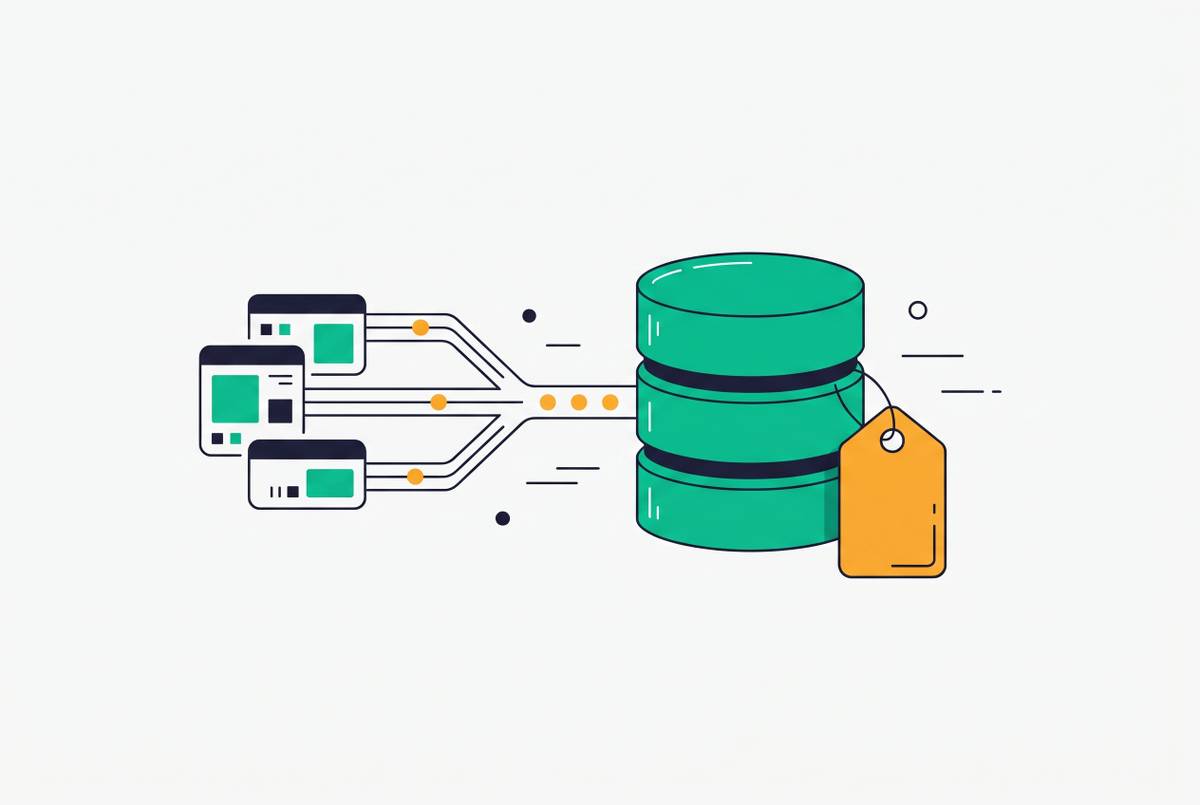
Destination-based pricing for data integration charges by destination rather than by rows or data volume, separating integration charges from customer data growth. It does not fix warehouse compute costs, which still depend on billing minimums, scans, and transformation design. Warehouse budget predictability therefore requires two choices together, namely integration pricing that tolerates unpredictable row counts and engineering that prevents those rows from multiplying compute spend.
Why warehouse bills spike when row volumes do — the structural mechanisms behind the surprise
Teams expect to “pay for what you use.” A dashboard load can trigger several briefly executed queries whose cost reflects minimum billing increments. When short bursts repeatedly activate compute, useful work and billed work diverge. Row growth then arrives inside a cost structure already sensitive to how work starts and stops.
Three amplifiers explain most of the structural surprise. Billing minimums mean there is a charge even when a task finishes quickly. Scan-based pricing charges for data touched, so a query against a large unpartitioned table can cost the same whether it returns one row or a million. Full-refresh pipelines add a third amplifier because they process existing data again whenever new data arrives. These mechanisms can stack when growing tables feed recurring transformations and interactive queries.
Low volumes conceal the mismatch between work and cost. A broad scan or repeated rebuild may cost so little at first that no one looks into it. As row counts grow, however, the same workload processes more data without any change in its business purpose. The resulting bill looks like a sudden volume problem, although the underlying exposure was present in the architecture.
How the same billing architecture behaves differently across Snowflake, BigQuery, and Redshift
Snowflake bills compute credits by the second, with a 60-second minimum per warehouse start or resume. Its risk is an “idle compute tax” when short interactive workloads repeatedly activate warehouses. Query frequency alone is not the billing trigger. The costly pattern is frequent work combined with repeated starts or resumes, each subject to the minimum. Resource Monitors provide a budget control through credit-consumption limits and warehouse auto-suspension.
BigQuery moves the exposure from warehouse activation to query breadth. Its serverless on-demand model charges $6.25/TB scanned, removing cluster-sizing decisions but leaving query discipline financially significant. A SELECT * against a large unpartitioned table can generate a large bill in seconds. Small results do not imply cheap queries. Partitioning and clustering reduce scanned data, while capacity-based slot reservations through BigQuery Editions change the economics for predictable workloads.
Redshift began with provisioned clusters billed hourly, whether busy or idle. AWS states that on-demand provisioned clusters are billed as long as the cluster is running. Redshift Serverless instead bills by compute unit-hour. For provisioned workloads, reserved instance discounts can make stable utilization economical, while variable demand weakens that fit.
Snowflake exposes activation patterns, BigQuery exposes scan breadth, and provisioned Redshift exposes idleness. ClickHouse’s cost-performance benchmark compared Snowflake, BigQuery, Redshift, another vendor, and ClickHouse Cloud across row scales using each vendor’s real billing rules. It found that cost-performance does not scale linearly across systems and that platform gaps widen as row counts grow. Platforms must therefore be compared on how well they fit the workload as well as their list price.
Why transformation pipelines are the hidden cost multiplier most teams don't see on the bill
Source row counts reveal how much data arrives, but not how much work follows. A team can monitor ingestion closely while remaining blind to the transformations that turn each arrival into compute consumption. A full-refresh model re-scans and rewrites an entire table on every run, while an incremental build processes what changed. At low volumes, the cost difference can be easy to overlook.
That difference grows as tables reach tens of millions of rows while transformations still run hourly. Each new batch enters a pipeline that processes the accumulated table again. A source-volume spike therefore enlarges every subsequent full refresh. If those runs repeatedly start or resume compute, billing minimums add another exposure. On scan-priced workloads, the repeated processing directly increases the data billed.
The invoice does not explain this chain of events. A standard cloud bill does not identify a dbt model by name or label a charge as a full refresh of the orders table. It shows warehouse credits or terabytes scanned, but those totals hide what caused the work. A model that is poorly configured can thus use up the budget without showing up as its own cost item. That blind spot makes pipeline-level attribution central to understanding a warehouse spike.
Why cost visibility must be built at the workload level, not read off the cloud invoice
Retiring unowned jobs and rebuilding one full-refresh model as incremental produced a material reduction in monthly run-rate. No platform switch was required for those changes. A resource-level total could show the spending, but not distinguish the jobs that deserved retirement from the model that needed redesign.
To make that distinction, workload identifiers must reach the query layer before a spike occurs. A request ID, tenant ID, endpoint name, and workload class must pass through the BI layer into warehouse query comments. The same identifiers can then appear in application logs and billing analysis. Pipeline job identifiers provide the corresponding trace back to a transformation model.
Without cost-per-tenant visibility, pricing and packaging decisions cannot establish whether smaller customers subsidize a larger customer’s workload. Unattributed spikes also consume engineering time that the cloud invoice omits. Governance creates a related blind spot when an integration ingests data merely because its user can access it. Those unnecessary rows accumulate storage charges and enlarge downstream scans, making the ingestion boundary a cost boundary as well as an access boundary.
How do you avoid paying more as customer data grows with an ETL tool?
For SaaS teams, customer behavior introduces volume changes outside internal workload schedules. A customer’s product launch or seasonal event can double the rows delivered by a scheduled or triggered pipeline. Transformations then process more data, and warehouse charges rise without a corresponding change in the product team’s capacity plan. The team controls the pipeline, while the event remains outside its control. This makes integration pricing an additional source of either stability or exposure.
With per-row or per-GB integration pricing, the bill is based on how much data is transferred. Its trade-off is direct exposure to customer growth, even when the destination and product feature remain unchanged. With destination-based pricing, the charge is based on the destination, so it does not rise as row counts grow. The limitation is equally important for buyers. It changes the integration bill while leaving the warehouse’s scan charges, compute billing minimums, and transformation costs unchanged.
Pricing alignment does not resolve shared-compute attribution by itself. Depending on the architecture, one tenant’s load can degrade others or generate shared costs that cannot be assigned to the tenant responsible. Multi-tenancy by construction addresses that isolation problem, whereas embedding added to a single-tenant-first tool may not. A stable integration charge still needs tenant-level visibility. Otherwise, predictable connectivity costs can coexist with opaque warehouse spending.
A white-label integration layer offers an alternative to building custom connectivity for each customer destination. It shifts responsibility for that connectivity to a purpose-built layer and allows destination-based commercial models. Custom pipelines leave the product team responsible for connectivity and its interaction with the warehouse’s cost amplifiers. They also consume engineering time that could serve the core product. The build-versus-buy decision must weigh how pricing fits, how tenants are kept apart, and who runs the system, as well as which connectors are available.
What AI agent query patterns add to the cost unpredictability problem
AI agents introduce wide scans at unpredictable intervals, often triggered by external events outside an analyst’s schedule. Historical human workloads are therefore an incomplete basis for forecasting their access patterns. Freshness adds another source of pressure on pipelines. A customer service agent resolving a delivery issue may need data from multiple systems in under a second, while stale warehouse data can produce the wrong recommendation. That need pushes teams toward Change Data Capture and event-driven synchronization, which make pipelines more active and may add to the bill.
MCP servers also introduce a query surface that needs its own access boundaries. The CoSAI MCP Security paper identifies identity-scoping failures as a central threat category. An agent operating with broader OAuth tokens or over-permissioned credentials can reach data beyond the calling user’s entitlements. That is both a security and cost problem. Broader access can allow scans beyond the data required for the task.
Snowflake Cortex Analyst provides a bounded architectural pattern. It runs inside Snowflake, keeps data in the warehouse, and uses existing role-based access control and row access policies. Access scope constrains what the agent can query. More generally, agents using data already synced through a governed integration layer can benefit from that layer’s controls and query optimizations, whereas direct access to raw operational systems does not inherit them.
The operational response is to treat MCP servers as privileged APIs. Permissions need tight scoping, and query comments need agent identity and task ID so agent work can be attributed like human work. Warehouse-only analysis also cannot account for costs generated outside the warehouse by direct operational queries. The new interface extends the set of identities and tasks that workload instrumentation must distinguish.
The deliberate mitigations — engineering against each amplifier, in order of leverage
Changing how transformations are built usually does more to cut costs than moving to another platform. Convert full-refresh models to incremental builds for tables whose row counts vary, so new arrivals do not force a rebuild of accumulated history. Reduce run frequency for transformations that do not require immediate freshness. A pipeline running far more often than its source changes can repeatedly incur activation minimums for little useful processing.
Next, address query breadth through partition hygiene and enforceable query rules. On scan-priced platforms, partition tables around columns often used in WHERE clauses so queries can read the slices they need. Clustering is another way to cut the amount of data scanned. Use linting to require WHERE clauses and prevent SELECT * on large tables, so these rules do not depend on each person following them. Filtering must actually narrow the scan to reduce cost. BigQuery project-level and user-level quotas provide a financial guardrail against runaway query consumption.
Compute configuration comes after cutting work that does not need to be done. On Snowflake, configure Resource Monitors to auto-suspend warehouses when credit consumption exceeds the set budget. Reserve capacity only for the stable, predictable portion of demand, rather than using commitments to cover inherently variable patterns. A budget stop can constrain spending without correcting the full-refresh model or broad scan that caused it.
Although workload attribution follows those interventions in leverage, it precedes them operationally. Build the request, tenant, endpoint, workload, and job context needed to target changes and distinguish their effects. Without that context, a lower bill does not show which workload improved or whose demand changed. Platform switching is therefore not the first remedy. Moving an unattributed, over-provisioned workload can replace one poor fit with another while leaving its unnecessary work intact.
For SaaS products, the final lever is integration pricing. Destination-based pricing keeps the integration charge from rising with row-count volume in the customer-facing pipeline, where teams have the least control over that volume. It complements governed ingestion, tenant isolation, and workload-level attribution.