Why Volume-Blind Pipeline Pricing Is the Only Model That Survives Hypergrowth Data Stacks
Fixed-fee destination pricing shields hypergrowth companies from unpredictable volume spikes.
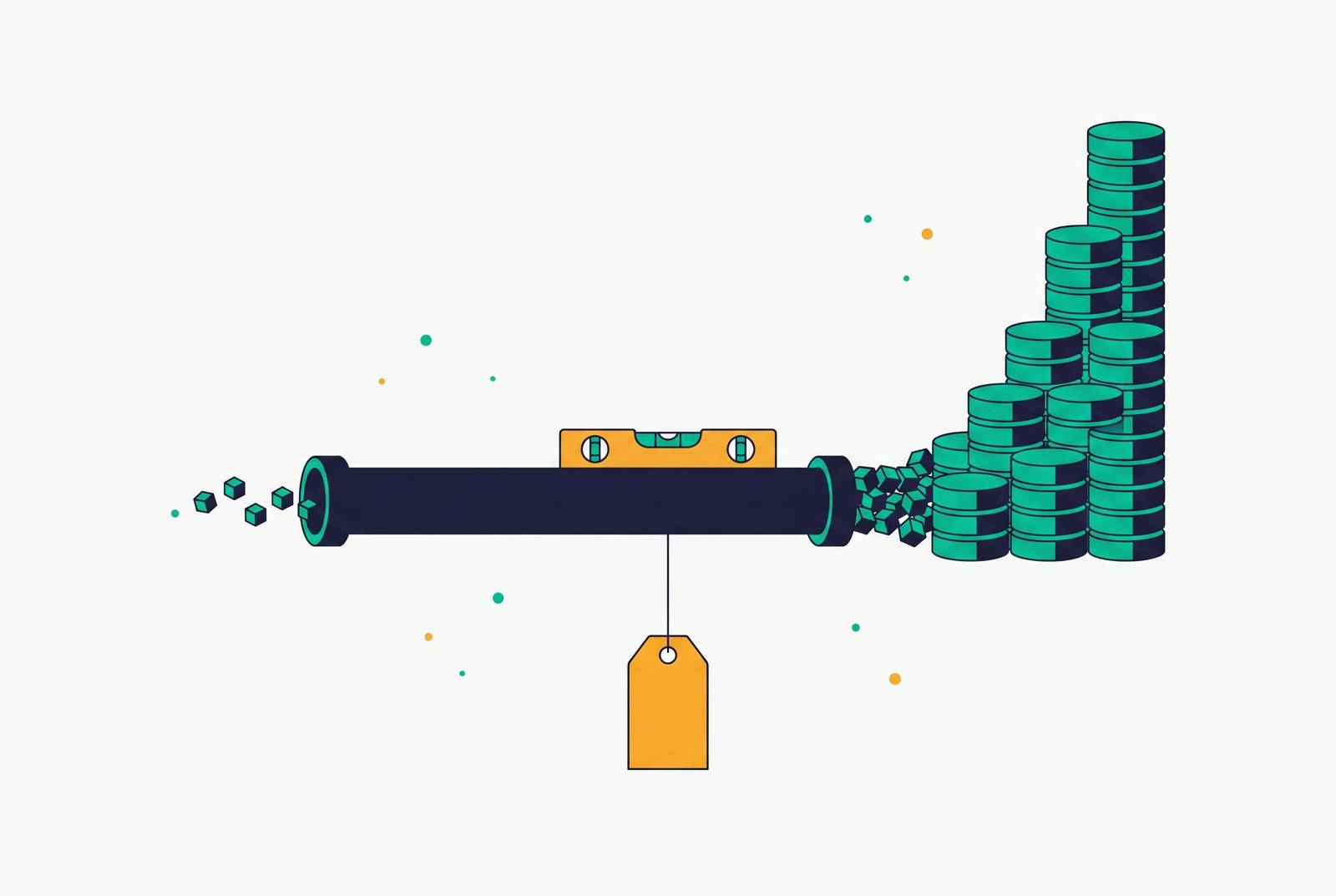
Destination-based pricing for data integration bases the charge on each destination served, rather than on each row, event, or unit of compute. Integrate.io offers fixed-fee pricing with unlimited data volumes, pipelines, and connectors in its Core plan. For hypergrowth stacks, volume-blind, destination-based pricing keeps the pipeline bill the same as throughput grows, as long as the number of destinations stays the same. That distinction makes pricing a strategic choice.
How consumption-based pipeline pricing is structured and what it meters
Consumption-based pipeline pricing charges for units of work, including rows processed, data integration units, vCPU-hours, and API calls. The bill depends on how much metered work the platform performs. With fixed-fee pricing, the rate stays flat no matter how much of that work the platform does. A monthly invoice can still be consumption-based if its total changes with throughput, compute use, or pipeline activity.
Under consumption pricing, more rows, pipeline runs, or shuffle operations can raise several parts of the bill at once. Under a volume-blind fixed fee, increases in data volume, pipeline count, connector count, or team size do not change the platform charge. Integrate.io’s Core plan includes unlimited data volumes, pipelines, and connectors. This differs from a plan that includes an allowance and then charges for use above it.
Google Dataflow charges for worker vCPU and memory, batch shuffle processing, and streaming resources, with a separate charge for persistent disk and prices that vary by region. Batch and streaming compute also have different rates. The headline rate is only one component. Some integration vendors add a minimum fee for each active connection, so sources that send little data can still add fixed charges across a large connector catalog.
These models also differ in what buyers must forecast. A resource-based model requires estimates of the work performed and the resources used to perform it. Destination-based pricing requires a forecast of the destinations served. For either model, the full bill depends on whether it also charges for rows, connectors, frequency, and other parts of the workload that grow.
Why hypergrowth data behavior is structurally incompatible with any volume meter
Hypergrowth combines high volume, sharp spikes, and limited predictability. Product growth adds customers, events, records, and log lines, each of which can increase the work performed by a pipeline. With a row or compute meter, the business pays for the extra work that comes with that growth. The relationship is built into the contract. A lower unit rate may reduce the expense, but it does not remove the link between growth and cost.
Spikiness makes that link harder to manage within an infrastructure budget. Launches, marketing campaigns, end-of-quarter reporting, and onboarding surges can lead to months in which data volumes are several times the baseline. Consumption charges rise with those bursts. The baseline is not a reliable budget. Because hypergrowth companies cannot reliably predict when those changes will come or how large they will be, they cannot reliably predict the consumption bill over several years.
The problem expands when the stack spans AWS, Azure, and GCP. Tools built within one provider’s ecosystem can introduce friction when data crosses cloud boundaries, with egress or transfer charges added to the underlying row or compute meter. These are separate sources of exposure. A fixed pipeline fee removes uncertainty from that fee, but it does not by itself erase charges imposed elsewhere in the cloud stack.
Meanwhile, growth adds sources, destinations, teams, and pipeline types, including ETL, ELT, CDC, and Reverse ETL. A consumption forecast must account for how those dimensions interact. Volume-blind pricing takes throughput out of that calculation, while destination-based pricing gives the buyer a defined number to predict: the destinations served. Pipeline volume stops being an uncontrolled billing variable.
AI workloads remove the last justification for treating data volume as a billing variable
AI and LLM systems make data reduction a particularly damaging way to manage pipeline expense. They need historical trends, long-tail events, raw text fields, clickstreams, and edge cases. Excluding those inputs narrows what the model can learn before training begins. Completeness becomes part of the product requirement. A pricing model that rewards moving less data puts pressure on teams to cut the data that the workload needs.
That pressure affects both historical breadth and freshness. Retraining and fine-tuning require more than recent records, and teams cannot retroactively recover data they chose not to sync for cost reasons. RAG pipelines and AI context windows also need up-to-date information. Reduced-frequency batch fetches are not an adequate substitute. Incremental syncs with change detection are needed, with frequency determined by source type and business criticality rather than by a desire to suppress billable activity.
As data accumulates, more services, models, and teams depend on it. This data gravity increases the range of possible uses, but a volume-linked integration bill can make each expansion more expensive. Experimentation then competes with the cost of supplying its inputs. Some possibilities remain unexplored because moving the necessary data is too costly. Per-row and per-GB models are a poor fit when the workload moves from running reports from time to time to real-time machine learning and continuous retraining.
Autonomous agents add more demand even after the data is complete enough for those workloads. Agents can interact with warehouses and pipelines without a person initiating each operation, and retries can create fresh charges where the underlying resource is metered. Autonomous activity carries a risk of escalating charges. Volume-blind pipeline pricing removes that particular integration meter from autonomous activity, although it does not make separately billed warehouse compute or other services free. The relevant guarantee is bounded pipeline cost.
White-label and embedded product builders face the sharpest version of this exposure
Embedded builders face a harder version of the same forecasting problem because they pay for the aggregate data volume of their customers. As those customers grow, the builder’s pipeline bill grows with them. That expense cannot be passed through cleanly in every product relationship. Revenue and infrastructure cost can therefore diverge. Margin erosion may be difficult to see at purchase, when the customer base and its data volumes are still modest.
Unlike an enterprise that runs its own stack, the builder has no direct control over how end-customer data changes. A large onboarding, a customer’s product launch, or a surge in a downstream warehouse can increase pipeline demand without a matching change in the builder’s commercial terms. The exposure sits outside its operating control. Metering aggregate volume makes the builder pay for what happens across many other businesses, each of which grows in its own way.
The architectural answer combines embedded connectivity with a billing boundary that the builder can manage. Integrate.io’s positioning brings together white-label data integration, an embeddable React SDK, destination-based pricing, SOC 2 Type 2 certification, and private-cloud deployment. These address different parts of the problem. The embedding layer supports connectivity within the builder’s application, while destination-based pricing separates the pipeline charge from end-customer throughput. Certification and deployment options help meet the security requirements that come with serving those customers.
Destination-based pricing still changes when the number of destinations served changes. Its value is a more legible relationship between the service sold and the integration expense behind it. Existing customers can generate more data without automatically increasing a volume-blind pipeline bill. For an embedded product, that distinction makes successful customer adoption less likely to become an unplanned margin penalty.
The legitimate case for consumption pricing and where it actually holds
Consumption pricing can be the cheaper and more appropriate choice for a small team with low, predictable volume. A seed-stage startup with a handful of sources and modest monthly row counts may have little reason to pay for unlimited throughput. Unused capacity has no immediate economic value. In that setting, a fixed fee can commit the buyer to expense well ahead of demand, while a usage-based model keeps the initial charge closer to actual activity.
Integrate.io’s pricing guide acknowledges that usage-based tools cost less at very low volumes and that the crossover depends on the buyer’s usage profile. Fixed-fee platforms have the highest entry floor in the no-code integration category. That is a genuine disadvantage for small workloads. Usage-based pricing is also the fastest-growing commercial model in the data pipeline market, reflecting a real preference for paying according to use. For buyers whose demand is stable and modest, that preference is rational.
Companies can underestimate volume when they choose a platform, then face a steep rise in costs after they sign a contract and build pipelines around its connector set. Switching requires a migration project, so the point at which another model becomes financially attractive may arrive well before switching becomes operationally convenient.
Buyers should compare costs based on how much they expect to grow as well as how much data they have now. That comparison should include the engineering labor needed to monitor and optimize consumption, because this work adds cost beyond the vendor invoice. The cheapest starting plan may not remain cheapest. At the same time, a company with little reason to expect high volumes should not assume that a flat fee is better. The case for volume-blind pricing rests on the workload’s direction, variability, and breadth.
How do you choose a pricing model that survives hypergrowth?
A model that survives hypergrowth must separate the platform charge from the activity that growth inevitably creates. Rows, events, connector counts, team members, and pipeline frequency must not become additional meters beneath a nominally flat fee. Otherwise, the exposure has only moved elsewhere. The decisive requirement is volume decoupling across the contract, rather than an unlimited claim that applies to one part of a multi-dimensional bill.
Destination-based pricing provides a predictable alternative by charging for organizational scope. The number of destinations served can change, but it is a more controllable planning variable than customers’ event volumes or autonomous pipeline activity. Within this defined boundary, more data and more frequent synchronization should not create a new integration charge. Agent access to synced data must follow the same principle if autonomous use is not to reopen the consumption risk.
Security must also be part of the platform’s commercial scope. SOC 2 Type 2 certification, end-to-end encryption, and private-cloud deployment options should come with the platform. Compliance pressure often arrives when volume is high and switching is difficult. Treating these capabilities as optional upgrades can therefore create another cost discontinuity at the point of greatest dependence.
The buyer’s evaluation question is concrete. What does the platform cost at three times current volume, with twice as many sources, running at twice the frequency, and can that number be stated in the contract today? A clear answer exposes which variables remain billable and which are genuinely decoupled from growth. It also distinguishes a predictable destination-based commitment from a consumption forecast presented as a price. The strategic choice is whether the data platform enables more ambitious products or taxes the activity that makes them succeed.