Flat-Rate ETL Pricing by Destination Count Compared Across the Major Integration Platforms
Destination-count pricing aligns integration costs with customer growth for multi-destination SaaS.

Destination-based pricing for data integration charges for where data lands. For SaaS products exporting data to customer-owned warehouses, this aligns integration cost with customer growth. Flat-rate and connection-count alternatives offer related predictability, but their contract boundaries differ, so the right comparison starts with the billable unit.
Why ETL pricing models diverge at the unit of measurement
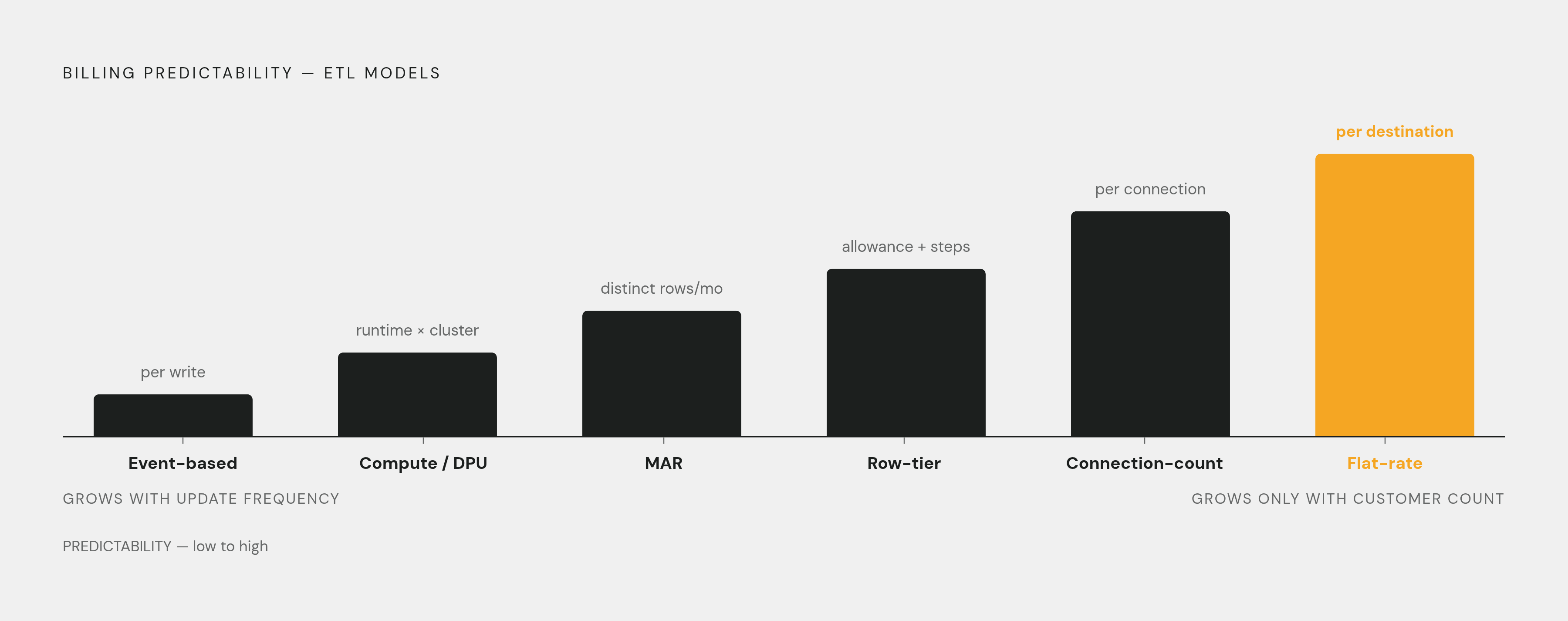
ETL platforms meter different kinds of work. Monthly Active Rows, or MAR, measures distinct rows changed during a month, while event-based billing counts every record written to a destination, including repeated updates to the same row. Row-based tiers instead sell a monthly allowance at a fixed price, with costs stepping up when usage crosses a tier boundary.
Credit, capacity, and compute models introduce further distinctions. Sync volume uses up credits, while capacity-based plans provide a fixed number of workers whatever the throughput. Compute-hours measure infrastructure runtime. Destination-count or connection-count pricing replaces those units with the number of destinations or connections, while a flat platform fee can cover unlimited throughput. A comparison between these models requires a workload description before a monthly price has much meaning.
How the metered-unit problem compounds as a SaaS product scales customer count
For a SaaS vendor exporting data to customer-owned warehouses, each new customer adds another destination. The integration workload expands even if the source dataset does not. Sending the same changed rows to more destinations can raise row-metered consumption even when the source data has not grown. An analytics pipeline feeding a small number of internal destinations has a different cost structure.
Frequent updates introduce another multiplier into that structure. An operational table containing orders, sessions, or inventory can generate repeated writes, which event-based billing counts separately at each destination. Consumption consequently depends on update frequency as well as customer count. Neither variable alone describes the bill. A SaaS team forecasting from source size alone can therefore miss the effect of distributing that source across a growing customer base.
Destination-count pricing charges for that growth by counting each new destination as a billable unit. Within the terms of the contract, integration cost is tied to each new customer, with additional activity within an existing destination covered by its destination fee. The underserved case is a product delivering data to many customer-controlled endpoints, with each endpoint forming part of the product’s commercial offering.
How the major volume-based platforms price today and where costs land at scale
Usage-based platforms cannot be compared reliably through entry prices alone. A MAR model responds to distinct changed rows, an event model responds to repeated writes, and a row-tier model responds to allowance boundaries. Event billing can cost less for insert-dominant workloads, but workloads with frequent updates need a closer look at the numbers. The same source can produce different bills. The relevant comparison is the charge for delivering the required workload at the required sync frequency and service tier.
Stitch’s row-based tiers range from roughly $100/month at entry-level row volumes to about $1,250/month on Standard. Its Premium tier is around $3,000/month for high row volumes and HIPAA compliance. Its framework gives it a wide range of connectors. Within an allowance, the monthly charge is comparatively predictable. The next tier, however, becomes part of the cost model when row volume exceeds that allowance.
AWS Glue prices ETL jobs by infrastructure runtime, with per-second billing at a per-DPU-hour rate. A DPU comprises four vCPU and sixteen GB memory. Flex execution lowers the per-DPU-hour cost for batch work that can wait. Runtime and cluster size drive the charge. How engineers design jobs therefore directly affects cost, and the total also includes infrastructure and engineering time.
Matillion uses quote-based pricing rather than a published rate suitable for direct workload arithmetic. Its warehouse-native approach pushes transformations into the warehouse, and its commercial offering spans entry-level, mid-market, and enterprise requirements. Qlik Talend Cloud also belongs in the enterprise quote-based comparison. Neither can be reduced to a comparable public unit price from the figures available here. Their contracts require a sales engagement before a team can model costs against a specific deployment.
What does flat-rate pricing by destination actually mean?
With flat-rate and destination-count pricing, the bill does not depend on data volume if the agreement covers unlimited throughput. A destination-count contract charges for the number of places receiving data. A flat platform fee can instead cover throughput across destinations within a tier. These terms are not equivalent by default. Connection-count pricing likewise requires attention to what the contract defines as a connection, rather than an assumption that every connection represents one customer.
For a SaaS product, a destination-based agreement can make integration cost forecastable from the sales pipeline. Adding a customer adds a destination, while more activity from a customer already on the platform is covered by the agreed destination fee. A flat-fee arrangement may remain unchanged until a tier boundary. The forecast follows the commercial contract more closely. It depends less on estimates of rows per table, update frequency, and how much data goes to each customer endpoint.
That predictability has a real tradeoff at low usage. A metered plan can cost less when a team has few destinations and limited data movement. The crossover depends on destination count, update frequency, connector count, and total data volume. Its advantage is strongest when the fixed charge replaces consumption that would otherwise grow independently of customer revenue.
How platforms align to each billing model and which fit the multi-destination SaaS case
For analytics teams with few, large, stable sources, MAR or row-tier billing can provide an economical match. Stitch uses row-tier billing, while event-based models can work well for insert-dominant workloads with little change-data-capture activity. Stability makes consumption easier to estimate across billing periods. These models become harder to forecast when destinations and update frequency both change.
When engineering control is the priority, AWS Glue offers a different tradeoff. Its cost follows job runtime and cluster size. This suits AWS-native teams with strong data engineering capabilities and the capacity to operate the workload. Operational investment remains part of the decision. A lower infrastructure charge does not, by itself, establish a lower total cost than a managed service.
For teams that want throughput costs they can predict, CData Sync uses connection-count pricing and can run in on-premises and cloud environments. Its meter is connections rather than data volume. That works well for enterprises whose data grows faster than the number of connections they have. Flat-fee unlimited platforms are another option, with charges that stay the same until usage reaches a tier boundary. Either model counts as destination-count pricing only if the contract clearly makes destinations the billing unit.
Enterprise suites answer a broader set of requirements. Qlik Talend Cloud, Matillion, Informatica, and MuleSoft use negotiated pricing, which can suit organizations buying governance, lineage, and master data management capabilities as part of a larger agreement. Public pricing is insufficient for detailed scenario modeling. For these buyers, contract complexity may be justified by the scope of the platform. That is a different purchasing decision from choosing a predictable delivery fee for each SaaS customer.
The embedded SaaS case begins with the product itself as the source and customer-owned warehouses, databases, or object storage as the destinations. A white-label export and import feature addresses that topology without treating each customer as a separate ETL platform deployment. Destination-based pricing aligns the fee with that product relationship. With high row counts covered on a fixed schedule and no surprise data-transfer fees, cost per customer can be established at contract close. This is the structural fit that general-purpose managed ETL pricing does not explicitly address.
Security and compliance requirements that change the platform shortlist
For enterprise SaaS products, SOC 2 Type II certification and data residency controls can determine eligibility before price enters the discussion. A platform that fails procurement requirements is not a cheaper substitute. Compliance also changes the relevant pricing tier. Stitch, for example, places HIPAA compliance in its Premium tier, so its entry price is not the appropriate starting point for that requirement. Comparing compliant configurations can produce a different shortlist from comparing basic plans.
Teams using open-source software still have to do the work to meet those requirements. Encryption, tokenization, RBAC, and audit logging require configuration, while the software itself does not supply a signed BAA or establish the operator’s SOC 2 posture. Engineering effort belongs in the cost assessment. In the embedded scenario described here, regulated customers also require end-to-end encryption and optional private-cloud deployment.
Named security evidence can narrow the shortlist, but it does not settle every deployment question. Tray.ai’s official trust page says it has SOC 2 Type II certification. Zapier’s official security page also states SOC 2 Type II certification, while Celigo’s Trust Center makes its report available to authorized users under NDA. Report access is itself a procurement consideration. Certification, private-cloud availability, data residency, and the required contract terms still need to align with the intended workload.
How AI agent data access is beginning to reshape what integration pricing needs to cover
AI agents accessing synced data introduce a use case beyond scheduled bulk delivery. The integration layer becomes a live data substrate for read-intensive, low-latency access alongside batch delivery. The dbt and Databricks ecosystem includes capabilities aimed at agentic workflows. These developments broaden the platform evaluation beyond connector coverage. The governance review also needs to cover how agent-generated output is approved before it runs.
The pricing distinction depends on what actually triggers a charge. A read against synced data should not be assumed to create a billable row or write event merely because an agent issued it. The contract must resolve that boundary explicitly. Destination-count pricing can cover an agent-facing endpoint without tying the bill to query frequency, if the agreement includes that access. Even with that pricing advantage, a destination-priced platform may lack support for low-latency reads.
For SaaS teams combining data sync with agent access, architecture and pricing therefore need to be evaluated together. Bulk export and responsive read access need different things from the integration layer. A platform that supports both uses may still charge for each one separately. The useful comparison is the cost and coverage of the combined service, rather than an assumption that an ETL agreement includes every form of agent access.
A practical framework for choosing a billing model based on your actual growth pattern
The practical decision starts with three questions about the planned workload. The first is whether cost growth will come primarily from more customers, more data per source, or more frequent updates. Second, the required compliance tier from day one may make entry pricing irrelevant. The third is whether the team needs AI agent read access alongside batch sync and whether the platform charges for each use separately.
For a few large, stable sources serving an analytics team, MAR or row-tier pricing can be cost-effective. A team in that position should monitor per-connection billing as its connector inventory grows. Insert-dominant workloads with modest change-data-capture activity can favor event-based billing, but repeated updates need to be modeled before assuming a saving. A flat-fee unlimited plan can make more sense when a team has many sources or high-churn tables. In that situation, the fixed charge buys predictability.
For a SaaS product sending data to a growing number of customer warehouses, destination-count or flat-rate embedded pricing is the closer structural match. The setup for this use has an embeddable SDK and API, end-to-end encryption, SOC 2 Type II, and optional private-cloud deployment. Regulated buyers should establish those requirements and HIPAA BAA availability before comparing prices. The final comparison should then use the customer growth forecast and the contract’s actual destination definition. A suitable billing model makes the cost of adding a customer knowable before that customer’s data activity begins.