The Hidden Cost of One-Off Snowflake Pipelines and the Architectural Exit Ramp
Engineering maintenance and compute waste hide the true cost of custom data pipelines.
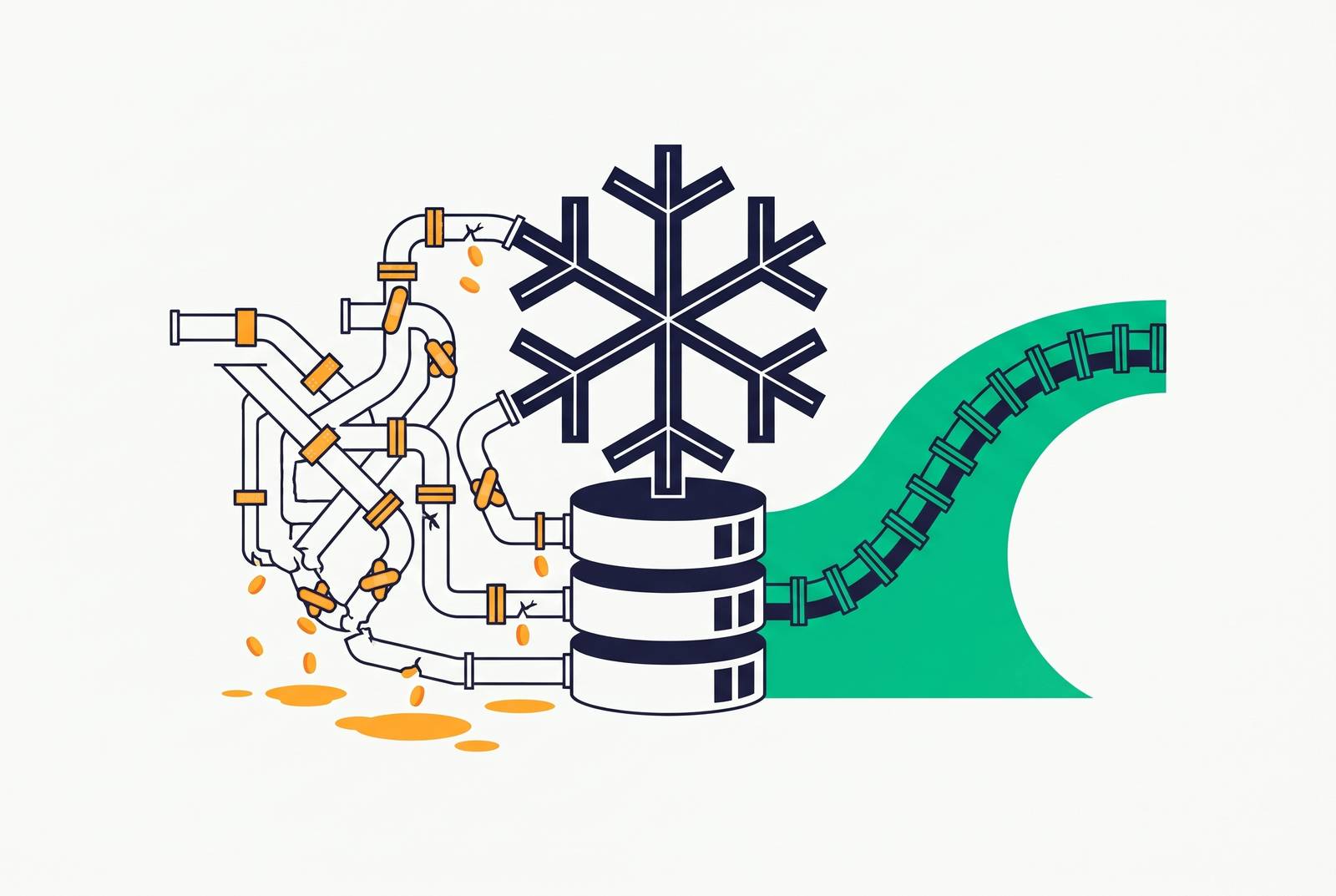
To export enterprise customer data to Snowflake and other data warehouses without custom pipelines, teams need an embeddable connectivity layer that makes destination-based sync a native product feature. The hidden cost of one-off Snowflake pipelines extends beyond billing into compute waste, engineering maintenance, schema-drift incidents, and lost product capacity. The architectural exit ramp is standardizing connectivity across individual pipelines, including managed ones.
Why one-off Snowflake pipelines hide their real cost until it is too late to ignore
A pipeline appears to cost whatever appears on its vendor invoice. Its real cost spans budgets and the effects on day-to-day work, which teams rarely measure together. Monthly platform fees are easy to compare, but the work it takes to keep data arriving reliably is harder to see. The invoice captures only part of the obligation. As pipelines multiply, their dependencies also make the aggregate cost harder to assign to any single integration.
Virtual warehouses bill for running time, including time outside active query processing, so a five-second query can trigger a full minimum billing period. Auto-suspend settings control how much longer the warehouse runs. Across dozens of concurrent pipelines, individually small decisions accumulate into a recurring expense that a connector’s advertised price does not explain.
How compute waste accumulates before anyone notices the bill
Snowflake has made real changes to reduce ingestion costs, including fully serverless, usage-based pricing for Snowpipe Streaming’s high-throughput, real-time workloads. This is not simply a vendor-pricing problem. Lower prices do not correct oversized warehouses or ingestion strategies that process more data than necessary. Each step up in warehouse size doubles the credits used per hour. A warehouse sized “just to be safe” can therefore double its running cost without a corresponding workload requirement.
Full-refresh ingestion creates a similar mismatch between work performed and work needed. Reloading an entire table every few hours consumes compute against the full table even when only a small fraction of rows changed. Incremental ingestion instead limits that work to the changes. Two connectors moving the same data can consequently generate very different compute bills because of their ingestion logic.
Warehouse scheduling adds another source of waste. Always-on warehouses accumulate idle running time, while repeated short wakeups accumulate minimum billing periods without reaching efficient utilization. When a third-party integration controls warehouse setup, the customer may be unable to fix those settings. These costs are structural, but they are visible in a dashboard. The next cost zone does not arrive as credits.
The engineering maintenance burden that never appears on a vendor invoice
The largest hidden cost can be the engineering time required to keep a custom pipeline operating at the quality the business needs. Monitoring failures, debugging intermittent errors, upgrading dependencies, and handling authentication edge cases are recurring obligations. Launch is only the beginning of ownership. An integration built in a week can generate schema-evolution and error-handling work for months afterward.
That obligation grows with every pipeline added. A large share of a senior data engineer’s time costs tens of thousands of dollars a year before any vendor spending is counted. With many pipelines, maintenance can grow from an occasional interruption to taking up most of the engineering team’s time. Teams should therefore compare total implementation and maintenance time alongside monthly platform fees.
Self-hosting does not remove this work. Building directly on Snowpipe Streaming’s Java SDK leaves the team responsible for schema evolution and error handling after launch. Managed integrations can impose a similar burden through extensive configuration and frequent support tickets. Compute spending and engineering time are at least measurable if a team chooses to instrument them. Schema drift is less predictable because its consequences can emerge in business operations before appearing in a cost report.
Schema drift as the pipeline failure mode that converts maintenance cost into business cost
Schema drift turns an upstream data-structure change into a downstream operational problem when a pipeline is tightly coupled to its source. Glossier’s experience shows the broader consequence of that fragility. A routine Shopify engineering update modified a million historical records, triggering surprise charges from Glossier’s previous platform and delaying operationally critical intraday sales data. The impact extended beyond the data team. An upstream change affected both spending and the availability of information needed by the business.
Related configuration choices can compound the expense. In one documented staging environment, large unexpected monthly charges built up because auto-clustering and materialized-view maintenance were left on for tables that did not need them. Heavy updates can also increase Time Travel storage costs. These schema-adjacent configuration risks have different failure modes, but they show the same flaw in a cost model that starts by assuming the source will behave the same way over time.
Tests do not eliminate that exposure by themselves. dbt tests, data contracts, and automated assertions can detect drift after it enters a pipeline, but detection does not prevent the disruption between an upstream change and a failed test run. The connectivity layer needs to absorb change as well as report breakage quickly.
Opportunity cost and what teams cannot build while maintaining pipelines
Maintenance consumes capacity that cannot build customer-facing capabilities. For SaaS teams, that trade-off is especially direct when customers want connectivity and analytics as product features. Each engineering-week spent repairing bespoke exports is unavailable for the feature those exports were supposed to support. The invoice cannot show that lost capacity.
A batch-only integration suited to reporting becomes a liability when a team needs a real-time feature using the same data. Tight coupling to a particular format or vendor API contract makes migration more expensive as dependencies accumulate.
The surrounding product work is substantial in its own right. Knowi describes an in-house analytics layer covering charting, filtering, multi-tenancy, export, scheduling, and access controls as typically requiring 6 to 12 months of engineering time, followed by ongoing maintenance. Pipeline upkeep adds work that competes with that development effort. With all four cost zones visible, the question shifts from whether the architecture needs attention to what a structural exit requires.
How can teams get customer data into Snowflake without building custom ETL pipelines?
The architectural exit is an embeddable, standardized connectivity layer that handles destination-based sync through an SDK or API. Instead of engineering a separate pipeline for each customer’s warehouse, the SaaS product exposes connectivity as a native capability. Albato describes this embedded pattern as a white-label integration experience inside the application.
Replacing five bespoke pipelines with five managed connectors can reduce maintenance while preserving separate integration paths. A shared connectivity layer changes the unit of design from the individual pipeline to the product capability. For customer-facing warehouse, database, and object storage sync, that means standardizing connectivity across destinations instead of accumulating destination-specific projects.
The layer must also avoid reproducing the original cost structure. Per-row or per-transfer charges can bring back surprise costs as the amount of data grows. An embeddable SDK or API addresses a different operational need from a standalone tool operated by the data team. The integration also needs enterprise security credentials because it must pass procurement even if it already meets the technical needs.
How embedded connectivity platforms compare on the dimensions that determine real TCO
Connector count alone is a weak basis for this decision. Pricing transparency, deployment control, compliance depth, and AI-agent readiness can reduce total cost of ownership or shift costs elsewhere. Use-case fit comes first. General workflow automation and high-volume customer-facing warehouse sync are different requirements, even when both involve connecting applications.
Paragon offers hosted cloud in the US/EU, managed on-premise, and forward-deployed options, with SOC 2 Type II, GDPR, and HIPAA compliance. Cyclr offers shared cloud, private cloud, or self-hosted deployment on AWS or Azure, with SOC 2 Type II and GDPR. Nango offers self-hosted deployment and a large API catalog, with SOC 2 Type 2 and HIPAA, and a BAA available on request.
Workato Embedded documents a broad compliance set, including SOC 1 Type II, SOC 2 Type II, SOC 3, ISO 27001, ISO 27701, ISO 42001, PCI-DSS, HIPAA, IRAP, and NIST 800-171A r2. It does not document a self-hosted option for its embedded product. Tray Embedded illustrates a different ownership consideration. It sends an expiry-warning webhook generally 7–10 days before end-user OAuth token expiry, and the partner must re-prompt users because it does not refresh those tokens automatically.
For warehouse sync, an embeddable React SDK, clean API, and high-volume row-level sync are more directly relevant than workflow breadth. Embedding is not always the cheaper choice. A single stable, low-churn integration can be faster and cheaper to establish with COPY INTO or Snowpipe. That case weakens as destinations multiply, schemas change, and customer requirements diverge.
Enterprise security and compliance as procurement gates, not post-launch considerations
Enterprise buyers that need SOC 2 Type II and private-cloud or on-premise deployment can consider only platforms that meet those requirements. Technical merit cannot substitute for procurement eligibility. Encryption at rest and in transit, platform-enforced tenant isolation, and audit logging of data access form the operational baseline. These controls belong in the architecture decision before launch.
Rules for deployment can further limit the choices in healthcare, financial services, and government. Prismatic documents GovCloud and named-region options, while Paragon offers managed on-premise and forward-deployed deployment. Those options address specific deployment requirements for enterprise readiness. A broad certification portfolio also does not establish that a platform supports a required hosting arrangement.
Discovering a gap after signing a contract creates another engineering project and can delay or prevent a customer deal. Deployment flexibility and compliance depth need evaluation before adoption. That evaluation must also account for how data will be accessed after it is synced. AI-agent access introduces a new compliance surface within the same architectural boundary.
AI agents querying synced data and the demand one-off pipelines cannot meet
AI agents require governed, structured access at query time in addition to delivery of files or rows to a destination. Transport and authorization are separate responsibilities. The distinction becomes concrete when source-system permissions do not follow the copied data.
Salesforce enforces access through profiles, permission sets, sharing rules, and field-level security. Syncing Salesforce data to a warehouse does not automatically reproduce those controls. Without equivalent governance, an agent querying the warehouse can access data the source system would have blocked.
Agent interfaces address a different part of the architecture. Paragon exposes connectors as agent tools through ActionKit and a native Model Context Protocol server, allowing agents to go beyond querying static copies to act within connected applications. Such interfaces do not make source permissions automatic. Governed access remains a requirement beyond the batch or stream a one-off pipeline delivers. A layer designed only for human-facing dashboards risks another rebuild when customers request AI-powered features, again diverting engineering time from product development.
Closing the gap through decisions that move a team to a connectivity layer
Ingestion strategy and warehouse right-sizing address compute waste, while standardized tooling reduces repeated maintenance work. Schema-aware connectivity handles changes at the source, and an embeddable design consolidates supporting connectivity projects into part of the product. No single vendor fee captures those decisions. For customer-facing sync, the scope extends beyond the SaaS team’s own Snowflake account across customer environments with different schemas, access controls, and compliance requirements.
Custom pipelines still make sense when there are few destinations and they stay stable, schemas rarely change, a data engineering team has time set aside for the work, and compliance does not require ongoing certification work. Embedding fits growing destination counts, diverse schemas, constrained engineering time, and procurement requirements that would otherwise demand a separate compliance project. Teams should also avoid per-row managed ingestion for high-volume, high-churn streams, while managed connector fees for low-volume sources with frequent schema changes can be worth paying for the maintenance they save.
Embedding nevertheless introduces a platform dependency of its own. Evaluating deployment flexibility and compliance depth before adoption reduces the risk of exchanging pipeline debt for another expensive migration. Data connectivity is a product feature to be shipped.