The Out-of-the-Box Warehouse Connectivity Checklist Enterprise Buyers Actually Use
A six-part test for catching procurement dealbreakers before the demo ends.
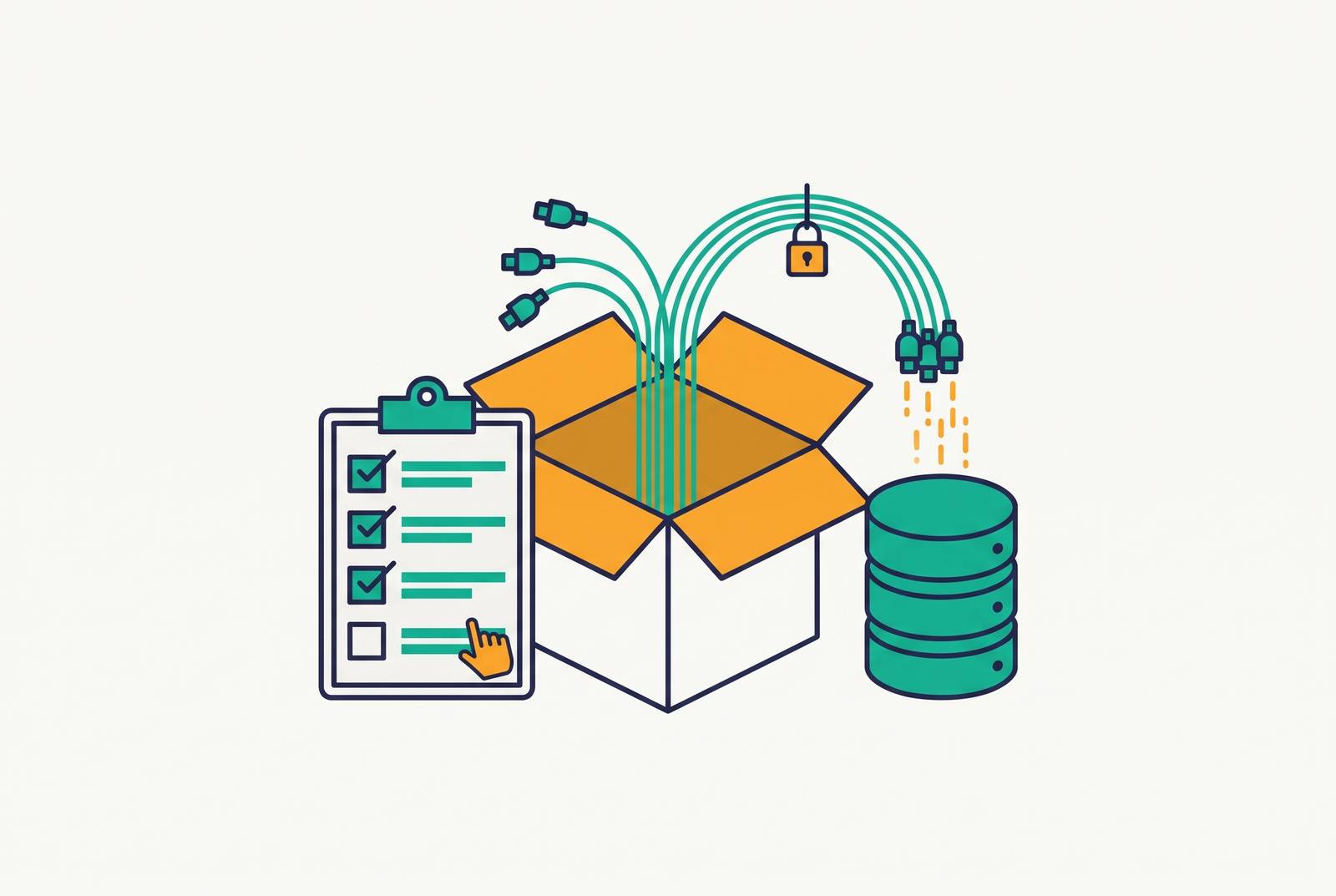
Enterprise customer data export to Snowflake and Redshift without custom pipelines calls for embedded warehouse connectivity with prebuilt connectors and automated synchronization. The buying decision turns on whether that integration clears procurement’s requirements for data custody, connector depth, performance, security, deployment, and predictable cost. This checklist explains how SaaS vendors can test those requirements before a successful demo becomes a stalled contract.
Why warehouse connectivity has become a procurement gate, not a product feature
The demo succeeds, but the deal dies in security or legal review. By then, months of evaluation may have passed, switching costs are high, and goodwill is spent. Connectivity failures become visible in security or legal review because procurement checks for risks that a product demonstration does not reveal.
CData’s 2026 guide describes embedded data integration as a choice about architecture that directly shapes how much buyers trust the product. Large organizations manage hundreds of SaaS applications and resist tools that create new silos or transfer sensitive data to unvetted intermediaries. Consequently, the vendor faces a second evaluation in writing, where the buyer asks who handles its data and under what controls.
How enterprise buyers frame the connectivity evaluation before they open the checklist
Enterprise IT and procurement assess security exposure, operational scalability, and architectural flexibility together. All three must pass. Their first architectural question is whether connectivity is native, depends on middleware, or relies on manual loads, because that answer establishes latency, maintenance burden, and compliance exposure. CData’s guide contrasts native, in-product integration with external, batch-oriented ETL or middleware that delays consumption. A questionnaire response describing a middleware dependency or manual fallback therefore invites deeper review.
Criterion one: whether the integration architecture caches sensitive data or passes it through
The most decisive architectural question is whether the integration platform retains sensitive customer data at rest in its own managed infrastructure. InfoSec teams specifically examine sync-and-cache models, in which the platform polls a customer’s source system, copies records into a vendor-managed database, and serves them from that copy. This introduces another place where sensitive data resides. The buyer must evaluate both that custody arrangement and the connection to the original system.
For sensitive CRM or HRIS data, caching triggers a separate compliance review that can add weeks or months. Strong performance does not remove the need for that review. Nor does a successful demonstration answer it, because the visible product experience does not establish where payloads are stored. The architectural decision therefore affects the procurement timeline before connector coverage or usability enters the discussion.
The alternative is zero data retention within the integration vendor’s infrastructure. A pass-through platform reads from and writes to customer systems without storing sensitive payloads at rest in its own environment. The customer warehouse where the data is meant to go is separate from an intermediary’s managed cache. Procurement needs a clear written account of that boundary, rather than a broad claim that the platform connects securely.
Criterion two: connector depth and the sources enterprise data actually lives in
Passing the custody test does not establish connector adequacy. Buyers check whether integrations give them dimensions, custom fields, and change events along with aggregate totals. An ERP connector may pass an initial inventory check by extracting account totals, yet fail implementation when finance discovers that custom fields and cost center dimensions do not map automatically.
Oracle’s developer guide distinguishes BICC for large-volume extraction from Oracle Cloud ERP and SCM from REST APIs for real-time, low-volume operations. SAP’s documentation permits direct calls to released SAP S/4HANA APIs for simpler use cases, although authorization involves Communication Arrangements and ABAP user mapping. A connector label alone does not show whether the chosen path suits the buyer’s workload.
The coverage audit extends to Salesforce and HubSpot for pipeline-to-revenue data, Workday and ADP for headcount and compensation, and Stripe or Zuora for subscription revenue. Warehouse coverage can include Snowflake, BigQuery, and the Databricks lakehouse as destinations or intermediaries. Building a connector is a multi-week engineering project per source, with complex sources taking longer before production testing and edge cases. After launch, API changes, authentication changes, tighter rate limits, and deprecated endpoints require a continuing maintenance owner.
Criterion three: sync performance at enterprise data volumes
Once source coverage is established, procurement asks whether synchronization meets explicit throughput and latency requirements at production volumes. Demo-scale results are insufficient evidence for enterprise workloads. The questionnaire asks whether Change Data Capture picks up changes since the last sync or scans full tables over and over. It also asks whether incremental loading processes only new or changed records, reducing processing time and resource consumption.
Parallelized loads face a separate test of whether concurrent destination writes avoid serialization at the source. Buyers also examine whether a load-then-transform approach pushes transformation into the warehouse’s scalable compute rather than making the integration layer the bottleneck. CData’s guide identifies event-driven and CDC patterns as techniques for low-latency embedded integration, contrasting them with batch-oriented legacy ETL. To users, those batch delays make features seem broken.
Procurement turns freshness expectations into contractual requirements. If CRM planning data refreshes weekly instead of daily, the revenue forecast is structurally stale, so the refresh interval becomes an SLA question. Tenant isolation receives similar scrutiny because one high-volume sync must not degrade performance for other tenants. A large enterprise buyer needs evidence that its workload will not make it the shared platform’s problem customer.
Criterion four: the security controls and certifications procurement requires before legal will sign
Technical approval does not substitute for documented security controls. Most enterprise procurement teams need that proof before they send a contract to legal. SOC 2 Type 2 is the baseline assurance they check first, with Security as the mandatory control domain. Availability, Processing Integrity, Confidentiality, and Privacy are optional domains that enterprise clients often ask to have covered too.
The encryption specification must cover databases, file systems, and backups at rest, using AES-256 or at minimum AES-128. Procurement also asks for FIPS 140-3 or FIPS 140-2 validated libraries where possible. For transit, the specification covers HTTPS/TLS across external and internal services, with TLS 1.2 or 1.3, strong cipher suites such as AES-GCM or ChaCha20-Poly1305, and elliptic-curve key exchange through ECDHE. General assurances about encryption do not provide this detail.
The access control model documents multi-factor authentication, OAuth-based authorization, SSO, and role-based access with least-privilege policies. High-assurance environments also examine hardware-backed standards including WebAuthn and FIDO2. Field-level protection is a separate documentation requirement. Regulated buyers ask where masking and tokenization obscure sensitive fields within the pipeline, rather than accepting transport and storage encryption as sufficient. CData’s guide treats security-by-design as a prerequisite for scale.
Criterion five: data residency, subprocessor transparency, and private-cloud deployment options
Security documentation extends to geography and jurisdiction. A regulated or multinational buyer may be prohibited from sending data through infrastructure in certain countries, regardless of the encryption applied. Legal therefore requires written evidence of residency controls.
The subprocessor inventory must identify cloud providers, analytics platforms, and support tools, their locations, and the customer data they handle. Buyers also check whether subprocessor agreements require the same protection controls and limit onward transfers. These rules apply beyond the place where the platform is mainly hosted. If the inventory is incomplete, legal may be unable to review the full processing arrangement.
Private-cloud or VPC deployment is another documented question for customers with strict residency requirements. Buyers expect the option to be demonstrable in a security questionnaire. For private deployments, Zero Trust expectations include continuous identity verification, role-based least-privilege access, segmented network zones, real-time access activity tracking, and regular permission reviews.
Criterion six: the developer experience controls that determine enterprise rollout speed
Security approval leaves a separate question of deployability. Enterprise IT and product teams evaluate whether each customer can configure connectivity without a new engineering project. Embeddable UI components let customers authenticate accounts, map fields, and set sync behavior inside the product instead of opening support tickets or commissioning development. Per-tenant credentials, mappings, and schedules must also be scoped through a consistent API surface.
The embedding method enters the technical questionnaire directly. Iframe delivery creates UX and security friction, while SDK or Web Component delivery supports an embedded experience without visible vendor branding. Buyers check error messages, loading states, notifications, and footers for signs of a third party.
API design determines whether that configuration model remains usable across workloads. CData’s guide identifies REST for broad compatibility, GraphQL for flexible queries that reduce over-fetching, and streaming APIs for latency-sensitive workloads. The appropriate interface depends on how frequently data changes and how it is consumed. Enterprise evaluators therefore look for capabilities exposed and governed through APIs from the start, rather than interoperability added after the product is built.
Criterion seven: AI agent data access and what procurement now asks about MCP and semantic layer readiness
Enterprise buyers in 2026 increasingly evaluate AI agent data access as a current capability. Security teams ask how agents authenticate, how permissions apply to production data, and whether an MCP gateway provides centralized audit logging and access control for agent-to-data connections.
The reference architecture is a centralized, agent-agnostic gateway between agents and the enterprise data layer. Buyers expect it to enforce existing permission models rather than introduce a parallel authorization system. Procurement can then evaluate the access model against the same controls used elsewhere in the architecture.
Semantic layer readiness addresses a different risk. Agents querying raw warehouse tables without a semantic layer lack governed metrics and are guessing at business definitions. Sophisticated buyers therefore ask whether the connectivity platform enforces or works with a semantic layer.
How pricing structure surfaces as a hidden criterion late in procurement
Finance review can stop a technically approved integration. Enterprise total cost of ownership models show per-row, per-event, and data-transfer charges that become hard to predict at the data volumes covered by the contract. Finance asks whether integration cost rises linearly with data volume and what fixed limit or capped model bounds that exposure. An unanswered question becomes a budget risk for procurement to escalate.
Destination-based pricing ties cost to connected destinations independently of the amount of data moved. Under that model, tripling data volume does not triple the integration bill. Finance still checks for cloud-egress and per-GB transfer charges that may be left out of the headline price, because a transfer fee that comes as a surprise can reopen an otherwise closed deal.
Using the checklist before procurement does: a pressure-test sequence for SaaS vendors
For SaaS vendors, the practical response is a pre-sales audit in procurement order. First, document whether the platform caches sensitive payloads, and give any architectural caveat an engineering response. Then map the target buyer’s ERP, CRM, HRIS, and billing systems against connector depth, including dimensions, custom fields, and CDC support. Prepare enterprise-scale throughput benchmarks before the proof of concept.
Next, assemble the SOC 2 Type 2 report, encryption specification, access control model, and subprocessor inventory. Have answers on residency and private-cloud options for each target geography ready before legal asks. Demonstrate per-tenant configuration inside the product so the buyer can configure a test tenant during the proof of concept. Document agent authentication and governance even when AI access has not yet appeared in the questionnaire.
Finally, prepare a written cost model at two or three volume scenarios so finance can conduct its analysis without repeated clarification. Vendors shorten procurement by arriving at security review with evidence assembled, rather than discovering their architectural and documentation gaps after both sides have invested months.