Replacing Custom Pipeline Logic With Declarative Warehouse Export for Enterprise Customer Data
Declarative export ships customer data to warehouses without per-tenant ETL scripts.
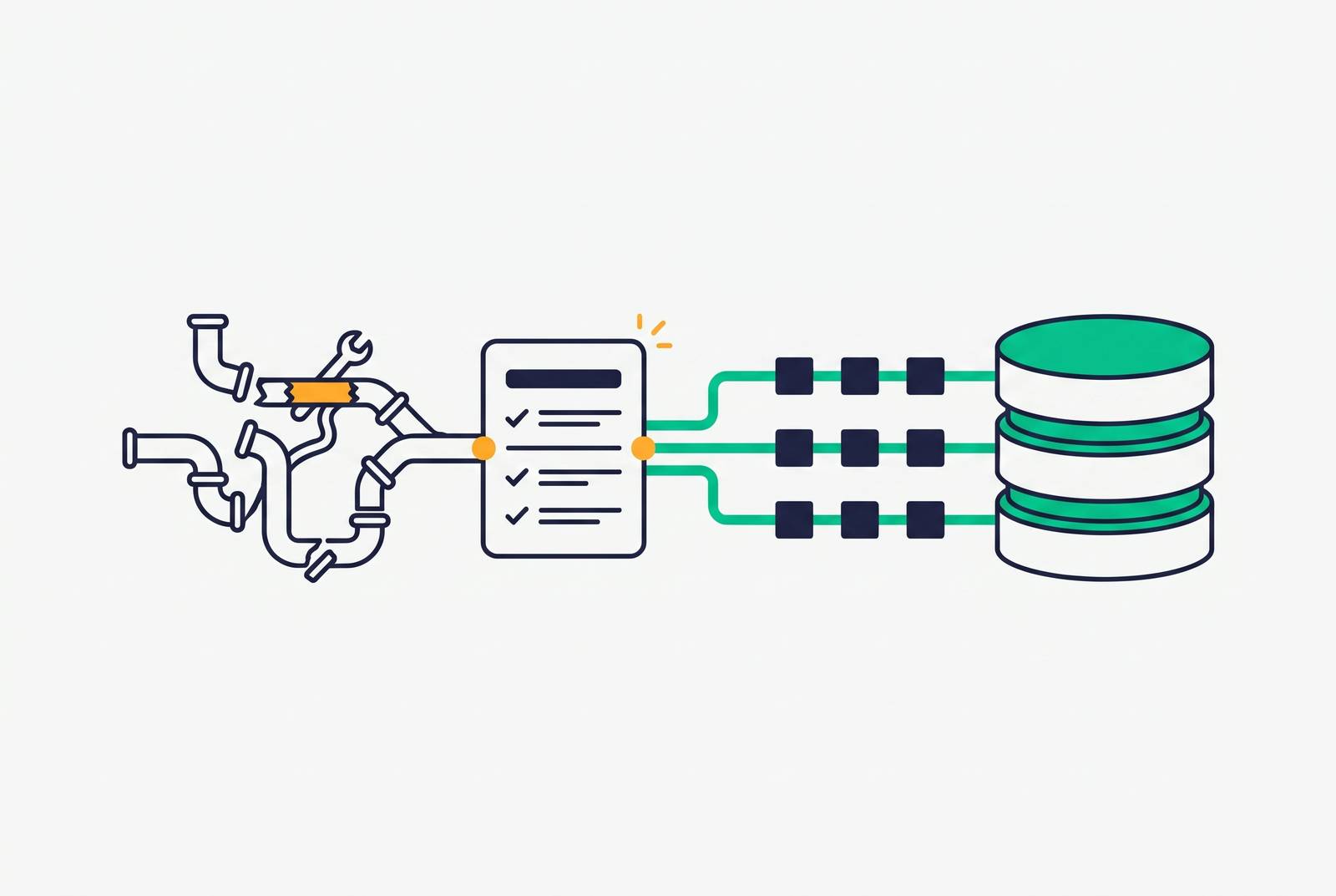
Enterprise SaaS teams can export customer data to cloud data warehouses without custom ETL pipelines by using declarative warehouse export configuration. A pipeline manifest defines the source, destination, mapping, and sync behavior, while a shared runtime handles execution across tenants. For embedded customer integrations, this replaces per-tenant scripts and unnecessary relay storage, making connectivity a shippable product feature and freeing teams from an open-ended infrastructure commitment.
Why hand-written pipeline logic breaks under enterprise multi-tenancy
An engineer inherits a graveyard of ETL scripts, then receives a 2 AM on-call alert because a provider rotated a security header. Each script has its own pagination logic, incremental sync cursor, error handling, and retry behavior. The immediate repair may be small. The maintenance surface is not, because token refresh edge cases, polymorphic fields, custom object variants, and undocumented API behavior accumulate behind every integration. What looks like a collection of working connectors is also a collection of independent failure modes.
When an upstream provider deprecates a field or silently changes its type, every tenant relying on that integration can break simultaneously. When a shared endpoint fails, it affects all customers who use it, and differences between tenants make it harder to apply the same repair to each.
The same multiplier applies to delivery and cost. Each enterprise prospect requesting Zendesk, then Jira, then ServiceNow adds another script with its own maintenance surface. When the infrastructure charges per row, costs grow across thousands of customer accounts, so the bill depends on more than the number of integrations. Connector count therefore understates the burden. The team owns both the integration logic and the growing number of tenant contexts in which that logic must work.
How the double-ETL pattern multiplies the problem for B2B SaaS
The warehouse-centric double-ETL pattern relocates this complexity. Its five-hop path runs from a customer SaaS API through an ETL tool, a data warehouse, SQL/dbt transforms, and a reverse ETL tool before reaching the application database. Each stage introduces its own schema expectations. Sync intervals add up across three tools, so end-to-end freshness depends on the whole chain, even after the first successful extraction. Each handoff also creates another place for a failure to interrupt delivery.
For internal SaaS analytics, ELT is still the right pattern because warehouse storage serves the work of analysis. Embedded customer integration is a different problem. A warehouse used only to relay records into an application database adds a storage step without serving that same analytical purpose. Choosing ELT over ETL leaves that difference in place, along with the costs for each tenant. When monthly row-based usage billing is calculated per connection, each source for each tenant has its own cost counter.
The relay also creates a retention question. GDPR Article 5(1)(e) requires personal data to be kept no longer than necessary for its purpose. A warehouse whose only function is forwarding customer records serves architectural convenience and is difficult to justify as necessary storage. The relevant distinction is between a destination with a defined purpose and an intermediate copy that exists only because the pipeline requires it.
How declarative configuration exports customer data to Snowflake without custom ETL pipelines
Declarative export replaces integration-specific runtime logic with a pipeline manifest. Instead of a Python or Node.js script per integration and tenant, the team declares the source, destination, schema mapping, incremental checkpoint design, and sync behavior. The runtime executes that configuration uniformly across tenants. Pagination, cursor management, retries, backoff, and incremental state become shared execution concerns, eliminating repeated implementations. Tenant isolation no longer needs a separate code branch for each customer.
For embedded customer data export, pass-through execution also removes the intermediate warehouse. Customer records flow through an in-memory transform layer and arrive directly at the destination datastore, which can be the customer's warehouse. The distinction is between destination and relay. Exports to a cloud data warehouse such as Redshift can go there without another warehouse to hold the data on the way. Under the described pass-through model, no customer data remains after delivery, and only sync metadata persists.
Schema drift moves into the transform layer rather than automatically triggering a runtime code deployment. Engineers still own the mapping and checkpoint design, but configuration replaces bespoke execution logic as the expression of those decisions. Removing relay retention deals with the GDPR risk from that unnecessary copy, but does not make the whole system compliant. Internal analytics can still use ELT and warehouse storage where those serve the intended purpose.
Why enterprise buyers treat data connectivity as a product feature, not infrastructure
Enterprise procurement evaluates connectivity with security certifications and SLA commitments because a product's fit with the customer's operating environment depends on access to data. Integration discussions appear in a large majority of SaaS sales cycles, and most vendors regard integrations as important or required by their customers. Buyers assess the capability before the contract. A connector request is a product requirement with a deadline tied to the sale, as well as a choice about infrastructure.
Custom pipeline work makes that deadline difficult to predict. Each additional connector requested during a sales cycle adds implementation and maintenance work to a backlog that can grow faster than hiring addresses it. Customers with more integrations also churn at substantially lower rates, giving connectivity a role beyond acquisition. Its value extends into retention and continued use. When deciding whether to build or buy, the team must also weigh the product work put on hold while engineers maintain the transport layer.
Declarative configuration changes the response to a supported destination request. When adding that destination requires a configuration change, the team can address the request during the sales process, avoiding a code deployment cycle and the wait until after signature. Coverage still sets the boundary of that promise. Within it, connectivity gains a predictable delivery timeline, allowing product and revenue teams to discuss a defined capability rather than an infrastructure project with an open-ended estimate.
Security and compliance requirements that declarative export must satisfy for enterprise deals
Even after replacing custom code, teams must show that they have security controls. SOC 2 Type 2 is effectively table stakes. Although SOC 2 is voluntary under AICPA, enterprise procurement commonly treats a report as a contract requirement. A declarative platform without that evidence can stall even when its data path is simpler than the custom alternative.
The relevant controls must cover the actual SaaS operating model. Audit scrutiny includes multi-tenant data isolation, the cloud shared-responsibility model, CI/CD change management, API security, and availability. Those areas span both configuration and execution. A uniform runtime is useful only if it preserves the boundaries between customers and operates under controlled change management. End-to-end encryption must be part of the same procurement review, with no option to treat it as an extra.
Data residency adds a separate deployment constraint. GDPR-covered personal data cannot be routed through US-based infrastructure without an approved transfer mechanism, although GDPR does not itself require all personal data to remain in the EEA. For some organizations and data types, private-cloud or bring-your-own-cloud deployment is therefore necessary. Financial services, healthcare, and insurance buyers can treat those options as requirements. Deployment location alone is not sufficient, however, because compliance also depends on identity controls, access policies, audit logging, and the services used across the data path.
How declarative warehouse export becomes the data foundation for AI agent access
Once governed customer data is available through a consistent export layer, the same foundation can support AI-powered product access. Model Context Protocol, or MCP, is an emerging standard interface between AI assistants and data sources that avoids custom API development for every connection. Amazon Bedrock AgentCore uses pre-built MCP connectors for systems including Redshift, Aurora, OpenSearch, and third-party systems. It handles orchestration, security, memory, and scaling through configuration. These concrete extensions of governed connectivity remain subject to its existing requirements.
A product with clean, declaratively synced customer data can expose an MCP server for an enterprise customer's internal assistant. That assistant can query customer segments, pull cohort analyses, and trigger list exports without a person entering the dashboard. Enterprise buyers are starting to require this access. Export configuration provides the data foundation on which an MCP interface can operate.
Agent access also exposes a governance gap. A warehouse role granted for reporting may also reach billing records, support history, and other joined data outside the tenant scope it was meant to cover. Product teams building with MCP must obtain explicit user consent before invoking tools and enforce granular permissions at the server level. Row-level tenant isolation and SOC 2 controls provide a structural foundation for those boundaries, but do not replace explicit authorization. A successful sync is not permission to expose everything it delivered.
Evaluating declarative warehouse export platforms against enterprise requirements
When assessing a platform, teams should first check destination coverage and tenant-level throughput. For customer CRM and product data bound for a cloud data warehouse, coverage must match the actual source and destination set. Teams also need specific evidence that the platform can handle high-volume enterprise accounts, since aggregate throughput alone does not establish capacity for individual tenants. A platform that needs architectural workarounds for those accounts has not removed the complexity the team is trying to replace.
An embeddable React SDK and a clean REST API let the product team control the interface and data access model rather than redirecting customers to a separate administration panel. Embedding time is a practical buying criterion. Delivery in days rather than quarters changes the comparison with an internal build, provided the required destinations and controls are already supported.
Teams should check how pricing changes as customer datasets grow. Per-row and per-event charges retain the volume multiplier that makes multi-tenant delivery difficult to forecast. With flat or destination-based pricing, costs are no longer tied to data volume, and teams can plan spending without surprise transfer fees. Security then becomes a procurement gate, including SOC 2 Type 2 evidence, encryption, and private-cloud or BYOC options where required. Finally, AI readiness means governed access to synced data through the same foundation, with granular permissions that restrict the warehouse role. These five criteria test product fit beyond connector availability.
Making the transition: from custom pipeline code to declarative export configuration
The transition should proceed in stages. Teams should begin with the integrations responsible for the most emergency fixes, schema drift incidents, or tenant-breaking outages in the past year. Maintenance history provides the starting point. A provider deprecating a field can be a stronger migration trigger than an arbitrary sprint boundary because it exposes the cost of continuing to repair the existing implementation.
Before migrating a source, the team should find out which warehouses, databases, and object storage services enterprise customers use. That list shows what the platform must cover and where custom connectors may still be needed. Row-level security and tenant ID scoping belong in the destination schema before migration and the arrival of records. This preparation connects platform selection to the customers and access boundaries it must support.
Pipeline manifests should then enter the product repository and follow the same review and CI/CD process as application code. Configuration remains code that needs disciplined ownership. This makes schema changes a modeling task under version control instead of another reason to patch bespoke runtime logic. Before promotion to production, teams should validate tenant isolation through explicit testing, including penetration testing, and verify row-level security and tenant ID use in all queries against the destination schema before customer data flows.
The completed migration leaves the team with a different product capability. Engineering responsibility remains, but its scope becomes predictable. Data connectivity can then be planned, shipped, and governed as part of the product instead of repeatedly competing with it for engineering capacity.