Data Integration Pricing Models for High-Volume SaaS Startups
How each billing meter behaves as sync patterns and volume grow.
For high-volume SaaS startups, the pricing model of a data integration platform determines infrastructure cost trajectory far more than the advertised rate. Two platforms with nearly identical list prices can produce bills that diverge by an order of magnitude once actual sync patterns interact with the billing mechanic. The gap between estimated and actual costs often traces back to this misalignment, which compounds across multiple customers as a startup scales. AI-driven data consumption is adding another layer of unpredictability: as AI agents query synced data continuously, the usage patterns that determined the original cost estimate stop applying.
Most startups evaluate integration platforms by comparing headline prices. The figure on the pricing page describes what a vendor charges at a single point on the curve. It says nothing about what happens when a table's update rate doubles, when a new enterprise customer brings a hundred million rows, or when an AI agent starts polling a destination every thirty seconds. Scaling to production routinely reveals cost underestimation that can reach an order of magnitude, and the gap originates in the billing model, not in the product itself.
How the four dominant billing mechanics actually work
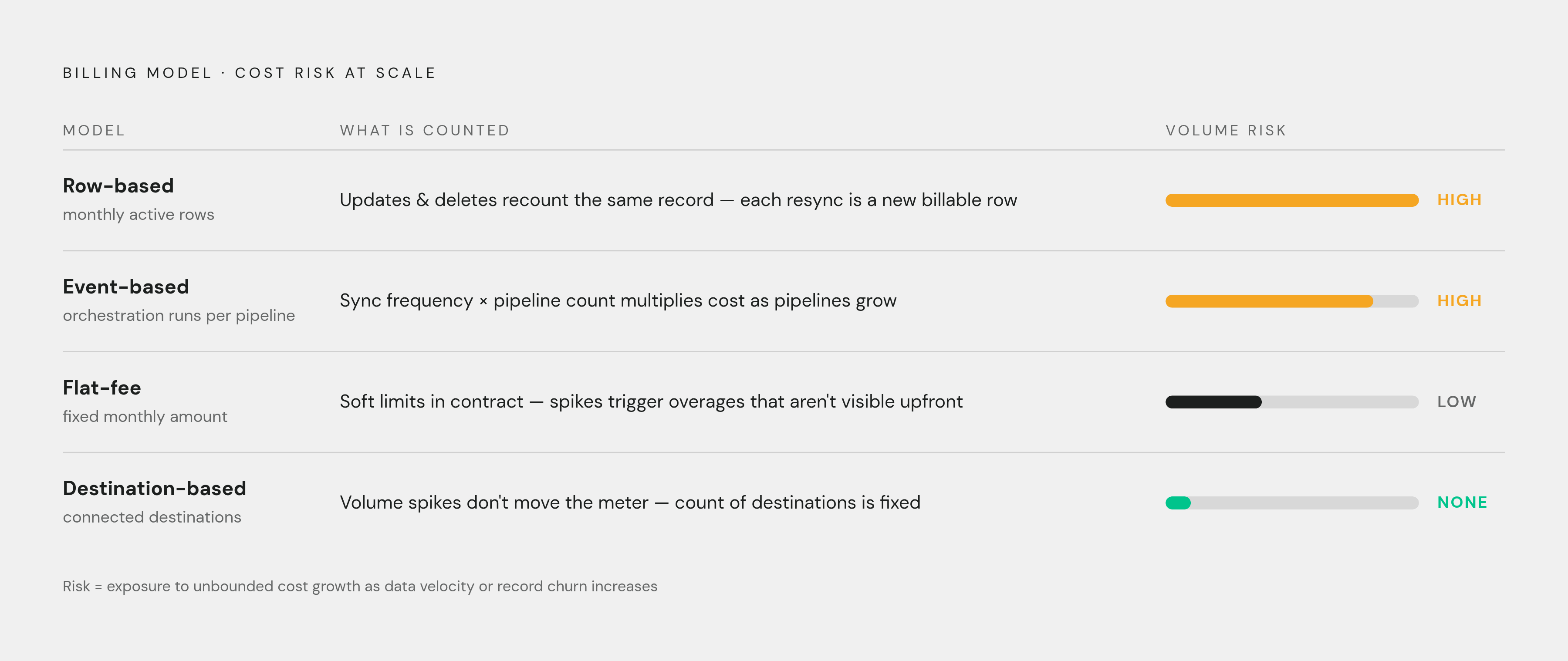
Data integration platforms settle into four billing structures, each of which meters a different dimension of value. The gap between what each model counts and what a startup's pipelines actually produce is where cost divergence originates. Row-based pricing, the most common structure, bills on monthly active rows, commonly abbreviated MAR. The meter measures how many rows a platform touches during a billing period, not how many records exist. A table containing one million records can generate several million billable row events in a month if those records are updated, deleted, and reinserted with any regularity. Stitch, now a Qlik product, operates this way: the Standard plan starts at $100 per month and scales from 5 to 300 million rows, with Standard allowing ten standard sources and one destination, while enterprise sources begin on the Advanced plan at $1,500 per month billed annually. The model rewards stable, insert-heavy workloads and penalizes tables with high update or delete rates because the same underlying record can generate multiple billable events in a single month.
With event-based pricing, you pay per orchestration run, pipeline activity, or sync event, not per row. Costs scale with the frequency of pipeline execution, not with the size of the data moved. The model favors infrequent, large-batch workloads and punishes high-frequency pipelines. Azure Data Factory illustrates the hybrid complexity this structure can take: it bills per 1,000 activity runs, per unit-hour for data movement, per hour for pipeline and external activities, and per vCore-hour for Data Flow execution, a compute-plus-event approach that requires modeling each dimension separately before any estimate is defensible.
Flat-fee pricing charges a fixed monthly or annual amount, so rows, pipelines, connectors, and users are all unlimited. Cost stays fixed regardless of volume, which makes this the model where high-throughput startups benefit most in absolute terms. The break-even point against consumption models moves lower as sync volume grows, so the model's predictability is its primary advantage rather than its absolute cost.
Destination-based pricing bills per connected destination, so each data warehouse, database, or object storage endpoint carries a fee regardless of how much data flows through it. The volume of rows moved within a destination does not affect the bill. This structure aligns pricing with the organizational reality of a multi-tenant SaaS product: adding a new customer destination is the event that should carry cost, not every row flowing through it. Prequel operates on this model, charging per connected destination with no data-transfer surcharges and supporting up to 100 million rows per destination every 15 minutes.
Why sync patterns are the variable that makes or breaks a cost model
A pricing model's cost trajectory is only predictable when mapped against the actual sync patterns of the workload. The same platform can be cheap or ruinous depending on how data moves, and four dimensions determine which model penalizes a team: update frequency, delete rate, connector count, and sync frequency. Update frequency measures how often existing rows change. If your customer-facing SaaS product updates order status, session state, or inventory fields continuously, it will generate a MAR count far above its raw record count. The same one million records can produce many millions of billable row events per month under row-based pricing, because each update registers as another billable touch.
Connector count measures how many sources feed a single destination. Teams with many integration connectors, common in B2B SaaS where each customer brings their own data sources, face the additional complication that billing changes can produce sudden cost increases as connector count grows. The removal of account-level discounts, when applied to a team that has quietly tripled its connector footprint, lands as an unexpected line-item jump rather than an incremental cost.
Sync frequency determines how often pipelines run. Under event-based billing, a startup syncing every sixty seconds across a dozen pipelines accumulates an enormous orchestration-run count even if each run moves a small payload. The per-event cost compounds across pipeline count and run frequency simultaneously, which means the two dimensions multiply rather than add.
How cost trajectories diverge as data volume scales under each model
The cost gap between models widens nonlinearly as volume scales, so a structure that looks acceptable at pilot stage can become a structural COGS problem at production scale. Consider a startup that doubles its customer base over a year. Under row-based pricing, cost grows with data velocity, not just data size. A startup that doubles its user base may more than double its MAR count if new users generate higher update-rate activity, and a multi-connector SaaS team faces compounded exposure because each new connector contributes its own update and delete events to the total. There is also a retroactive risk: when Stitch tightened its definition of a billable row so that deletions contributed to MAR alongside the already-billable inserts and updates, teams saw their bills rise without any change in their own data behavior. The lesson is that row-based definitions are not static, and a vendor can move the meter after the contract is signed.
Under event-based pricing, cost scales with the product of pipeline count and run frequency. Adding pipelines or increasing sync cadence multiplies the event total across both dimensions simultaneously. Optimization pressure is high: teams on event-based models are incentivized to reduce sync frequency or batch more aggressively, which can degrade data freshness and undermine the product experience they are trying to deliver.
Under flat-fee pricing, cost is fixed regardless of volume growth, and the economics improve as volume increases because the fixed fee is amortized across larger data throughput. A team processing tens of millions of rows monthly pays the same $1,999 as a team processing hundreds of millions on Integrate.io Core. The risk sits elsewhere: flat-fee platforms can impose soft limits through support tiers, SLA terms, or feature gates that only appear at scale, so the contract must be read for what "unlimited" actually excludes.
Under destination-based pricing, cost scales with the number of customer destinations added, not with data volume. A startup that grows its customer base adds predictable, discrete cost increments, not a continuous consumption curve. For a B2B SaaS product where each enterprise customer connects their own data warehouse, this maps directly onto the unit economics of customer acquisition: the cost of adding a customer's destination is knowable in advance. Prequel's pricing, fixed per destination rather than metered by rows or events, means high-frequency updates and bulk deletes don't trigger unexpected charges, making cost forecasting straightforward even as workloads evolve.
What multi-tenant architecture does to pricing model risk
For B2B SaaS startups serving enterprise customers, multi-tenant architecture transforms pricing model risk in a way that single-tenant environments never encounter. One large customer's data behavior can drive the entire team's infrastructure bill under consumption-based models. In a low-tenant environment, usage variance is manageable because a large sync job is an exception. In a multi-tenant product, a single enterprise customer with high update rates or large datasets can push total MAR or event counts far beyond what the rest of the customer base would generate. Row-based and event-based models expose the startup to unbounded cost variability from individual tenant behavior, so the startup absorbs the billing risk of its own customers' data patterns. A single tenant that updates ten million rows every hour becomes, in effect, a cost driver the startup cannot control.
Destination-based pricing aligns cost directly with a multi-tenant SaaS's operational reality. Each customer's destination carries a known, fixed cost increment regardless of that customer's data volume, which makes per-customer COGS calculable. The architectural question of how the platform enforces tenant isolation also matters here. If a platform is built for multi-tenant isolation, one tenant's load does not degrade others or trigger unexpected rate-limiting that forces re-syncs, which under row-based billing would generate additional billable events.
Hidden cost dimensions that the billing model does not show
The billing metric is only part of the true COGS picture. Engineering overhead, compliance requirements, and build-versus-buy costs vary by model and platform choice in ways that can dwarf the subscription fee, and each layer reveals itself only after the contract is signed. The first hidden cost is the engineering maintenance tax. The fix is not one-time. It is ongoing attention from engineers who could be building product. Against this stands the build-versus-buy calculus: building a production-grade embedded data integration module carries substantial year-one engineering cost before maintenance even begins, which must be weighed against the subscription cost of a managed platform.
The second hidden cost is security and compliance overhead. SOC 2 Type II certification has moved from differentiator to baseline requirement, and enterprise procurement screens out platforms that lack it before technical evaluation begins. For startups with customers in regulated industries, private-cloud deployment capability is a gating requirement: if customer data cannot leave the customer's infrastructure, the integration platform must support self-hosted or bring-your-own-cloud deployment. Prequel addresses this layer directly with SOC 2 Type II certification, end-to-end encryption, and optional private-cloud deployment for customers with strict data residency requirements, none of which are add-ons but rather baseline product characteristics.
The third hidden cost is AI agent access, an emerging driver that did not exist when most contracts were signed. Under row-based or event-based billing, AI-driven data access patterns can silently inflate the integration bill. Destination-based models are structurally insulated from this effect: AI agents reading more data from an existing destination do not change the destination count and therefore do not change the bill.
A practical framework for matching billing model to sync workload before signing a contract
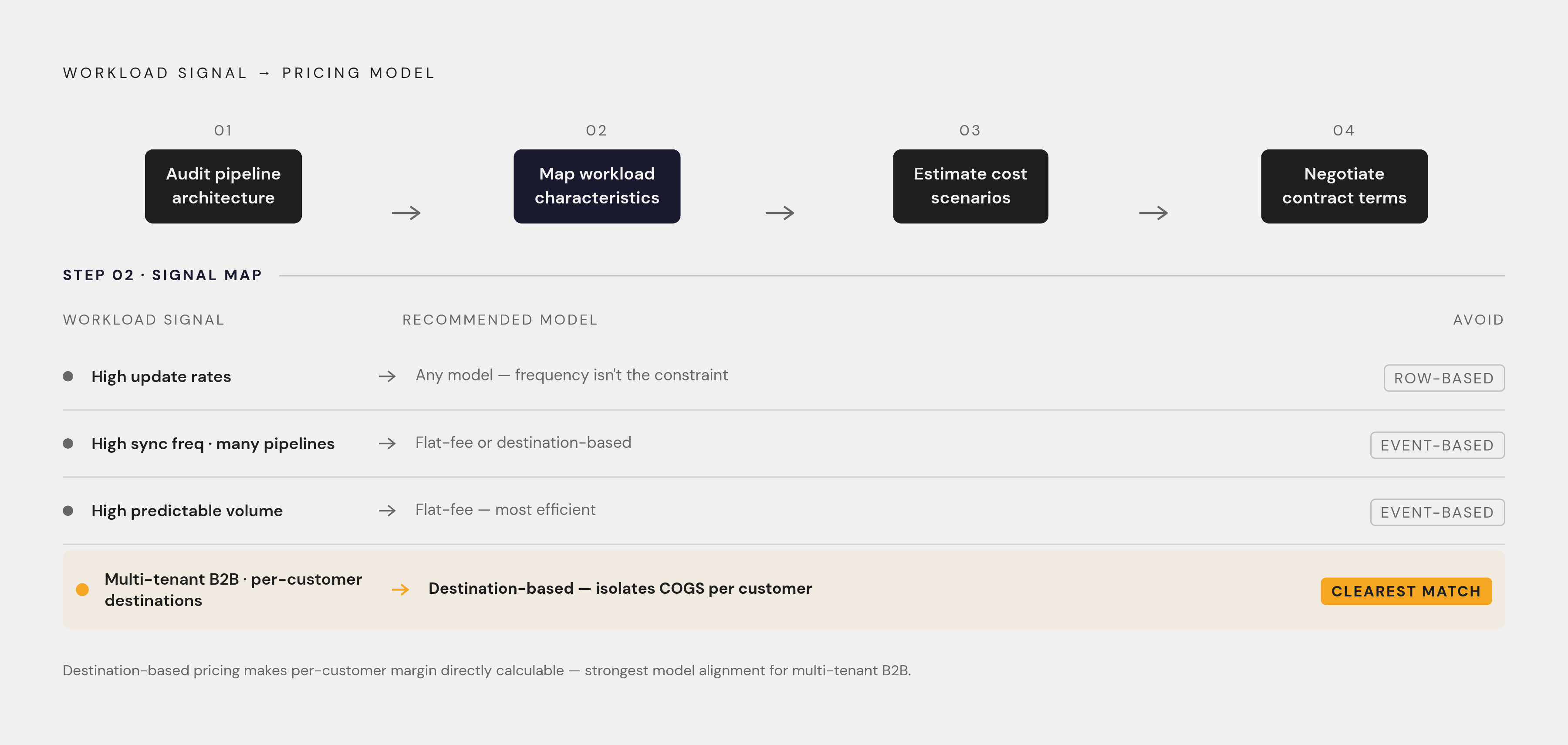
The practical skill that prevents invoice shock is to model your own sync patterns against each billing mechanic before committing, not to rely on vendor benchmarks or list-price comparisons. Four steps make this tractable for a senior engineer or a technical founder. Step one is to characterize the sync workload. Count current and projected connector count, because multi-connector growth under row-based models carries compounded exposure if per-connector discounts are removed. Identify whether AI agents will access synced data, and if so, model the additional sync frequency that autonomous agent queries will generate.
Step two is to map the workload to model exposure. High update rates argue against row-based models where updates and deletes each count as billable events. High sync frequency with many pipelines argues against pure event-based models in favor of flat-fee or destination-based structures. High and predictable volume makes flat-fee models the most efficient amortization, provided "unlimited" terms hold under contract review. Multi-tenant B2B with per-customer destinations points toward destination-based pricing, which isolates COGS at the customer level and makes per-customer margin calculable.
Step three is to ask the right contract questions. What exactly constitutes a billable unit, and has that definition changed in the past 24 months? And what happens to the bill when one enterprise customer's usage spikes, meaning is the exposure bounded or unbounded?
Step four is to evaluate developer experience as a COGS factor. An embeddable SDK and clean API reduce the engineering hours required to ship data connectivity as a product feature, and a platform that takes days to embed rather than quarters changes the build-versus-buy calculus materially. Prequel's embeddable React SDK and destination-based pricing with no data-transfer fees are designed specifically to let engineering teams treat data connectivity as a shippable feature rather than an infrastructure project.
The team that performs this analysis before signing has fundamentally different COGS predictability than the team that discovers it on renewal. The list price is a number. The pricing model is the physics of how that number will move as the business grows. For high-volume SaaS startups getting customer data into a warehouse without building custom ETL pipelines, measuring the right dimension at the outset is the difference between a cost that scales with customers and a cost that scales beyond them.