Schema Evolution in Iceberg Tables During Live Production Syncs
Column IDs make most schema changes safe, but renames still break things.
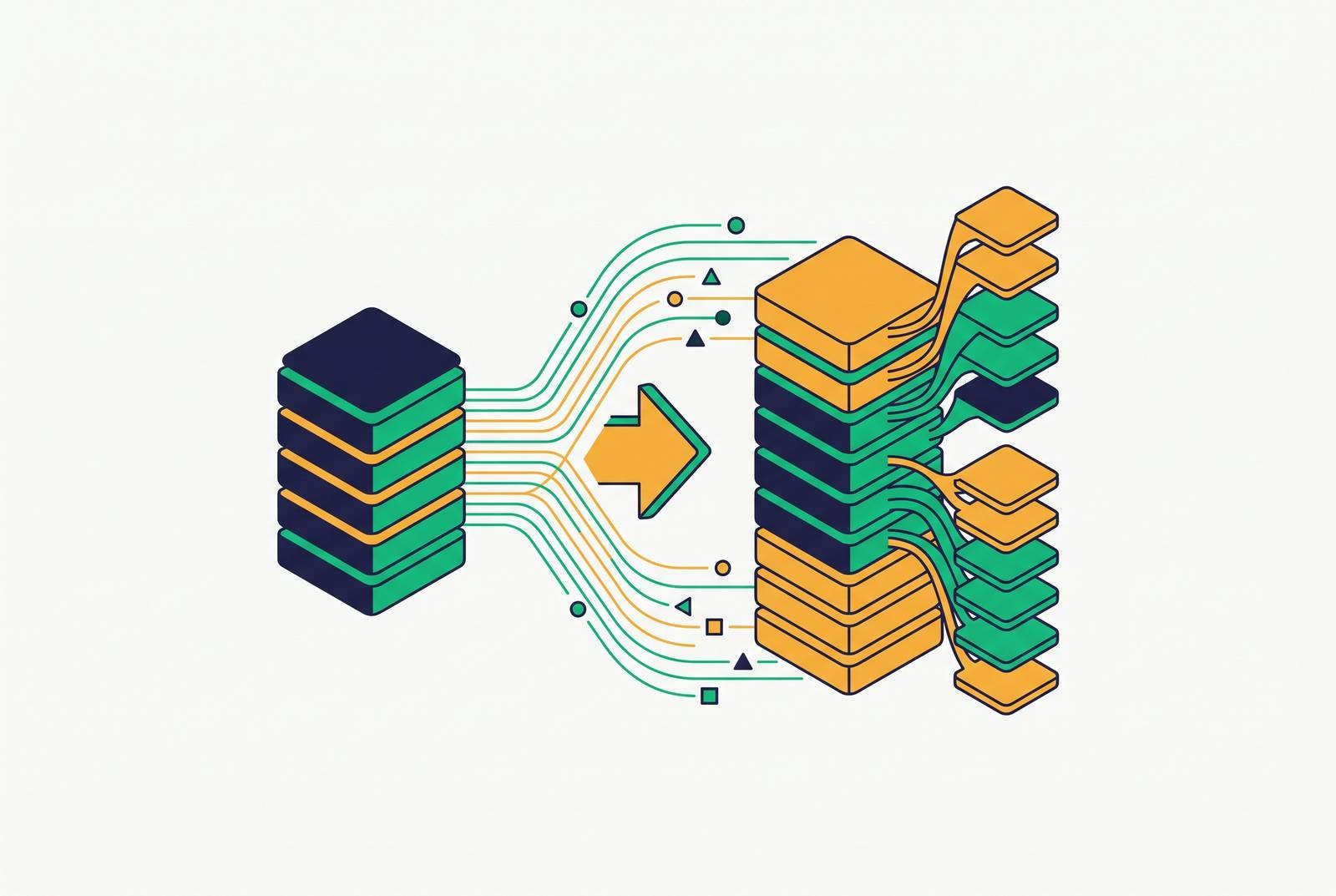
Schema evolution in Iceberg tables works while production traffic keeps flowing, because the format separates a table's logical structure from the physical files that hold its data. That single design choice is the subject of this piece, and understanding where it holds and where it doesn't is what separates a clean schema change from a pipeline that falls over at 3 a.m.
Why Iceberg tables handle schema changes differently
In most traditional data lake setups, schema and data are fused together. A column's name, type, and position are properties of the physical file itself, so changing any of them means rewriting every file that contains that column. At any meaningful table size, that rewrite cost turns a one-line schema edit into a planned event.
Iceberg breaks that fusion by storing schema as metadata, kept apart from the data files it describes. Individual data files still carry their own self-describing structure for physical reading, but Iceberg's metadata layer, not the files, decides how columns resolve when a query runs. That distinction holds up the rest of the architecture.
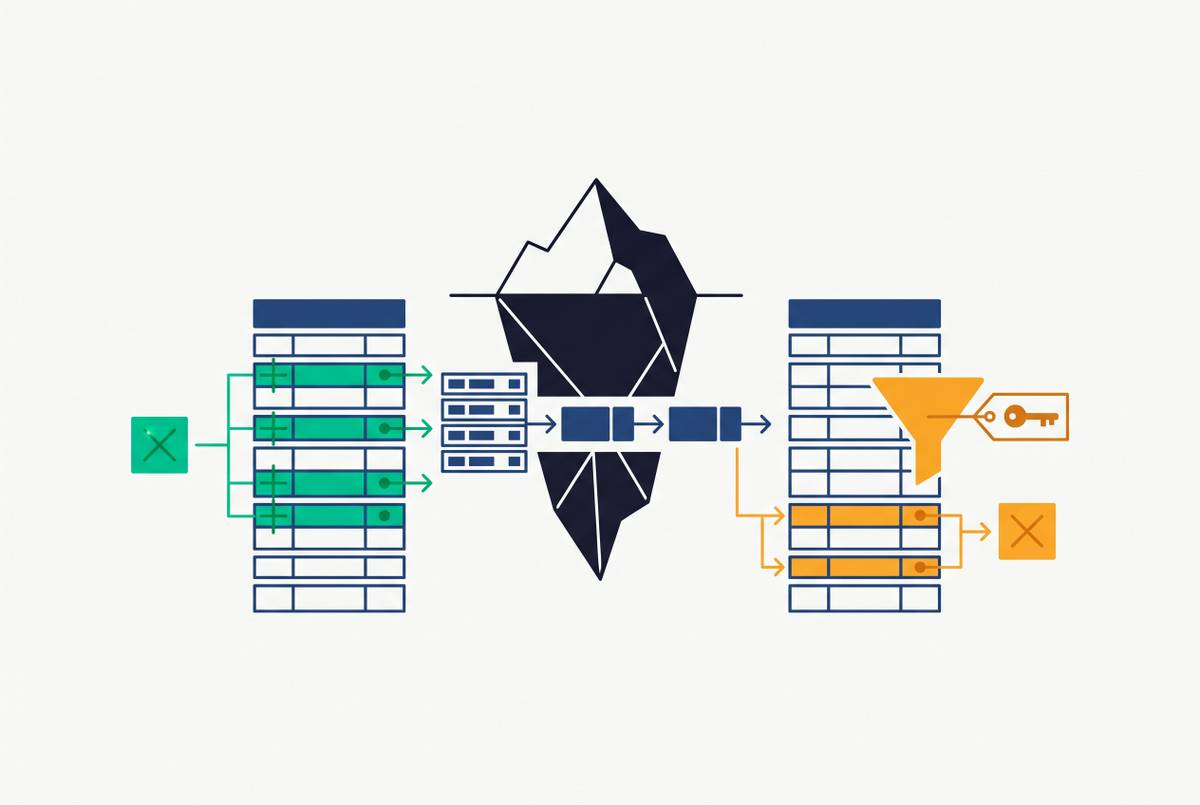
The mechanism that makes it work is simple to state and consequential in practice: every column gets a unique, immutable integer ID the moment it's created. When Iceberg reads a data file, it matches columns by that ID, never by name and never by position. A rename, a drop, or a reorder becomes a change to the ID-to-name mapping in metadata, not a change to a single byte in a Parquet file on disk.
IDs are never recycled. When a column is dropped, its ID retires for good; when a new column shows up later, it gets a fresh ID of its own. That rule closes off a quiet but dangerous failure mode, where an old column's leftover data gets misinterpreted as belonging to whatever new column happens to land in the same name or position.
Every schema change commits atomically, through Iceberg's optimistic concurrency control. The whole update either lands or it doesn't. There's no half-applied state where one reader sees the new schema while another is still working off the old one, because the commit is a single, indivisible metadata write. That atomicity is the foundation the rest of this piece builds on.
The five schema operations Iceberg treats as safe
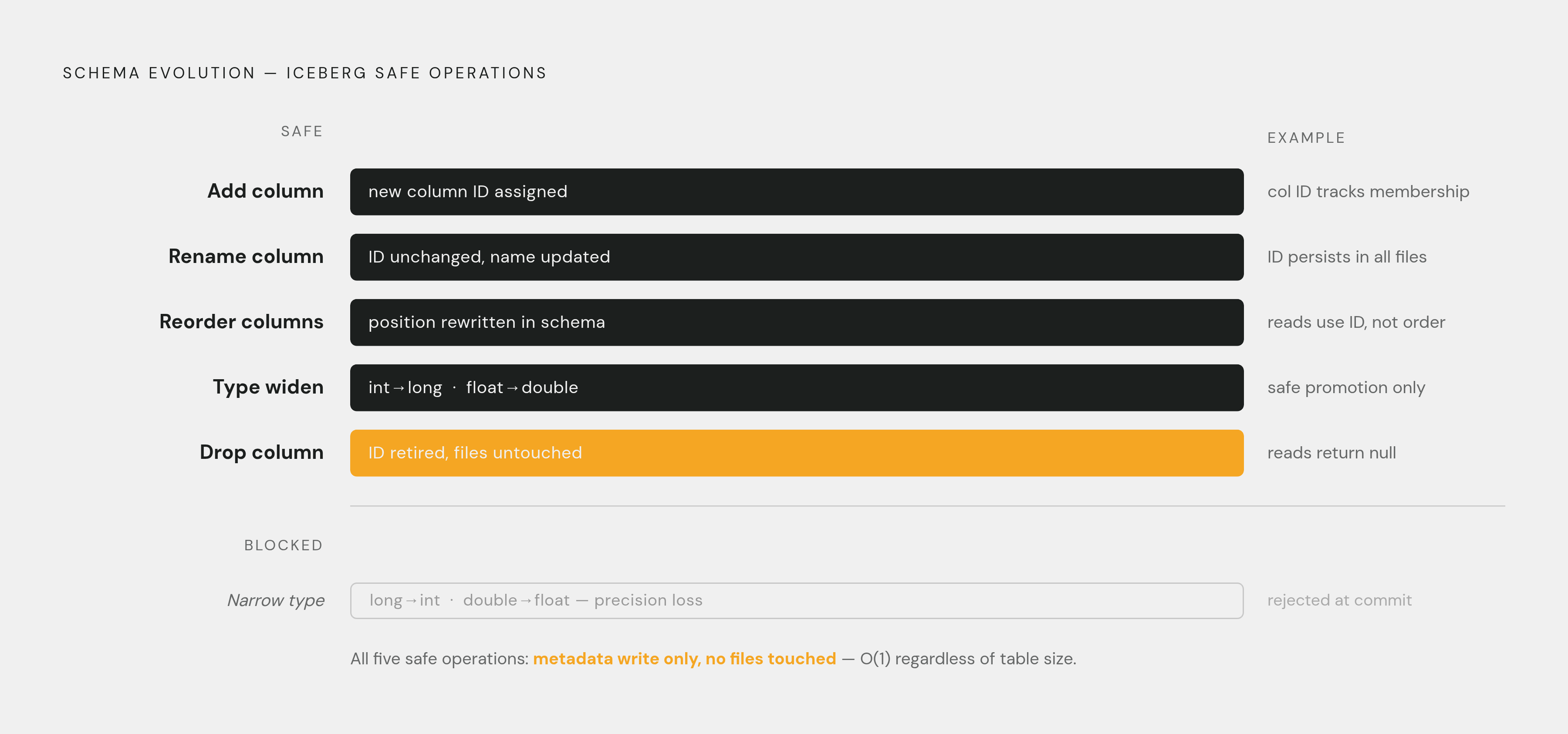
Iceberg defines five categories of schema change that never require rewriting a data file, because column IDs do the translation work at read time. Each one qualifies by the same test: does the change require touching existing physical files, or can it be resolved purely through the ID mapping in metadata? If the answer is the latter, Iceberg treats it as safe.
Adding a column is the simplest case. A new column can be inserted anywhere in the schema, not just appended at the end, using a statement like ALTER TABLE orders ADD COLUMN shipping_address string. No backfill job runs, and no file gets touched.
Renaming a column works because resolution runs on ID, not name. Iceberg would rather break a query loudly than risk a name collision silently serving the wrong data.
Reordering columns changes only the logical order recorded in metadata. Physical byte order in existing files never moves, because engines read by ID regardless of where a column happens to sit inside the file.
Type widening, or promotion, covers changes that expand a type's range without losing precision: int to long, float to double, decimal(P,S) to decimal(P′,S) where P′ is larger than P. Iceberg permits these because no existing value can overflow or lose information when read under the wider type. The reverse direction, long to int or double to float, is blocked, because narrowing a type risks exactly the data loss that promotion avoids.
What unites all five is that each is "zero-copy." The operation is a metadata write only. It completes in roughly the same amount of time whether the table holds a thousand rows or a trillion. That's the clean picture: five operations, one shared property, and no maintenance window attached to any of them.
Operations and side effects that still break things
Renaming a column leaves the underlying Parquet files untouched. Every dbt model, BI dashboard, and analytical query that still refers to the old name breaks the moment the rename commits. Iceberg's guarantee here is about the physical safety of the table, not about the dozens of downstream artifacts built on top of a name that no longer exists. The format raises an error rather than quietly serving the wrong column, which is the right behavior, but it's still a production incident if nobody warned the BI team first.
Type widening carries its own quiet cost. Promoting int to long doesn't rewrite the files written before the promotion, so the Parquet min/max statistics recorded under the old type stay attached to those older files. A query planner that leans on those statistics for partition pruning or file skipping can make pruning decisions that don't account for the type change, degrading query performance on exactly the historical data the promotion was meant to make more usable.
Multi-engine environments add a timing dimension to all of this. The schema change was atomic at the metadata layer; the experience of every engine reading that metadata was not.
Partition evolution sits outside all of this as a separate, explicit operation. Someone has to update the partition spec on purpose, because Iceberg won't do it as a side effect of the schema change.
How schema changes flow through a live streaming pipeline
Traditional streaming pipelines treat schema as a contract fixed at deploy time. When a record shows up with a field the deployed Flink job doesn't know about, the job has no mechanism for handling it gracefully: the field gets dropped, or deserialization fails and the job stops. Either way, someone has to intervene, redeploy with an updated schema, and restart the pipeline. The pipeline goes down exactly when the business event generating that new field is most active.
The Dynamic Iceberg Sink, supported in Flink with Apache Iceberg 1.10.0 or newer, removes that fixed contract. The schema change happens in the middle of the stream, as a side effect of processing a record that needed it.
The sink's fan-out capability extends this past a single table. One job handles the whole fleet, and schema evolution on any single topic happens without an operator touching anything.
The Apache Iceberg 1.11.0 DynamicIcebergSink pushes further still: a single sink chooses the destination table at runtime per record, creates tables on demand, and evolves both schemas and partition specs on the fly, including dropping unused columns when dropUnusedColumns is turned on.
None of this works without Flink's checkpointing protocol, which commits data files as a new snapshot only once a checkpoint completes. The Iceberg sink commits the data files written during a checkpoint interval as a new Iceberg snapshot only once that checkpoint completes. If the job fails before a checkpoint finishes, the pipeline rolls back to the last successful checkpoint, and the files written since then are orphaned. Exactly-once delivery and schema evolution rely on the same mechanism: nothing becomes visible to a reader until it's fully committed, and nothing is ever half-written.
What the REST Catalog contributes to schema change coordination
An atomic commit only guarantees consistency if every engine reading the table is working off the same metadata. Older Iceberg deployments ran into exactly this gap: engine-specific catalog implementations, built on something like the Hive Metastore or a plain file-system catalog, could leave different engines holding different views of the same table's schema for stretches of time.
The Iceberg REST Catalog specification addresses that gap by giving the ecosystem one vendor-neutral HTTP API for catalog operations, covering namespace listing, table creation, snapshot commits, and metadata reads.
What the REST Catalog changes structurally is where commits happen. Commits, conflict handling, and credential management all move server-side, so every engine hits the same commit path rather than negotiating its own route to the metadata. A schema change becomes visible to every reader the moment the commit is acknowledged by the server, rather than waiting on whatever local cache refresh cycle a particular engine happens to run on. The lag isn't eliminated by making caches faster; it's eliminated by making the commit path the same for everyone.
Polaris Catalog, donated by Snowflake and Dremio to the Apache Software Foundation, implements this spec and has become the reference open-source implementation of it. Unity Catalog, from Databricks, also implements the REST spec. By 2026, starting a new Iceberg deployment on the REST Catalog has become the default choice. Credential vending through the REST Catalog scopes an access token to a single table for a short window. Remote signing goes a step further, keeping the engine from ever holding credentials directly. Both travel with the schema change itself rather than requiring separate, out-of-band configuration every time a table's structure shifts.
How Iceberg v3 extended schema evolution
Iceberg v3 extended the safe-schema-change surface in ways that matter most on large tables. Adding a column with a default value is now a metadata-only operation under v3: no backfill job runs, and the operation completes just as fast on a trillion-row table as on a small one, because Iceberg records the default directly in schema metadata and applies it at read time to every row that predates the column. That closes one of the more expensive gaps in earlier schema evolution, where a default value still implied some form of backfill work.
Iceberg v3 also introduced table-level encryption keys, giving organizations one consistent way to secure tables at rest and manage key rotation. That matters directly for schema governance in regulated or multi-tenant environments, where a structural change to a table often needs to be reviewed alongside who can access it and how.
Iceberg's features are additive and optional across format versions, and that creates a fragmentation risk worth taking seriously. A table using v3 features like deletion vectors or variant types might read cleanly in Spark while failing, or degrading, in a query engine that hasn't implemented those v3 features yet. The practical consequence, in a large organization running several query engines side by side, is that the slowest engine to adopt v3 effectively sets the ceiling for what the whole lake can safely use. Teams end up running in what amounts to common-subset mode, holding off on newer features until every engine in the fleet has caught up.
By 2026, Iceberg v2 row-level delete files reached a level of maturity where Trino, Spark, DuckDB, and other major engines all handle them correctly and efficiently. V3 adoption is moving in that same direction but isn't universal across engines yet, so v3 features belong in a staged rollout. A v4 spec exists on the horizon as a subject of ongoing discussion, but nothing about it is released, and no team should be targeting v4 capabilities in a production plan today. V3 is the current target for anyone evaluating what's actually available to ship.
The governance and testing practices that separate uneventful schema changes from 3 a.m. incidents
Iceberg's mechanical guarantees cover the physical safety of the table, and a team that mistakes them for operational guarantees runs into trouble. A rename that's perfectly safe at the metadata level can break every downstream consumer that referenced the old name. A type promotion Iceberg explicitly permits can invalidate partition statistics without raising any error. An uncoordinated change pushed through one engine can leave another engine's readers working off stale metadata for hours. None of these are format bugs. They're the gap between what Iceberg protects and what a production system actually depends on.
Closing that gap starts before the change ever gets committed. Schema changes should be treated as cross-team events: every downstream consumer, whether it's a dbt model, a BI dashboard, or a streaming job, needs to be identified and told about the change before a rename or a drop lands, not after someone's dashboard breaks and they go looking for why.
The safest sequencing for a breaking change is additive first. Add the new column, migrate writers to start populating it, confirm downstream consumers work correctly against the new name or type, and only then drop or rename the old column, as a separate, second committed change. Running all of that as a single operation under live traffic is how a mechanically safe rename turns into an outage.
Snapshot expiry and compaction belong in this same governance conversation, not off to the side as a performance afterthought. Streaming ingestion produces write amplification: every row-level write generates a new data file, a new manifest, a new manifest list, and a new metadata JSON file. Without regular compaction and snapshot expiry, those metadata files pile up and query planning slows down as a direct result. For any table taking continuous writes, compaction isn't optional maintenance, it's a requirement for keeping schema changes and query performance both stable over time.
Iceberg's own metadata tables expose schema history and snapshot logs, which makes schema drift detectable directly: a field showing up in new data files without ever being formally committed to the active schema is visible in that history before it reaches a downstream consumer. Teams that check for that drift as a routine operational habit catch the kind of problem that otherwise first appears in a broken dashboard at 3 a.m. The format gives teams the mechanism to see it coming. Whether they look is a matter of practice, not of what Iceberg guarantees.
Sources
- Announcing Apache Iceberg 1.11.0
- Building unified data pipelines with Apache Iceberg and Apache Flink
- What's new in Apache Iceberg v3?
- Unlock real-time data insights with schema evolution using Amazon MSK Serverless, Iceberg, and AWS Glue streaming
- Spec - Apache Iceberg™
- Apache Iceberg 1.10: Maturing the V3 spec, the REST API and Google contributions